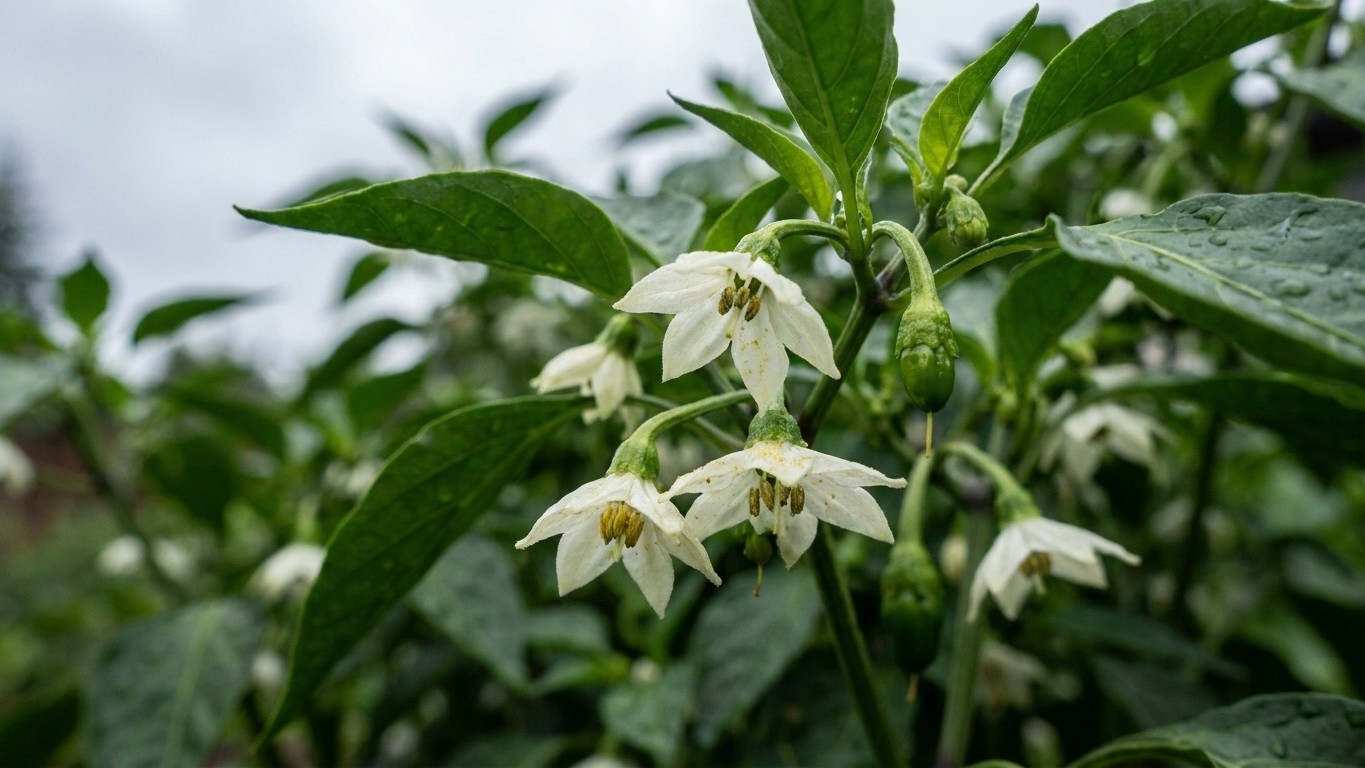

British Columbia’s short answer is simple: peppers here almost never fail because of heat. What trips them up is the other threshold, cool nights, and that’s a number no regional weather station publishes for you here. Fruit set in peppers depends on pollen staying viable, and pollen viability collapses at both extremes. In this province the risk runs cool, not hot, and that changes when you start seed, when you transplant, and what you watch for once flowers appear.
The short answer
British Columbia’s reference station, Vancouver, logs a mean of 0.0 days a year at or above 90 F, according to Environment and Climate Change Canada’s Canadian Climate Normals for 1981 to 2010. Zero. Not “rare,” not “a handful most summers.” The average sits flat at zero. For pepper growers that’s about as reassuring as a heat number gets: the plant’s upper failure point, where daytime heat scrambles pollen and blossoms drop before they ever set fruit, is a threshold this province’s coastal and southern growing areas essentially don’t reach in an average year.
That doesn’t make heat stress impossible. A normal is an average across three decades, and an unusual stretch of weather can still push a thermometer past 90 F for a day or two even where the long-run norm sits at zero. But structurally, the heat failure mode that plagues pepper growers in hotter states barely applies here. If your peppers are dropping blossoms in a July heat spell, hot days are not the first place to look in this province.
The other failure mode is a different story, and it’s the one BC growers need to take seriously. Per Utah State University Extension, pepper fruit set fails at both ends of the thermometer: nights below 55 F block pollen from developing properly, just as surely as excessive daytime heat does at the other end. Cool nights are common across much of British Columbia, especially away from the immediate coast, at higher elevation, or in the shoulder weeks of spring and early fall when a plant is holding its first flush of flowers.
Here’s the complication. This site tracks days at or above 90 F for BC, and that figure is 0.0. It does not track summer night minima, for BC or for anywhere else. There is no published regional number here telling you whether your particular garden runs 58 F nights in July or 50 F nights. That’s a real gap in the data, and it means the answer to “why aren’t my peppers setting fruit” in this province usually lives on your own back porch, not in a provincial average.
The practical move is to watch your own nights directly, with a min-max thermometer near the pepper bed, rather than guess from where you sit on the map. Coastal Vancouver Island gardens, Okanagan valley bottoms, and Interior high-elevation plots can all sit within the same province and still run well apart on a given July night. Latitude tells you almost nothing useful here; elevation, slope, and distance from open water tell you far more, and none of it substitutes for a thermometer you actually read.
When to start seed here
- Start with the frost line, not a calendar habit. Environment and Climate Change Canada’s Canadian Climate Normals for 1981 to 2010 give a mean last spring frost date of March 18 for the station VANCOUVER INT’L A, climate ID 1108447. That’s a mean, not a safety cutoff: frost falls later than March 18 in roughly one year out of two, and this airport site sits in one of BC’s milder corners. Northern districts, the Interior, and anywhere at elevation should expect a mean that runs weeks to a month later, not the same date as the coast.
- Wait for two conditions before transplant, not just one. Utah State University Extension is specific on this: move pepper transplants outside only after frost has passed and once the soil itself has warmed to 60 F. Air temperature and soil temperature don’t always arrive on the same schedule. A garden with mild air but slow-warming clay soil can sit well under 60 F even after the frost risk has cleared, and setting transplants into cold soil stalls a pepper plant before it ever gets to flowering.
- Count back 8 to 10 weeks indoors from that transplant date. This is the window Utah State University Extension recommends for starting pepper seed before it goes into the ground. Using March 18 as an illustrative frost midpoint for the reference station, and assuming soil catches up on a similar schedule, an 8 to 10 week countback lands seed-starting somewhere in mid-to-late January, before layering in the caution that the frost mean itself runs later than March 18 in about half of all years.
- Re-run the math for your own district rather than borrowing the reference station’s date. A grower an hour inland, at elevation, or well north of Vancouver International Airport is not working from March 18 at all. Pull the closest available normals for your own area, apply the same 8 to 10 week countback from a transplant date built on frost passing and 60 F soil, and treat the result as a floor to build extra buffer around, not a fixed date to plant by.
What goes wrong here
- Blossom drop from a cool night, not a hot spell. Because BC’s reference station averages 0.0 days at or above 90 F, the hot-end version of blossom drop that Utah State University Extension describes is rarely the cause here. The cool-end version, nights below 55 F, is the more likely culprit in this province, particularly early in the season or at elevation. Remedy: hold transplants a little later if a cold snap is forecast, and use row cover over young plants on nights you expect to run cool, since there’s no published regional night-minimum figure to lean on instead of your own reading.
- Sunscald where the sun is strong. Peppers exposed to direct, intense sun after losing leaf cover, from over-pruning, wind damage, or disease, can develop pale, papery patches on the fruit itself. Remedy: avoid stripping foliage back hard, and let the plant keep enough leaf canopy to shade its own developing peppers, especially through the sunniest weeks of the growing season.
- Blossom-end rot from uneven watering. This shows up as a sunken, dark patch at the blossom end of the fruit, and it tracks inconsistent soil moisture more than any single weather threshold. Remedy: water on a steady schedule rather than letting the soil swing between bone-dry and soaked, and mulch around the base of the plant to even out moisture between waterings.
Common questions
Does British Columbia get hot enough to cause pepper blossom drop from heat?
Not on average. The reference station logs a mean of 0.0 days a year at or above 90 F, per Environment and Climate Change Canada’s Canadian Climate Normals for 1981 to 2010. That’s the province’s flat baseline, though an unusual stretch of hot weather could still push past that threshold in a given year.
What frost date should I use for transplanting peppers in BC?
Environment and Climate Change Canada gives a mean last spring frost date of March 18 for VANCOUVER INT’L A. Treat it as a midpoint, not a guarantee: frost arrives later than that in about one year out of two, and districts away from this reference station, especially northern or upland areas, should expect a later mean date.
How do I know if my nights are too cold for pepper fruit set?
This site does not carry summer night minima for BC or any other territory, so there’s no regional figure to check against. Per Utah State University Extension, the threshold that matters is 55 F: nights below that can block pollen development. The only reliable way to know is a min-max thermometer placed near your own pepper bed.
When should I start pepper seed indoors in BC?
Count back 8 to 10 weeks from your planned transplant date, per Utah State University Extension, with transplant itself timed to after frost has passed and once soil reaches 60 F. Using the reference station’s March 18 mean frost date as an example, that arithmetic points to mid-to-late January for indoor sowing, adjusted earlier or later based on your own district’s normals.