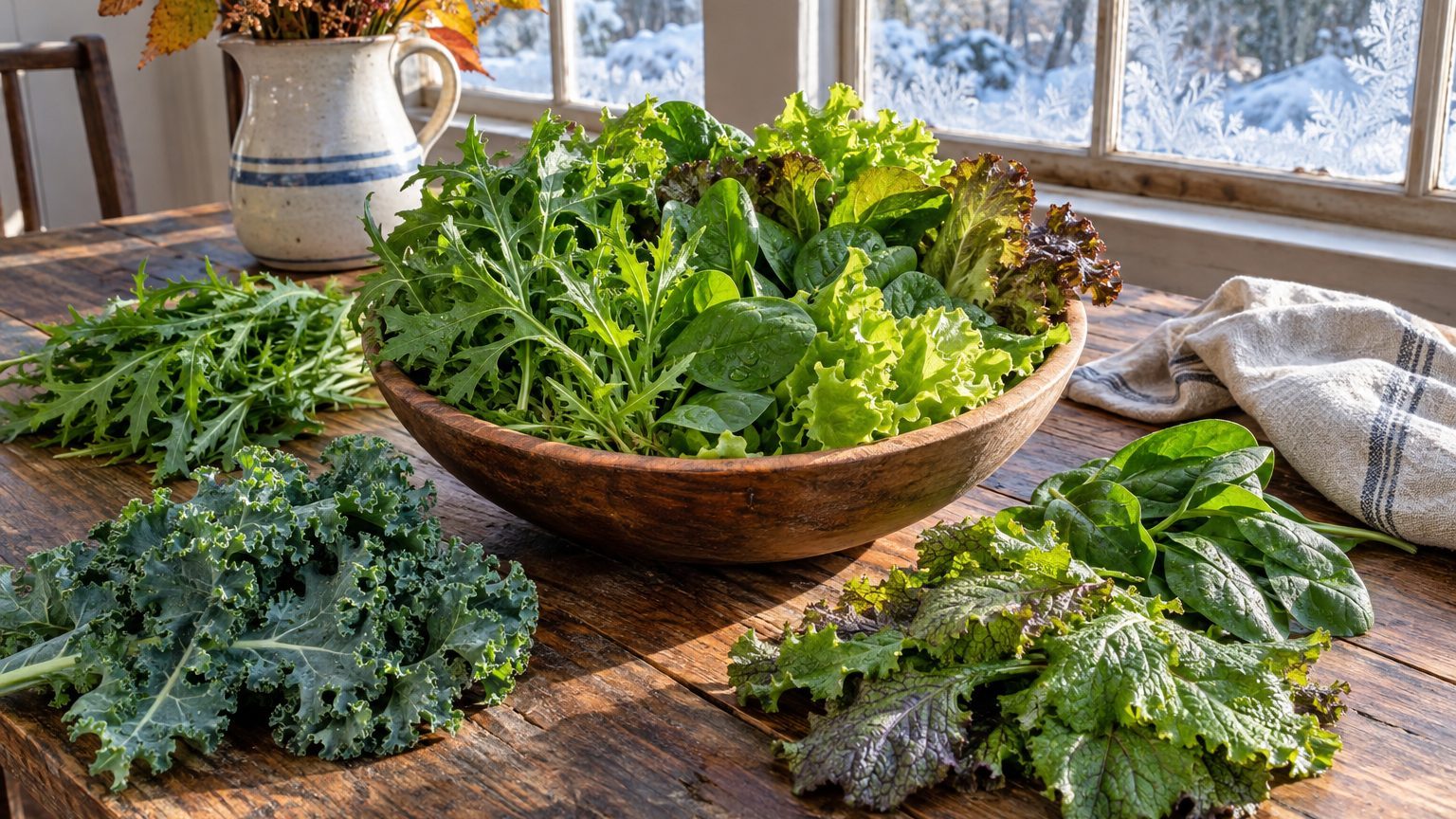

The best winter salads for Nebraska are the cold-tough leaves: spinach, mâche, claytonia and kale, with mizuna and tatsoi close behind. Tender lettuces and arugula can join them, but only under a cold frame or low tunnel. Omaha’s coldest month has a mean daily low of 15.2°F, so what works here is anything that shrugs off that cold and is nearly full-size before the short days of November arrive.
The short answer for Nebraska
Choose by type. Open beds get the toughest leaves, and anything tender goes under cover. The 15.2°F figure is the mean daily minimum of the coldest month at the Omaha reference station. It means a typical January night sits well below freezing, and the plants that sail through are spinach, mâche (corn salad), claytonia and kale. Heading lettuce and arugula are the ones at risk when nights drop into the teens.
The frost dates frame the sowing. At the Omaha reference station, the last spring freeze (32°F) falls between April 12 and April 23, and the first fall freeze between October 15 and October 26. Those spans are the dates when the odds of a 32°F freeze sit between 30 and 70 percent. They come from an airport weather station. Suburban and rural gardens usually see the last spring frost one to two weeks later and the first fall frost one to two weeks earlier, and more so on higher ground.
For winter salads, the fall frost matters less than the light. Once daylight shrinks noticeably in early November, growth nearly stops. Whatever is full-grown by then keeps well in the cold and can be picked leaf by leaf through winter. Whatever is still a seedling mostly waits for March. The sowing windows are worked out in When to Sow Winter Salads in Nebraska, and the wider picture sits in Winter Salads for Nebraska Gardens.
Which winter salad types suit Nebraska?
Three groups cover the decision. The first can sit in open ground under a light row cover. The second does well in an open bed through late fall and wants a cold frame or tunnel for the deep cold. The third belongs under cover from the start.
| Type | Examples | Cold tolerance in Nebraska | Best placement |
|---|---|---|---|
| Cold-tough leaves | Spinach, mâche, claytonia, kale | Handle January lows with light protection | Open bed with row cover, or a cold frame for easier picking |
| Middle group | Mizuna, tatsoi, hardy leaf lettuces, endive | Fine through fall, need help in deep cold | Cold frame or low tunnel from December on |
| Tender greens | Heading lettuce, baby lettuce mixes, arugula | At risk when nights fall into the teens | Cold frame or tunnel, vented on mild days |
Which varieties should you look for in a catalog?
Within each type, read the descriptions. Seed companies flag selections bred for cold with words like “winter,” “overwintering” or “cold-hardy.” For spinach, favor smooth, thick-leaved types with a reputation for winter holding. For lettuce, choose small, loose leaf forms over big heads, since they size up faster and recover from frost damage better.
What will not work here

Why does late sowing fail in Nebraska?
Sowing in late October fails. The reference first fall freeze lands between October 15 and October 26, and the light is already fading by then. A seedling that size has too little leaf area to grow through November. It sits through the winter and gives you nothing to pick until spring. The slowest salad crops, such as radicchio and endive grown for full heads, need the earliest start of all, and many gardeners find they never size up when sown in September.
What goes wrong with hot, dry sowing weather?
Late August and early September are when most winter salads go in, and Nebraska soil is still hot and often dry then. Lettuce seed in hot soil refuses to sprout, and spinach germinates poorly too. A weekly soak does not cover it. Seed rows need light watering every day or two until the seedlings are up, ideally with shade cloth or a board over the row until sprouting starts. Sowing in the evening, and waiting for a cool snap when the soil feels cool rather than warm to the hand, saves a lot of reseeding.
Why do tender greens fail in open beds?
With a mean daily January low of 15.2°F, many winter nights are colder than that. Head lettuce and baby lettuce mixes in open ground generally collapse. Arugula often survives a hard fall but struggles in the deep cold without a cover. Cold-tough leaves like spinach and mâche sit tight and look grim for weeks, then perk up on the first mild day.
What problems show up under covers?
Nebraska winters are windy and dry, and the sun can be strong on a clear day. A closed cold frame can heat well above the outside air on a sunny afternoon even when the air outside is near freezing, and it will cook seedlings and invite mildew. Vent the lid on mild days and close it at dusk. Dry winter wind also pulls moisture from uncovered leaves, so water on a thawed morning when plants look limp. Heavy wet snow bends hoops spaced too far apart, so brush it off. In eastern Nebraska, where summers run humid, tight spacing under a tunnel in a damp fall breeds mildew, so give leaves room to dry.
What changes across Nebraska
Nebraska is not one garden. The USDA Plant Hardiness Zone Map (2023 edition, built on 1991-2020 normals) runs from 4a to 5b across the state, four half-zone steps. That reflects a range in the average annual extreme minimum temperature, so there is no single answer for the whole state. The Omaha reference figures sit toward the warmer, eastern end of the spread.
If you garden in the north, the northwest or the high ground of the Panhandle, shift everything toward caution. Fall freezes arrive earlier, often by a week or two compared with the reference city, so the sowing window closes sooner. Sow at the early end of the window, lean on spinach, mâche, claytonia and kale, and plan on covers from the start rather than from December. Row cover over an open bed that works in Omaha may not be enough where the nights are colder, so a cold frame is the safer bet.
Gardeners in the southeast and along the Missouri River sit closer to the reference numbers. The warmth of a town or city, and the shelter of a house wall, can add a few degrees in protected spots. A bed on the south side of a building might hold salad greens longer into the season than an exposed bed across the yard.
To see where your own ground falls, use the USDA Plant Hardiness Zone Map and search by ZIP code. The map gives a zone for your location, and it is better than guessing from a neighbor or a town an hour away. Then treat the zone as a hint about winter cold, and the frost dates in your county as the guide for timing.
Where to check this for your own county
Start with University of Nebraska–Lincoln Extension. It runs offices across the state, and each office serves its own county’s soils, weather and gardeners. Two things are worth finding there. One is the local planting calendar for vegetables, with sowing dates for fall crops like spinach, lettuce and kale. Extension calendars run one per crop, so look up each salad green separately. The other is the list of varieties trialed in your county or region, since a variety that handles one part of the state may stall in another.
Ask the county office for its average first fall freeze, which is the date that matters most for winter salads. Ask, too, whether local gardeners have luck with cold frames or low tunnels, and what snow load and wind they have to plan for. Extension staff and Master Gardener volunteers hear the same questions every season and know which sowings worked last year.
A county recommendation beats a state one every time. Statewide advice has to cover a Panhandle bed above the plains and a Missouri River garden at the opposite end, and a single sowing date cannot be right for both. Treat the statewide guidance as a starting point, then adjust it with whatever your county office says.
Checking this against your own garden
Your own observations outrank every date here. Three are worth watching.
- Soil warmth by feel. Push your hand into the bed in late August. If the top inch feels warm, like a sunlit sidewalk, lettuce and spinach seed will probably stall. If it feels cool, sow. Compare a shaded spot with a sunny one, since the difference shows you where to start seed first.
- The first true leaves. Seedlings first show two rounded seed leaves, then the first true leaves with the real shape of the plant. If most seedlings have true leaves by the time the nights turn cold, you sowed early enough. If they are still bare, expect a slow winter and plan to cover them.
- The first frost on your lawn. Note which morning frost whitens the grass and which spots stay green longest. A low corner collects cold air and frosts first, while a bed near a south wall may hold off a week or more. That tells you where to put the tender greens.
Write the dates down for a season or two. A notebook entry showing your first frost came earlier than the county’s average does more for your next sowing than any chart.
Common questions
Can winter salads survive Nebraska winters without covers?
The cold-tough ones often can. Spinach, mâche, claytonia and kale may come through in open beds, especially with a layer of row cover or straw. Tender lettuce and arugula generally need a cold frame or tunnel once nights fall into the teens.
What is the easiest winter salad for a beginner in Nebraska?
Spinach is the usual starting point. It germinates once the soil cools, holds through hard cold, and regrows after being picked. Kale is a close second, and it tolerates a late sowing better than most.
Do I need a hoop house or cold frame?
Not for the toughest crops, but one makes picking easier in snow and keeps leaves cleaner. A simple cold frame with a vented lid does the job for most home gardens. Without one, row cover over hoops is a cheaper way to protect the middle group.
Will anything grow in January?
Growth nearly stops when days fall to about ten hours of light in early November. Plants that reached size before then stay fresh in the cold and can be picked a few leaves at a time, but they will not put on much new growth until the light returns in February.