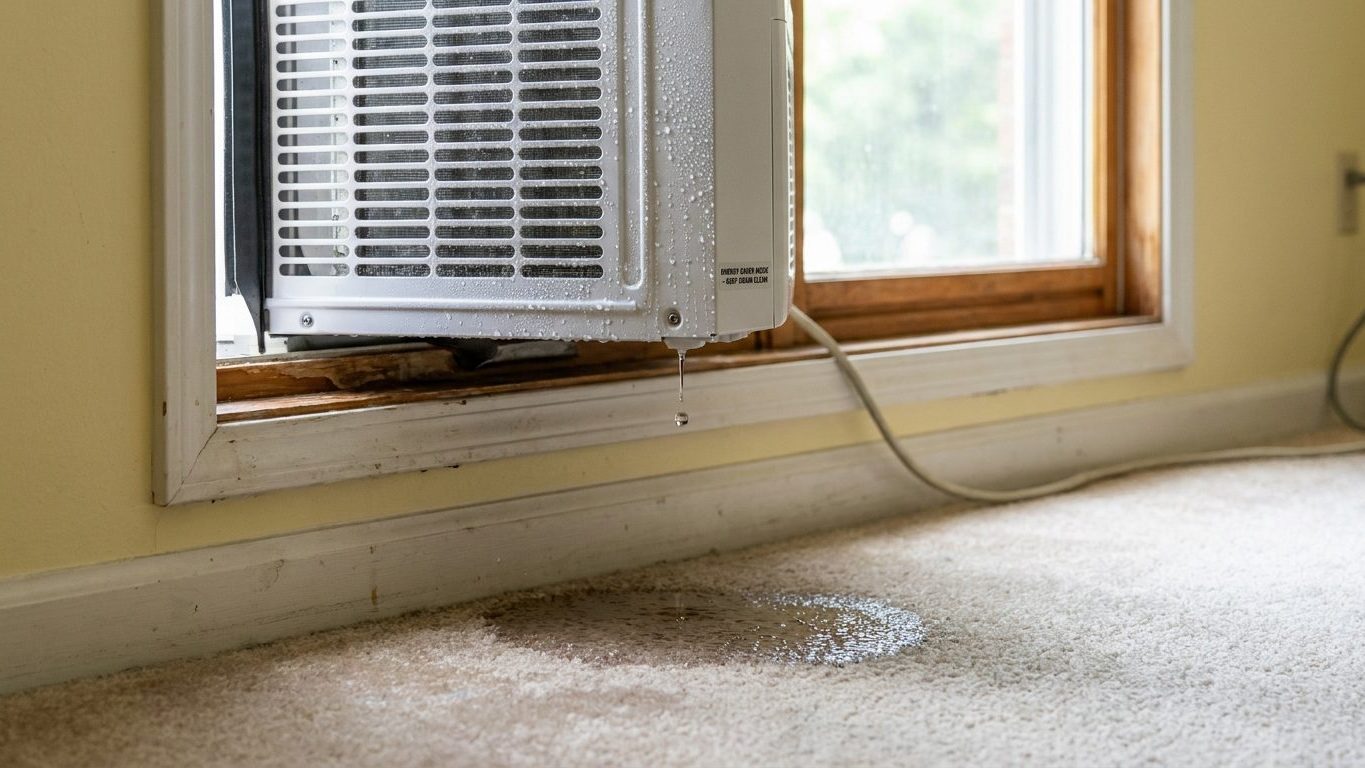

Water dripping from a window air conditioner into the room almost always comes down to one of four mechanical issues: a unit that isn’t tilted correctly, a drain opening clogged with dirt or debris, a cracked or overflowing drain pan, or ice on the coil that’s melting faster than it can drain outward. None of these mean the unit is broken beyond repair. Most are fixable in the time it takes to pull the unit partway out of the window and take a look.
The water is supposed to be there
Before troubleshooting anything, it helps to drop the assumption that water means malfunction. It doesn’t. A window air conditioner cooling a room on a humid August afternoon is pulling moisture out of the air by design, and that moisture has to go somewhere. Warm, humid air passes over a coil chilled by refrigerant, the air can’t hold as much water vapor once it cools, and that vapor turns to liquid on the coil’s fins. On a sticky day in a room with a few people in it, that’s not a few drops. It can be a quart or more over several hours, sometimes closer to a gallon in a poorly ventilated space with high humidity.
Where that water is meant to exit
The engineering solves this with a slight rearward tilt. Water collects at the back of the unit, in a shallow pan built into the base, and either drips outside onto the ground below the window or gets slung back onto the hot condenser coil, where it evaporates into the exhaust air and leaves through the vent facing outside. That’s the entire plumbing system on most window units: gravity and a tilt, no pump, no hose running to a drain line.
So the real question isn’t whether water is being produced. It’s whether that water is landing outside the house or inside it. Every fault covered below is really the same failure wearing a different face: something is interrupting the path between the coil and the outdoors, and the water is finding the shortest route instead, which is often back over the front lip of the unit and onto your windowsill or floor.
The four reasons it comes inside
Once you accept that condensation itself is normal, the fix becomes a process of elimination. The table below covers the four common causes, roughly in order of how often each one turns up.
| Cause | How to recognize it | What to do |
|---|---|---|
| Wrong tilt (unit sits level or tilts forward) | Dripping happens steadily whenever the unit runs, water pools at the front edge or on the sill inside | Re-level the unit so the back sits slightly lower than the front, using the sash and shims rather than the unit’s own feet |
| Blocked drain path at the base | Water backs up and overflows even though the tilt looks correct; sometimes a musty smell accompanies it | Slide the unit out partway and clear dust, insect debris, or grime from the drain opening and pan |
| Cracked or overfilled drain pan | Leaking continues even after cleaning and re-leveling, sometimes worse on older units | Inspect the pan for visible cracks or warping; a damaged pan usually means the unit needs professional repair or replacement |
| Ice melting off a frozen coil | No dripping at first, then a puddle after the unit has run for hours, often with weak airflow beforehand | Turn the unit off and let the ice thaw completely before restarting; then address the underlying cause of freezing |
Why the ice case is different
The first three problems are drainage problems. The fourth one isn’t, and it deserves more attention because it’s frequently misread as a leak when it’s really a symptom of the unit struggling to cool. A coil freezes when airflow across it drops, usually from a dirty filter, a fan running too slow, or the thermostat set so low that the unit cycles for hours without a break. Ice builds invisibly while the unit runs, then melts once it’s shut off or once the ice mass gets heavy enough to slump, and that meltwater has nowhere organized to go. It drips wherever gravity takes it, which is often straight down onto the floor rather than back toward the drain pan.
A leak that only shows up after the unit has been running for several hours, especially paired with airflow that felt weak before the dripping started, points at ice, not drainage. Clearing a clogged filter and giving the unit time to fully thaw solves this far more often than adjusting the tilt does.
Checking the tilt
Tilt is the most common cause and the easiest to check, but it has to be checked correctly or you’ll get a false reading. Here’s the sequence that avoids the usual mistakes:
- Turn the unit off and unplug it before doing anything else. Working around a running compressor and a window ledge at the same time is an easy way to get hurt.
- Place a small level on the windowsill itself, not on the plastic casing of the unit. The casing can be molded at an angle for looks, which throws off the reading and leads people to “fix” a tilt that was never wrong.
- Check the installation guidance that came with the specific unit before assuming it needs a rearward slope. Some models are built with an internal channel that routes condensate to the exhaust side regardless of tilt, and forcing a slope on those can do nothing or even make drainage worse.
- Adjust the slope with shims placed under the unit at the sash, not by lifting the unit itself in and out of the window repeatedly. Small wood shims or a folded piece of rigid plastic under the rear edge, checked again with the level on the sill, get the job done with far less strain.
Window units are heavy, often 40 to 90 pounds depending on capacity, and they’re being supported partly by a sash that wasn’t designed to hold that kind of load without a bracket. Keep a firm grip, work with another person if the unit is large, and confirm the support bracket is doing its job before letting go of the unit fully. That’s the one safety point worth repeating here: a unit that shifts or falls while you’re adjusting it is a real hazard, not a remote one.
Portables collect it instead
The same search brings in a fair number of people whose unit isn’t a window model at all but a portable one, and the mechanics there are different enough to spell out separately. A portable air conditioner sits inside the room with no sill to drip onto and no rear coil facing outdoors, so it has to handle condensate one of three ways: evaporate it back out through the exhaust hose along with the hot air, collect it in an internal tank, or route it out continuously through a drain hose attached to the back of the unit.
Most units lean on the first method for a good share of the moisture load, which is why a portable rarely needs constant attention in an average room. But evaporation only handles so much. In a humid room, or a basement, or a space with a lot of moisture load from cooking or a bathroom nearby, the unit produces condensate faster than it can evaporate it, and the excess goes into that internal tank. Once the tank fills, nearly every portable model responds the same way: it shuts down cooling and lights up an indicator, refusing to run again until someone empties the tank. That’s the “leak” a lot of portable owners actually experience, not water on the floor but a unit that mysteriously quits mid-afternoon.
The practical fix is either emptying the tank on a schedule that matches the room’s humidity, which might mean daily in a damp basement and barely ever in a dry upstairs bedroom, or fitting the continuous drain hose if the model has that option and running it to a floor drain or out a low window. One more point worth a single mention here since portables often get set up wherever an outlet happens to be closest: avoid running one on an extension cord. These units draw enough current that a cord rated for lighter loads can overheat, and if a longer connection is unavoidable, that’s a job for an electrician to size correctly rather than a guess based on cord thickness alone.
Common questions
Is it normal for a window air conditioner to drip water outside?
Yes. Dripping onto the ground or pavement below the window is the system working as intended. The concern is only water landing inside the room, not outside it.
Can I fix a window unit that’s leaking without removing it from the window?
Often yes for a tilt problem, since shims can be adjusted from outside or by sliding the unit out slightly rather than removing it fully. A blocked drain or a cracked pan usually requires pulling the unit further out to inspect and clean it properly.
Why does my air conditioner only leak after running for a long time?
That pattern points to ice buildup on the coil rather than a drainage fault. The unit runs fine at first, ice accumulates gradually, and the leak appears once that ice starts to melt, often after the unit has been shut off or once airflow has been restricted for a while.
Does a portable air conditioner need a drain like a window unit?
Not in the same way. A portable relies on evaporating condensate through its exhaust or storing it in an internal tank, with a continuous drain hose as an optional add-on for humid rooms. A window unit relies on gravity and tilt to send condensate outside continuously while it runs.