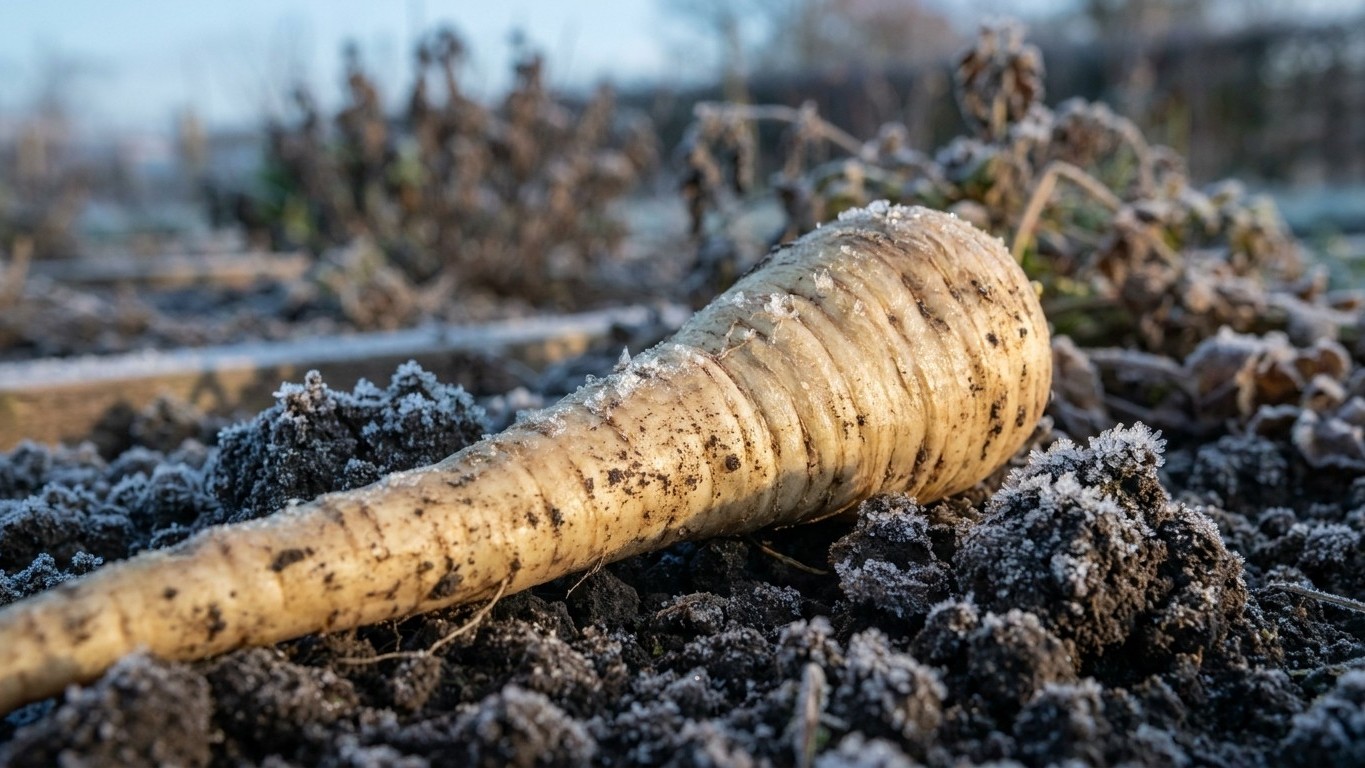

Lift parsnips 100 to 120 days after seeding. For a winter sowing in Louisiana, that usually means April into May, before warm weather toughens the roots. Sweetness is the part the calendar can’t promise, because it takes several frosty weeks and the Gulf coast rarely delivers them. Once the roots are out, they can keep four to six months. That holds only at 32 to 34°F with 98% humidity, and never beside apples or other ripening fruit.
The short answer
Does the winter deliver several frosty weeks? Along the coast, barely. The mean daily minimum of the coldest month at the New Orleans reference station is 46.1°F, according to NOAA’s NCEI Climate Normals (the most recent 30-year set). A month whose average night low sits in the mid-40s is cool, but it isn’t a frost month.
The freeze record is thin too. A 32°F freeze occurs in only 86.8 percent of years at that station, so roughly one year in seven has no freeze at all. When freezes do arrive, they cluster around the New Year. The first fall frost falls between December 17 and January 8, and the last spring frost between January 18 and February 8. The two windows nearly touch, which squeezes the whole frost season into a short stretch of midwinter.
Utah State University Extension says parsnips taste best after several weeks of cool, frosty weather, which converts stored starch to sugar. In a typical south Louisiana winter, a parsnip will grow rather than sweeten. You get a full-sized root with a mild, somewhat starchy flavor. In the year with no freeze, you get nothing more than that. A comfortable hardiness zone doesn’t add up to several frosty weeks, and the sweetening follows the frost the plant actually sees. North Louisiana freezes far more reliably, so gardeners there come much closer to the textbook result. The longer explanation is in Will Parsnips Sweeten in Louisiana?
So when do you lift? Count from seeding, not from the first cold snap. Parsnips are sown in place, and germination is slow. Bare soil for two or three weeks after sowing is normal, and digging it up to re-sow is the usual mistake. The 100 to 120 days run from the day the seed went in. If a freeze lands while the roots are nearly full size, leave them for it and lift afterward. If no freeze comes, lift on schedule and don’t wait for one. For the full growing plan, see Growing Parsnips in Louisiana.
Storage is where the real surprise sits. A parsnip isn’t sensitive to chilling, so cold never hurts it. Ethylene does. Parsnips make almost none of their own, but even low levels of the gas in cold storage turn the roots bitter. Apples, pears and any ripening fruit give it off, so keep parsnips well away from the fruit bowl and the fruit drawer.
Does the season fit?
Yes, with room to spare if you sow early. The freeze-free stretch at the reference station runs from the mean last spring frost in late January or early February to the mean first fall frost in late December or early January, which covers most of the year. The limiting factor here is spring and summer heat, so the timeline below works backward from that.
- Sow in place two to three weeks before the last spring frost. With that frost falling between January 18 and February 8, the sowing window runs from late December to late January.
- Expect nothing for a long stretch. Germination is slow, and the 100 to 120 day clock is already running even while the row looks empty. Keep the seedbed evenly moist so the seed doesn’t dry out, but don’t soak it.
- Count 100 to 120 days from seeding. A sowing in late December or early January finishes in April. One made in late January finishes in May, when days are getting warm.
- Judge the fit. An early sowing fits comfortably, with roots sized up before heat arrives. A sowing at the tail end of the window fits tightly, and anything later pushes the roots into warm weather, when growth turns tough and woody.
- Lift when the shoulders have thickened at the soil line. Loosen the ground beside the row with a garden fork first, then ease the roots out. Top them after harvest, but don’t trim into the crown.
Once they’re lifted, storage works on a different clock. Parsnip roots can be held four to six months at 32 to 34°F with 98% relative humidity, according to USDA Agricultural Handbook 66. Four to six months is a long keeper by any standard, but the number assumes those conditions are held steady. Almost no house manages that. A refrigerator runs warmer and drier than the handbook’s target, so treat the long figure as a ceiling and not a promise.
What goes wrong here
Most problems trace back to soil, water, timing or the winter itself. Each has a fix, and they don’t all share the same cause.
- Forked roots in heavy or stony ground. A root that meets resistance splits around it. Parsnips want deep, sandy soil, and heavy soil needs to be double dug before sowing. Much of south Louisiana has heavy clay, but your own bed is what counts. Squeeze a moist handful, and if it holds a tight ball and won’t crumble, loosen the bed two spade depths down and pull out stones.
- Forked roots from overwatering. This is a separate cause and it needs a separate fix. Constant wet soil encourages a shallow, branching root even in good ground. Water deeply and less often, and let the surface dry between waterings once seedlings are up.
- A season that runs out. A late sowing carries the roots into warm weather, and they turn coarse. Sow in the late December to late January window and lift as soon as the shoulders fill out. Don’t leave the roots sitting in warming soil.
- A winter too mild to sweeten. In a year with few or no freezing nights, the root stays bland. Accept that for the crop’s first run, and use the roots in soups, roasts and mashes where mild flavor works. Chilling lifted roots in a cold refrigerator drawer is a common workaround, though it won’t match frost in the ground.
- Bitterness in storage. Ethylene from nearby apples or ripening fruit does it, even at the right temperature. Store parsnips alone, top them without cutting into the crown, and check them regularly for soft spots.
Insect damage looks different from any of these. If the tops are chewed or the roots are tunneled, What Eats Parsnip in Louisiana, and When covers what to look for and when each pest shows up.
Common questions
How do I know a parsnip is ready to lift?
Check the days from seeding first, since 100 to 120 days is the target. Then brush the soil back from the top of a root. When the shoulder is broad and the root has filled out to a good size, it’s ready.
Can I leave parsnips in the ground through a mild winter?
You can wait for a freeze if one is coming soon and the roots are nearly full size. If the weather turns warm with no frost, though, lift them. Roots left in warming soil lose quality, and the sweetening never arrived anyway.
Why do my stored parsnips taste bitter?
Ethylene is the usual cause. Parsnips aren’t chilling sensitive, so a cold refrigerator won’t hurt them, but low levels of ethylene from apples or other ripening fruit will turn them bitter. Store them on their own.
How long will parsnips really keep at home?
The four to six month figure applies to 32 to 34°F at 98% humidity held steady, and ordinary home storage falls short of that. Expect less time, and check the roots every week or two. A bag with a few air holes helps hold humidity, and any root that softens should be used first.