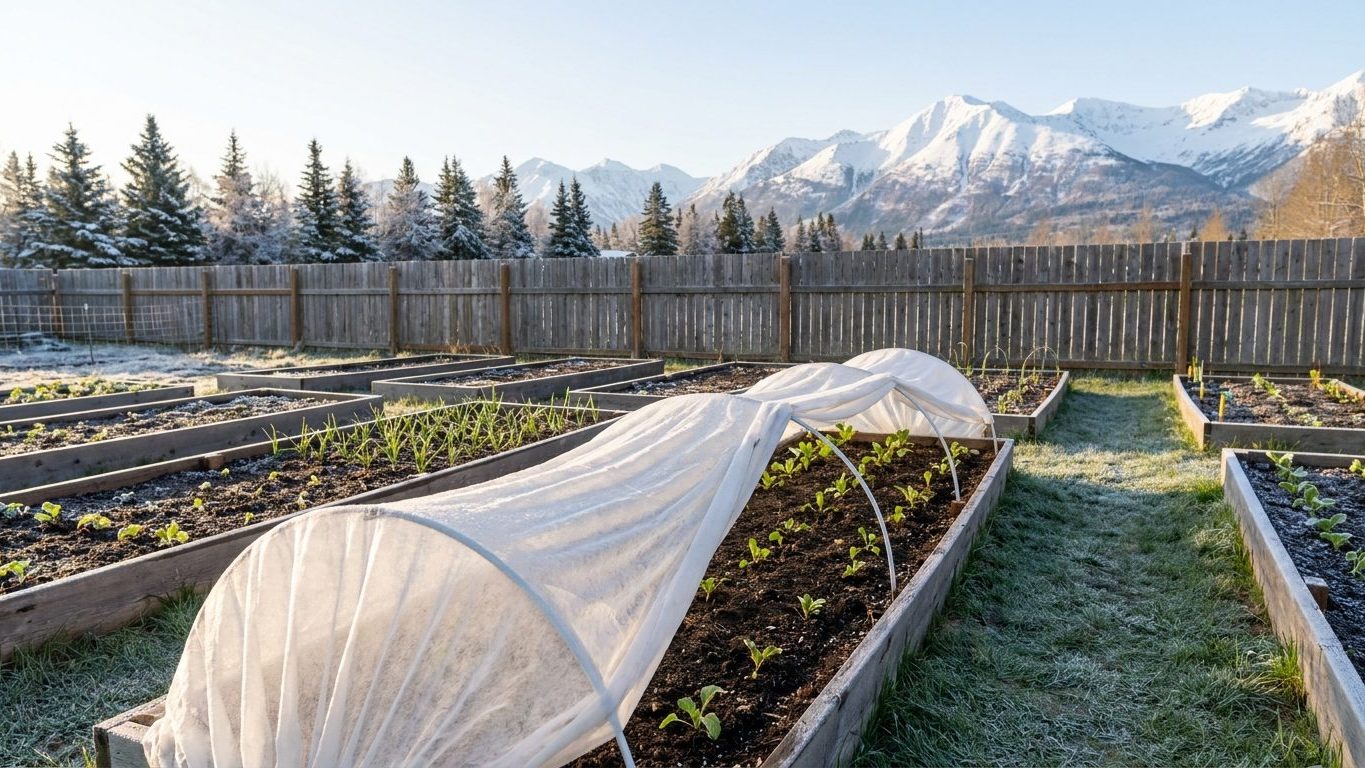

Cover the garden on any night the forecast low reaches freezing, 32°F. In Vermont that can happen into mid-May, and it starts again in early October. Covers belong on the beds at both edges of the season. Below: how those dates work, where covers fail, and how to adjust for your own hillside.
The short answer for Vermont
Plan on covering tender plants from late April through about May 10, and again from early October on. Let the nightly forecast make the final call. On clear, still nights the air at plant level runs colder than the forecast, so a predicted low of 36°F is reason enough to cover tomatoes, peppers, squash, and cucumbers.
What do the spring and fall dates actually mean?
The NOAA 1991-2020 Climate Normals for the Burlington station put the last spring frost at April 30 to May 10. They put the first fall frost at October 3 to October 13. Both ranges are the 30 to 70 percent band of probability for a 32°F freeze. A date inside that band is a coin flip, so it gives no all-clear. The Burlington station has a frost-free stretch from early May to early October.
Burlington sits on Lake Champlain, the mildest corner of the state. The Green Mountains and the Northeast Kingdom run substantially shorter, so treat these dates as the best case.
Which plants need covering, and when?
| Plant type | Cover when |
|---|---|
| Hardy crops (spinach, lettuce, peas, kale, radishes) | A hard freeze is forecast, or in early spring to warm the soil and speed growth |
| Tender crops (tomatoes, peppers, squash, cucumbers, beans, basil) | Any night the forecast is near freezing, and on cold, wet stretches in late May |
| Fall plantings of greens and roots | From the first October freezes, to carry them through the cold snaps |
A light frost often comes first, followed by a mild stretch of days. A cover that gets a tomato plant through that first night can buy several more weeks of harvest. Put covers on in the evening while the day’s warmth is still in the soil. Take them off the next morning once temperatures are above freezing, so the plants don’t overheat and pollinators can reach open flowers.
For a rundown of the materials themselves, see Which Season Extenders Work in Vermont. The wider picture is in Extending the Growing Season in Vermont.
What will not work here

Why does planting tender crops early under cover fail?
A season this short punishes anyone who tries to jump the calendar by weeks. Cover cloth adds only a few degrees of protection. A tomato set out in mid-April under a single layer of fabric will meet nights well below what the cloth can handle, since the frost band does not even start until April 30. Cold soil is the other problem. Warm-season plants sit in chilled ground and stop growing, and a cover over the top does little for the roots.
Plastic is the other trap. On a sunny spring afternoon, a closed low tunnel or cold frame can climb far above outdoor air temperature. Seedlings can cook before you get home from work. Without venting or removing covers on warm days, the fabric that saved the plants at 2 a.m. can kill them by 2 p.m.
Why do covers fail in winter?
At the Burlington station, the mean daily minimum in the coldest month is 12.9°F. That is the average night, not the worst one, and it is far below what a frost blanket handles. Lettuce or spinach under one layer of fabric in January is not going to make it. Even a cold frame with no extra layers loses most of its edge on the coldest nights. Hardy greens such as spinach and kale can survive in a protected structure. Tender plants cannot be held there.
Day length makes things worse. Burlington sits at 44.47 degrees north, and in late fall and winter the days are too short for much growth even when the temperature is fine. A cover keeps hardy crops alive but does not make them grow. Anything meant for late harvest needs to reach near-full size before the light fades, so seeding in October for November eating does not work. Hold-over crops have to be planted while days are still long.
Heavy, wet snow adds another failure. Low hoops with thin supports flatten under it, and the fabric sags onto the plants and freezes to them. Sturdier hoops, or a quick brush-off after a storm, keep the structure standing. If a cover stays on through a long, damp autumn spell without any airflow, leaf diseases follow.
What changes across Vermont
Vermont has no single answer. The USDA Plant Hardiness Zone Map (2023 edition, built on 1991-2020 normals) runs from zone 3b to 5b across the state. That spread reflects the average annual extreme minimum temperature. Burlington is the warm end of the picture. The Champlain Valley, with lake moderation, is the mildest part. Higher ground in the Green Mountains and the Northeast Kingdom is colder, with a shorter season on both ends.
If you garden in the north or at altitude, treat the Burlington dates as the earliest you could possibly act. Push the spring dates later and the fall dates earlier. How much depends on your elevation and your site, and a hilltop garden may sit several weeks away from the lake-moderated ones. Fall covers go on sooner, and the spring wait for warm soil is longer. A hardiness zone also says nothing about the date of the last frost. It describes winter cold, which matters for perennials and overwintering crops, not for when to set out tomatoes.
Latitude matters too. The 44.47 degrees north figure belongs to Burlington. Vermont stretches over a couple of degrees of latitude, so a reader near the Canadian border or the Massachusetts line is a little off from those day-length numbers. To find your own zone, look up your location on the USDA Plant Hardiness Zone Map rather than guessing from a neighbor’s garden. Valleys also hold cold air on still nights, so a low corner of a hillside yard can freeze while the slope above stays clear.
Where to check this for your own county
Start with University of Vermont Extension. As the state’s land-grant extension service, it is the best source of local planting calendars and of vegetable varieties trialed in Vermont conditions. Look for two things. The first is a planting calendar for your area, with frost dates and sowing windows for your own part of the state. The second is any variety trial results for crops you grow, since a variety that thrives in the Champlain Valley may be too slow for a short-season hill town.
The extension’s regional offices, staff, and garden helplines can also tell you how local weather has been running compared with the long-term averages. That counts for a lot, since a spring that runs two weeks behind makes a printed calendar misleading. Master Gardener volunteers are often the people who know which neighborhoods hold frost.
A county or town recommendation beats a state one. A statewide set of dates is a starting point, built from one reference station at the warm end. Treat it as a first draft, then correct it with what your local office and your own site tell you.
Checking this against your own garden
Your own observations outrank every date above. Three are worth watching, and none needs more than your hands and your eyes.
- Soil warmth by feel. Push your hand or a trowel a few inches into the bed in the morning. If the soil feels cold enough to numb your fingers, warm-season plants will sit and wait. Beds that warm up first are your warm microclimates. Slow beds are cold, wet, or shaded.
- The first male flowers. Squash and cucumbers open male flowers before female ones. When they appear, the plants are established and growing. If the covered plants flower well ahead of uncovered ones, the cover is doing its job.
- The first true leaves. After the seed leaves, the first leaves with the real shape of the plant show that roots are working and growth is under way. Compare covered and uncovered rows. A gap of several days tells you how much shelter your site gives.
Frost on the grass at dawn is a bonus clue. Note where it shows up first and lingers longest, and where it never forms. Those spots map your cold pockets better than any chart.
Common questions
What temperature should I cover plants in Vermont?
Cover tender plants when the forecast low is near 32°F, and on clear, calm nights as high as about 36°F. Hardy crops like kale and spinach can take a light frost, so wait for a hard freeze or colder lows for those.
Is it safe to plant tomatoes before the last frost date?
Not safely. The April 30 to May 10 range is a probability band for a 32°F freeze, so a freeze is still possible within it. You can transplant earlier if you commit to covering on every cold night, but cold soil still slows plants down. Many gardeners wait until the freeze risk has passed.
Should I leave covers on all day?
No. Take them off in the morning once temperatures are above freezing, or vent them on sunny days. Closed plastic can overheat quickly, and plants with open flowers need access for pollinators. Put covers back on in the evening.
Do the Burlington dates apply to the Northeast Kingdom?
No. Burlington is the mildest corner of the state. The Green Mountains and the Northeast Kingdom run substantially shorter, so expect later spring and earlier fall freezes. University of Vermont Extension and your own observations will help you adjust.