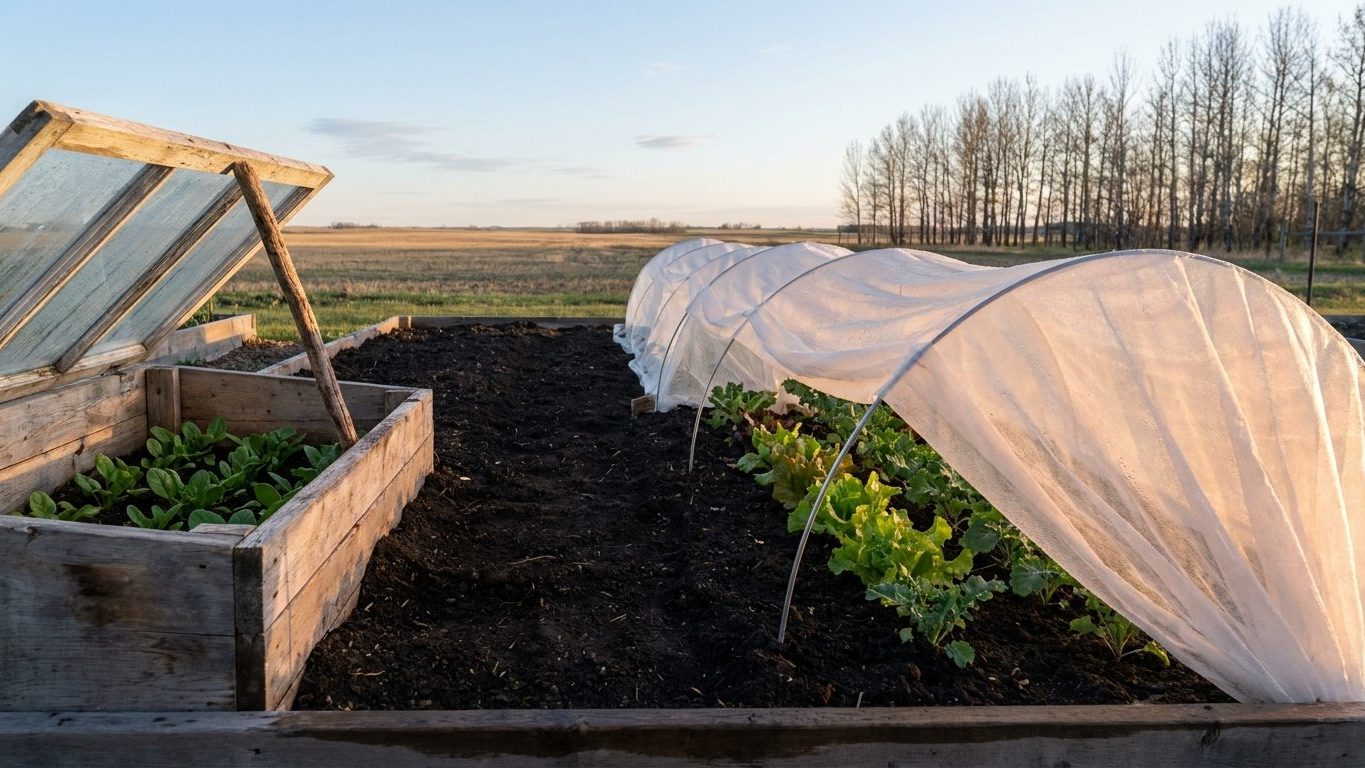

Floating row cover, low tunnels, cold frames and an unheated high tunnel all earn a place in Vermont, and row cover, the cheapest of the four, pays back first. Together they can stretch a short season by a few weeks at each end. They will not turn it into a long one. The best pick depends on how cold your site runs and what you want to harvest in March or November.
The short answer for Vermont
Start with row cover and low tunnels for spring and fall, add a cold frame for seedlings and winter greens, and save a high tunnel for the day you want real cold-season harvests. At the Burlington reference station, the last 32°F freeze falls between April 30 and May 10, and the first falls between October 3 and October 13. Those dates mark the band where the chance of a freeze sits between 30 and 70 percent. A freeze can still arrive on either side of them.
That is the room a season extender works in. It captures daytime heat from the soil and the sun, then slows the loss of that heat after dark. The gain is a few degrees on a clear night. A few degrees decides whether lettuce or a young pepper plant lives, but it will not save tender plants when the air drops far below freezing. Burlington’s coldest month has a mean daily minimum of 12.9°F, so winter is a job for hardy crops only.
Which season extender fits which job?
| Extender | Best use in Vermont | Main limit |
|---|---|---|
| Floating row cover | Frost cover for spring transplants and fall crops | Adds only a few degrees, and snow can crush it |
| Low tunnel (hoops plus cover) | Early greens, fall carrots, hardy brassicas | Needs venting on sunny days and a firm anchor in wind |
| Cold frame | Hardening off, early lettuce, winter spinach | Small footprint, and it overheats if left shut |
| Unheated high tunnel | Early tomatoes, winter greens, a long fall | Cost, snow load and midwinter short days |
| Black plastic mulch | Warming soil for squash, peppers, tomatoes | Does nothing for air temperature on a frosty night |
For most backyard growers, row cover over hoops is the best first purchase. It handles frost nights in May and October, it rolls up and stores in a tote, and the same hoops hold plastic in a pinch. The full range of options is laid out in Extending the Growing Season in Vermont.
What will not work here

A cover cannot add summer heat. Melons, sweet potatoes and other crops that need a long, warm stretch struggle in Vermont even under plastic, because the limit is the number of warm weeks. A grower who wants them is better off choosing short-season varieties and warming the soil with black mulch. Pushing the planting date earlier does not fix the problem.
Starting too early under cover fails too. Row cover protects leaves from a frost, but it does nothing for soil that sits cold. A pepper transplant set out in early May with roots in chilly ground will hold still for weeks. Cold soil under a warm cover wastes the head start, so wait until the ground feels workable and a little warm to the hand. The guide to when to cover your garden in Vermont explains how to time the cover to the forecast.
Why do fall extenders disappoint when sown late?
At 44.47 degrees north, the Burlington latitude, days shorten quickly after the first freeze window opens in early October. Plants make little new growth in that light. A cover holds what is already there, it does not grow a crop from a late sowing. Seed spinach, lettuce, carrots and kale in summer so they reach size before the light fades, then use the cover to keep them for harvest.
Several other setups also fail in this climate:
- Unvented cold frames and tunnels, which can cook seedlings on a sunny April afternoon even when nights are still freezing.
- Thin fabric or plastic on loose hoops under wet snow, which sags and collapses.
- Tunnels on windy ridgetops without anchors or ground stakes, which can lift off in one storm.
- A single layer of cover over tender crops in January, since a few degrees of help cannot cover a gap that wide.
Winter harvests are possible with a high tunnel, but they run on stored growth. Midwinter light is too weak for much new leaf, so the plan is to sow in late summer and pick slowly through the cold months.
What changes across Vermont
Vermont does not have a single hardiness zone. The USDA Plant Hardiness Zone Map (2023, based on 1991-2020 normals) places the state in zones 3b to 5b, a spread built on the average annual extreme minimum temperature. Lake Champlain gives Burlington the mildest conditions in the state. The Green Mountains and the Northeast Kingdom run substantially shorter on season and colder in winter.
A grower in the north or at elevation should treat the Burlington dates as the best case. Expect a later last freeze in spring and an earlier first freeze in fall, so there is less room to get a crop to harvest before the cold returns. That makes covers more useful there, and it also makes them work harder. Row cover that suits Burlington in October may need a second layer or a tunnel in the hills, and fast-maturing varieties matter more.
Valley floors add another twist. Cold air drains downhill on clear, still nights and settles in low spots, so a garden at the bottom of a slope can freeze while a bed fifty feet higher stays clear. A south-facing slope near a building can run milder than the zone suggests.
Latitude matters a little as well. The Burlington figure of 44.47 degrees north belongs to that city, and a gardener near the Canadian border or the New Hampshire line should check their own latitude. Day length is what tells onions when to stop making leaves and start making bulbs, so a variety suited to one end of the state may behave differently at the other.
No one else can name your zone for you. The USDA Plant Hardiness Zone Map lets you look up a ZIP code, and that result is the number to plan around.
Where to check this for your own county
The best local source is University of Vermont Extension, the state’s land-grant extension service. Look there for two things: the planting calendar that fits your county, and the vegetable varieties that have been trialled near you. A calendar built from local frost records is more useful than a statewide range, and a trial result tells you which cultivars handled a cool, short season in practice.
A county recommendation beats a state one every time. Statewide dates, Burlington’s included, average over a lot of very different ground, from lake shore to mountain valley. The extension office can also tell you which season extenders have a record of working in your area, what snow loads a tunnel needs to handle, and which pests show up under covers in your part of the state.
When you call or visit, bring a few facts: your elevation, the direction your beds face, and the lowest temperature you have seen in late spring. Those details turn a general answer into a useful one.
Checking this against your own garden
Your garden’s own signals outrank any date in this article. Three are easy to read without any equipment.
First, the feel of the soil. Dig down a few inches in early spring. If it feels cold and clammy, it is too early for transplants, even under a cover. Check a covered bed and a bare bed on the same day. The gap in how they feel is your cover’s real gain on your site.
Second, the first flush of male flowers on squash and cucumbers. They open ahead of the female flowers, and when they appear it tells you the plants have found enough warmth to run. If they arrive a week or two late compared with a neighbor’s garden, your site runs cooler and a tunnel or black mulch will pay off.
Third, the first true leaves. A seedling shows its seed leaves first, and the true leaves follow once roots have taken hold. If seedlings under cover wait a long time for true leaves, the soil or the air is still too cold, and venting or mulch may help.
Common questions
Does row cover stop a hard freeze?
Not a hard one. It adds a few degrees on a clear night, which is enough for a light frost around freezing. Hardy greens and roots handle colder nights under cover, but tender crops like tomatoes and peppers need extra protection or a tunnel.
Is a high tunnel worth it in Vermont?
For a serious market or heavy home harvest, yes. It brings in tomatoes earlier and keeps greens going through the cold months. For a small garden, hoops and row cover do most of the work at a fraction of the cost.
When should I take the cover off?
Vent on sunny days when it warms up, and remove it for pollination of crops like squash. Put it back on when frost threatens. Nights near freezing in May and October are the usual reason to keep it handy.
Can I grow vegetables all winter?
Only some. Hardy greens such as spinach and kale can hold in a tunnel through winter, but growth nearly stops in the short days. Sow in late summer so plants are full-sized before the light drops, then harvest as you need them.