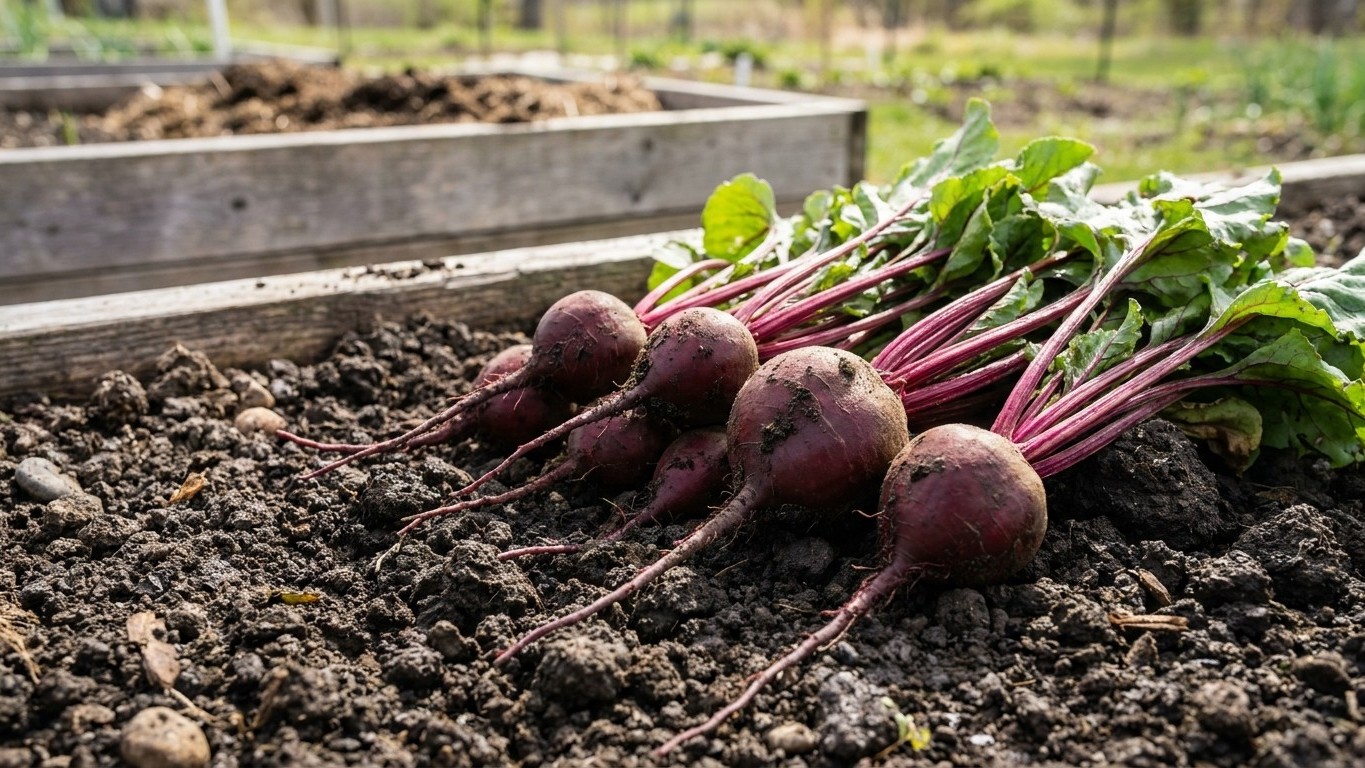

Once pulled and topped, the roots keep best at 33 to 36 °F, which is warmer than the near-freezing storage that suits other root crops. The USDA’s storage handbook says colder rooms produce more black spot and rot. So the pull date is only half the question. Where the roots go afterward decides how long they last.
Why colder is not better for beets
What does the USDA say about storage temperature?
The most direct source is USDA Agricultural Handbook 66, The Commercial Storage of Fruits, Vegetables, and Florist and Nursery Stocks. Its beet chapter, written by F. Adamicki, puts topped beets at 33 to 36 °F with 98% relative humidity. It then adds a line most gardeners would not expect: during storage at 32 to 34 °F, more black spot and rot occur than at higher temperatures.
That runs against habit. Gardeners are used to pushing carrots, parsnips and similar roots as close to freezing as the room allows, and the colder the better. Beets do not follow that rule. A root cellar corner that makes carrots happy can leave beets with dark, sunken patches and soft spots by midwinter.
The handbook is written for commercial storage, but the physics carries over to a basement shelf. Beets are mostly water. They lose it quickly in dry air and they rot when the temperature and moisture are wrong, so the target is a narrow band: cool, a few degrees above freezing, and very humid.
How long do beets keep with the leaves on?
Not long. The same chapter says bunched beets can be kept for about 10 to 14 days at 32 °F and above 98% humidity. That is a ceiling under ideal conditions, reached in a commercial cooler with the humidity held steady. A kitchen fridge with its drier air and fluctuating temperature will often do worse, and a bunch left on a counter will do worse still.
For anything beyond a couple of weeks, top the beets first. Twist or cut the leaves off, leaving a short stub of stem so the root does not bleed, and store the roots on their own. The greens can be eaten right away, which is the better use for them anyway.
The 10 to 14 days applies only to the bunched form. A topped root held in the 33 to 36 °F band is a different storage job and runs on a different clock, though the handbook gives no single number of weeks for it. Treat any storage length you read as the best case, and check the roots every couple of weeks rather than trusting the calendar.
Where in the house that actually is
A refrigerator is the wrong tool for long storage. It is built to hold food at a temperature that suits milk and meat, and it can run colder than the beet target, especially near the back wall or in an overstuffed crisper. A heated room is the opposite problem, far too warm and far too dry. The handbook says cellars and pits should stay between about 31 and 41 °F, never dropping below 31 or climbing past 41.
In a New Hampshire house, the best candidate is usually the coolest corner of an unheated basement or cellar, along a north or east foundation wall, away from the furnace and water heater. Old fieldstone cellars with a dirt floor tend to be cool and damp, which suits beets. A bulkhead stairwell or an insulated cold room can work. An unheated attached garage is riskier, because winter nights there can drop below 31 °F and freeze the roots solid.
Do not guess at any of these spots. Put a min/max thermometer on the shelf for a week or two before the harvest and read it each morning. You want the low to stay above 31 °F and the high to stay below 41 °F, ideally sitting in the 33 to 36 °F range most of the time. A second reading for humidity helps too, since 98% is wetter than most basements manage. Packing roots in a lidded tub with damp sand or sawdust, or in a perforated plastic bag, raises the humidity around them without soaking them.
Size matters as much as location. The handbook says large roots keep much better than small ones because they lose water and shrivel more slowly. Eat the small roots first and store the big ones, since a small beet in a cold cellar will go soft and wrinkled well before a large one does. This is the opposite of what many gardeners do, saving the pretty little beets and eating the oversized ones. Sort the harvest by size the day you pull it, and put the largest, undamaged roots in the cold room.
When are beets ready to pull in New Hampshire?
Beets are sown directly in the garden, so the days on the seed packet run from seeding, never from a transplant. Count forward from the day the seed goes in. The reference airport weather station in the state puts the last spring freeze between April 16 and April 27. Suburban and rural gardens usually see the last frost one to two weeks later, and hill country later still, so check your own county with the local extension office before planning a sowing date.
For a fall storage crop, work backward. Sow early enough that the roots reach good size before the soil freezes, and pull them before it does. Roots left in frozen ground do not store the way carefully handled ones do. As a rule, the roots are ready when the shoulders show above the soil and have reached a size you would be happy to slice. For storage, wait for the larger end of that range, because the bigger roots keep better.
Dry the roots briefly after lifting, brush off loose soil rather than scrubbing, and look each one over. Any root with a cut, a crack or a chewed spot should go to the kitchen first. Damage invites rot, and the same applies to roots marked by insects. The article on What Eats Beet in New Hampshire, and When covers what to look for on both leaves and roots.
What makes beets bolt or turn woody before harvest?
These are two separate failures with two separate causes. Utah State University Extension says water stress in the first 6 weeks causes premature flowering, which is bolting. A dry spell in that early window can send the plant toward seed instead of a good root. Woodiness is a later problem: heat above 85 °F combined with water stress makes the root woody. A bed that was watered well early can still turn out tough roots if a hot, dry stretch arrives near harvest.
Soil sets the stage for both. Beets want deep, sandy, well-drained soil rich in organic matter, and the same extension source says to amend with no more than 1 inch of composted organic matter per 100 sq ft. The soil USDA lists as representative of New Hampshire is the Marlow series, a Spodosol, which is sandy, acid and strongly leached, typically under conifers. Its mapped surface layer is about 57 percent sand, 38 percent silt and 5 percent clay, it is well drained, and its surface pH is about 3.5.
That is the state’s representative soil, not necessarily what is in your yard. The mapped surface layer is natural forest litter and carries about 85.0 percent organic matter, which no cultivated bed will match, and river bottoms, hillsides and builder-scraped lots differ widely. What the Marlow series suggests is that ground in this region tends to drain fast and run acid, so a soil test tells you far more than the state average does. Beet Soil in New Hampshire: What the Root Will Meet goes through what to do with the result, and Growing Beets in New Hampshire covers the season from sowing on.
Common questions
How long do beets keep with the leaves on?
About 10 to 14 days at 32 °F and above 98% humidity, according to USDA Handbook 66. That is the best case. Top the roots if you want to keep them longer.
Is the refrigerator the best place to store beets?
For a few days, yes. For weeks, a cool cellar usually does better, provided it stays between about 31 and 41 °F. Fridges can run colder than the 33 to 36 °F target, and colder storage means more black spot and rot. Check the temperature with a thermometer before committing the crop.
Which beets should I store and which should I eat?
Store the large, undamaged roots, which lose water and shrivel more slowly. Eat the small ones first, along with any root that has a cut or a soft spot.
How many days from seeding until beets are ready?
Plan on the days to maturity on the packet, since beets are sown in place. A hot, dry stretch late in that window can turn roots woody, so keep an eye on the weather and on the bed as harvest approaches.