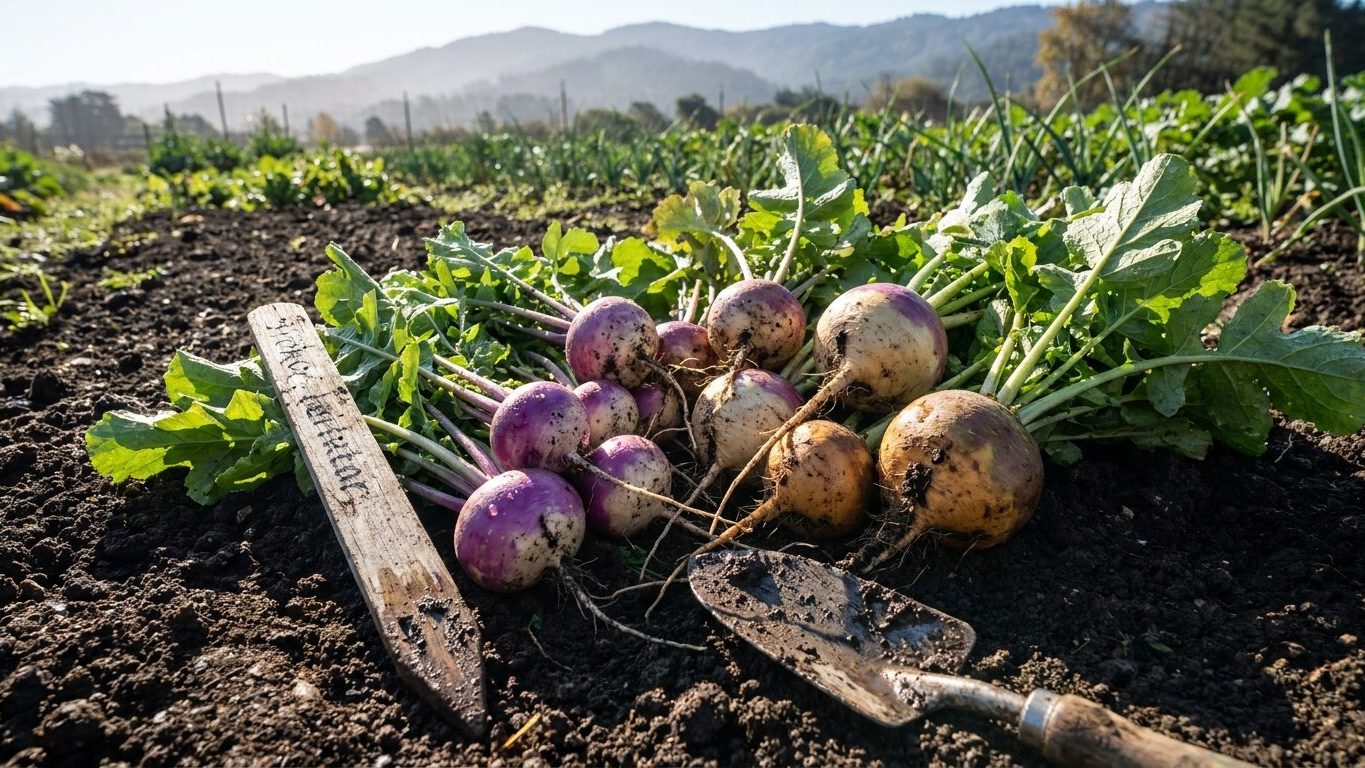

For Prince Edward Island, grow a quick salad turnip for early and late crops, a mid-season storage turnip for the main fall harvest, and a standard-length rutabaga sown in early summer. All three fit the roughly 154 frost-free days at Charlottetown. The types to skip are the slowest rutabagas sown late. The right pick for you also depends on how far your garden sits from the Charlottetown weather station.
The short answer for Prince Edward Island
Choose by type, not by brand. A fast salad turnip, a mid-season purple-top storage turnip and a standard rutabaga each suit the island, and a typical garden has room for all three. Catalog names change from year to year, but the types behave the same way. (In much of Atlantic Canada, the “turnip” on a dinner plate is usually a rutabaga, so check which root a recipe or a neighbor means.)
The Charlottetown A station, in Environment and Climate Change Canada’s 1981-2010 normals, puts the average last spring frost on May 16 and the average first fall frost on October 17. That leaves about 154 frost-free days between them. Both dates are averages. In one year out of two the last spring frost falls later than May 16, and in one year out of two the first fall frost arrives before October 17. Treat each date as the middle of a window.
How long does each type take to grow?
Seed packets count days from sowing, since turnips and rutabagas are sown straight into the garden. The ranges below are typical packet figures.
| Type | Typical days from sowing | Best use on the island |
|---|---|---|
| Salad turnip (small, white, tender) | 35 to 50 | Spring crop and a second sowing in late summer |
| Storage turnip (purple-top, larger) | 50 to 70 | Main fall harvest, short-term storage |
| Rutabaga | 90 to 100 | Early-summer sowing, winter storage |
Against a 154-day average season, even the slowest rutabaga fits with weeks to spare, as long as it goes in on time. All three tolerate light frost, and cool fall nights improve the flavor of the roots. That is why the fall harvest is the one worth planning around. For exact sowing dates, see When to Sow Turnips in Prince Edward Island.
Which type should a first-time grower start with?
Start with a storage turnip sown in midsummer and a short row of rutabaga. The salad type is the most forgiving if you want quick results. The broader picture of how the crops grow is in Growing Turnips and Rutabaga in Prince Edward Island.
What will not work here

A late-sown rutabaga is the clearest failure. Sown in mid-July, a rutabaga reaches maturity in the autumn. That lands right on the average first fall frost of October 17, with days getting shorter and growth slowing. In about half of all years the first frost comes earlier still. The roots end up small and woody, and a variety that needs the full 100 days has nothing in reserve.
Treating May 16 as a safe sowing date is another mistake. It is the midpoint of the window, and half of all years bring a later frost. Turnip seedlings shrug off a light frost, so the risk is lower than for beans or squash. A long cold snap on very young plants can still push some types to send up a flower stalk instead of swelling a root. Wait until the soil is workable and crumbly, and sow in small batches a couple of weeks apart.
Leaving the roots in the ground all winter does not work either. The mean daily minimum of the coldest month at Charlottetown is -12.1 °C. Frozen ground turns turnips and rutabagas to mush, and what survives is of little use. Lift the roots in late fall after a few light frosts, trim the tops, and store them cold and humid.
Heat is not the main threat on the island. Season length is, and the short end of the season sets the limit. That makes the slowest varieties and the late sowings the real losers.
Crowding causes trouble too. Close spacing leaves the leaves damp for longer after rain or fog, and wet, crowded tops invite disease and slugs. Thin turnips and rutabagas so the remaining plants have room to swell.
Spring-sown crops also meet the root maggot. Early plantings are the most exposed. A floating row cover set down right after sowing and sealed at the edges keeps the fly off the crop. A late-summer sowing escapes much of the pressure.
What changes across Prince Edward Island
The island does not have a single garden climate. Charlottetown sits in Canadian hardiness zone 5b, according to Natural Resources Canada’s 1991-2020 plant hardiness map for the reference city. That is the zone of one city, not of the whole province. Natural Resources Canada states that its system does not convert to USDA zones. It uses seven climate variables where USDA uses one, and a single Canadian zone can overlap many USDA zones. Every Canadian zone number is a Canadian number, and it should be read that way.
The Charlottetown frost dates also come from one station. Northern and upland districts run weeks behind them, so their growing season is shorter at both ends. A gardener there should shift the plan in three ways. Sow the rutabaga earlier, so the 90 to 100 days finish well ahead of the first fall frost. Favor the faster storage turnips over the longest rutabagas. Expect the spring sowing to start later than the Charlottetown calendar suggests.
Exposure also matters within one district. A low spot where cold air settles, an open shore field and a sheltered yard can differ from each other by days or weeks. To find the zone for your own municipality, use the Natural Resources Canada plant hardiness site, and read the zone off the map instead of guessing from a neighbor’s.
Where to check this for your own county
The provincial agriculture department is the first stop. Prince Edward Island Agriculture is the province’s extension-style resource, and it is where commercial and home growers go for local advice. Look for two things there. The first is a planting calendar for your part of the island, since Kings, Queens and Prince counties do not warm up on the same schedule. The second is the list of varieties that have been trialled near you, which tells you what has actually produced in local soil.
A recommendation for your county beats one for the whole province. A province-wide guide is built on one station and a handful of averages, and it cannot see your hill or your hollow. When the county calendar and a province-wide summary disagree, go with the county.
If the department has no turnip or rutabaga trial results for your district, ask at a local seed supplier or garden club what has done well on nearby farms. Those growers have already run the experiment, often for years.
Checking this against your own garden
Your own observations outrank every date above. Three are worth tracking, and none needs equipment.
- Soil warmth by feel. Push your hand a few inches into the bed. If the soil feels cold and clings in a wet lump, it is too early to sow. If it crumbles and feels neutral against your skin, seed will sprout. A bed that gets there a week later than a neighbor’s tells you your garden runs cool.
- First true leaves. After the round seed leaves, the first rough, lobed true leaves appear. When they show up, it is time to thin. If they come late on one side of the garden, that spot is cooler or shadier than the rest.
- First frost damage. Watch tender plants such as bean or squash leaves. The night they blacken is your garden’s own first frost. If it comes well before October 17, count back from that date and put the rutabaga in earlier next year.
Write the dates down for a season or two. A garden notebook gives you a calendar that no regional table can match.
Common questions
Is a rutabaga the same as a turnip?
No. They are separate crops. Rutabagas are larger, yellow-fleshed, denser and slower. Turnips are smaller, whiter inside and quicker. In much of Atlantic Canada, people call rutabagas “turnips,” so confirm which one a recipe means.
Can turnips stay in the ground over winter?
Not on the island. The coldest month averages a daily minimum of -12.1 °C at Charlottetown, and frozen soil ruins the roots. Lift them after a few light frosts and store them cold and humid.
What is the latest I can sow a rutabaga?
Count back from the average first fall frost of October 17 and allow the full 90 to 100 days on the packet, plus a margin. Because half of all years bring an earlier frost, a rutabaga sown in mid-July is already cutting it close. In northern or upland districts, sow earlier.
Is Canadian zone 5b the same as a USDA zone?
No. Charlottetown’s zone 5b is a Canadian zone, built from seven climate variables, and it does not convert to a USDA zone. Natural Resources Canada notes that even Canadian zone 4a overlaps nine USDA zones, from 3a to 7a. Use Canadian zones for Canadian plant tags and maps.