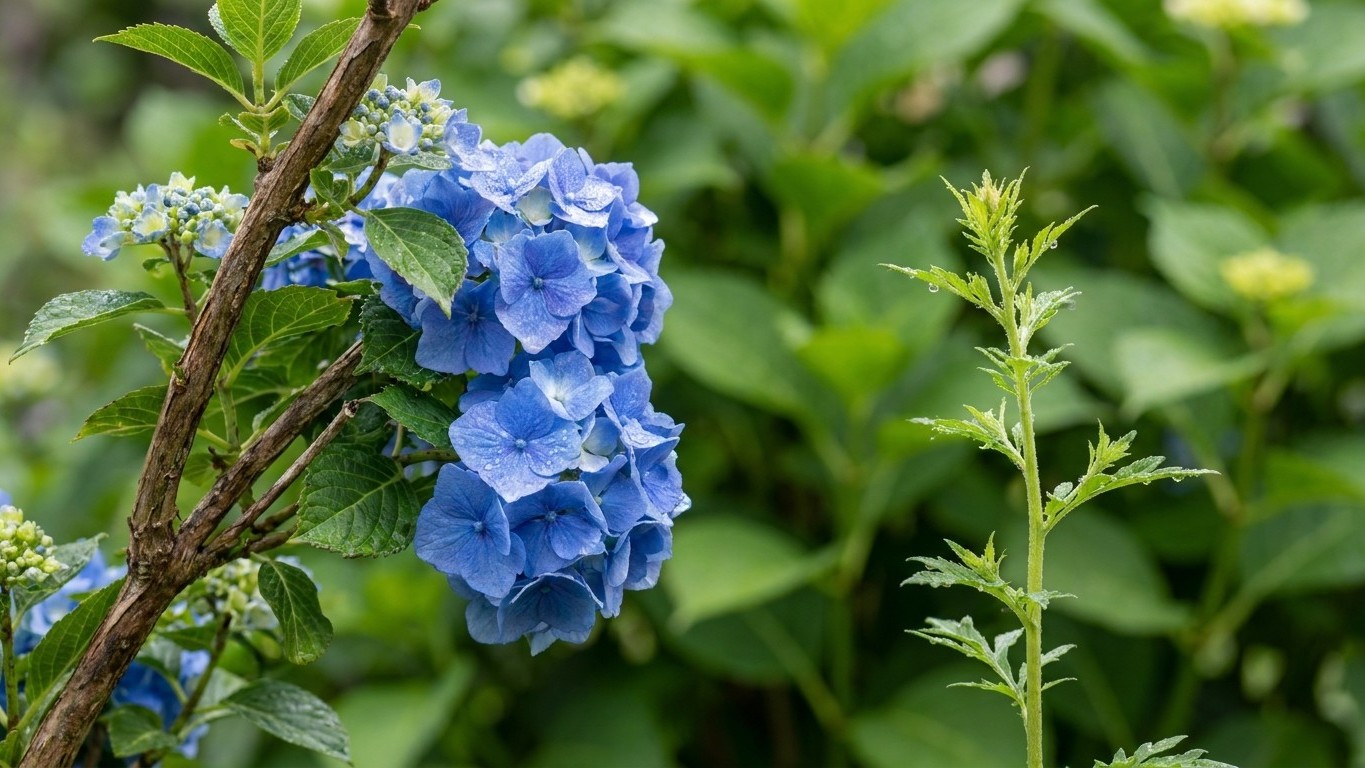

Bigleaf hydrangeas come out pink in much of Michigan because the soil holds too little acid for the roots to take up aluminum, and aluminum is what turns the flowers blue. Lime-rich glacial soil, hard well water and even a concrete foundation all push the pH up. The fix is to lower the pH around the roots and keep aluminum available, starting in spring and sticking with it for a season or more. White varieties stay white either way.
What this comes down to in Michigan

The work starts when growth does: around April 30 in the Detroit area, and early to mid May across most of the Lower Peninsula, once the last spring frost has passed. That is when to begin acidifying the soil, because flower color follows what the roots absorb during the season that comes next.
Why do Michigan hydrangeas turn pink?
Much of the southern Lower Peninsula sits on glacial till, a mix of clay, sand and gravel the ice sheets dragged across the state. A good share of that material contains ground-up limestone, which keeps soil near neutral or alkaline. Add municipal or well water that carries dissolved calcium and magnesium, and every watering nudges the pH higher.
Homes add their own lime. Concrete foundations, block walls and poured walks leach alkaline compounds into the bed beside them. A hydrangea planted against a foundation often runs pinker than the same variety twenty feet out in the yard. Lawn fertilizer matters too. Mixes high in phosphorus tie up aluminum in the soil, so a bed at the edge of a heavily fed lawn can stay pink even when the pH is only mildly high.
What makes a hydrangea flower blue?
The pigment in bigleaf and mountain hydrangea sepals is the same in pink and blue flowers. When aluminum reaches the flower tissue, it binds to the pigment and shifts the color toward blue. Most Michigan soils hold plenty of aluminum already. In acidic soil it dissolves and the roots carry it up. In alkaline soil it stays locked in minerals where the roots cannot reach it.
So the job has two parts: lower the pH, then make sure aluminum is on hand. Only the bigleaf and mountain types respond. Panicle, smooth and oakleaf hydrangeas ignore soil chemistry, so a white Annabelle-style shrub will not turn blue however much sulfur you spread. Check which type you own before you spend money on amendments. The sorting below shows where each flower color usually points.
| Flower color | What the soil is likely doing | What to do |
|---|---|---|
| Clear pink or rose | Alkaline or near neutral, aluminum locked up | Leave it, or acidify slowly if you want blue |
| Purple, or pink and blue on one shrub | Slightly acidic, partial aluminum uptake | Continue acidifying and keep the phosphorus low |
| Clear blue | Acidic, aluminum available | Maintain with yearly sulfur and acidic mulch |
Working it out for your own garden
How do I find out what my soil is doing?
Start with a soil test, because guessing at pH wastes a season. A sample sent to a university lab gives you a reading and a recommendation for the amount of sulfur your soil needs. Heavy clay needs far more than sand to move the same distance. Test the water as well. If the hose or the well delivers hard water, it will undo your work a little at a time.
When do I apply sulfur or aluminum sulfate?
Work from the frost window. The last spring frost usually falls in early to mid May across most of the Lower Peninsula and around April 30 near Detroit. Apply the first round when the leaves are opening, water it in well, and repeat at the intervals the label gives through early summer. Stop by midsummer, so the shrub is not pushing soft new growth when the first fall frost arrives.
Here is a worked case. Say a shrub has bloomed pink for years and the soil test shows alkaline clay. Begin right after the last frost window closes in your area. The flowers that open that summer will shift partway, usually to purple. A clean blue tends to arrive after a full season of acidifying.
Now take the harder case: alkaline clay watered from a hard-water well, planted beside a block foundation. The soil pushes back on every application, and you may be re-treating all season for a muddy purple. This plant is unlikely to finish blue in the ground. Move it to a container with an acidic potting mix and rainwater, or accept pink and enjoy it.
Your toolbox is short:
- Elemental sulfur works slowly, because soil microbes have to convert it to acid. Apply it early in spring, or the previous fall, for the steadiest result.
- Aluminum sulfate acts faster and supplies aluminum directly, but it can burn roots when overapplied. Use the label rate on moist soil and water it in.
- Fertilizer low in phosphorus keeps aluminum from being tied up.
- Acidic mulch such as pine needles or shredded oak leaves helps a little, as a supplement to the other steps.
- Rainwater or collected water gives you a gentler pH than the tap.
What changes across the state
Michigan stretches across a long north-south span and is nearly surrounded by the Great Lakes, so no single answer fits it. USDA hardiness zones run from 4a to 6b in the USDA system, and the reference frost dates above come from the Detroit area. Everything else shifts from there.
In the southeast and much of the southern Lower Peninsula, lime-rich till and hard water make pink the default, and blue takes steady effort. Farther north, soils turn sandier and often more acidic, especially under pine and oak. A hydrangea in those sandy soils may lean blue with little help, and sulfur works faster because sand has little buffering capacity. The trade-off is winter. Colder nights mean frost-damaged flower buds on bigleaf types, and blooms of any color become less dependable. Our guide to protecting hydrangeas through a Michigan winter covers that side.
The lakes also move the calendar. Land close to Lake Michigan stays cooler in spring and holds its warmth into fall, so frost can come later in the season and leaf-out arrives later than it does a few miles inland. Treat the Detroit-area dates as a starting point and watch the shrub itself: begin when buds swell and leaves open, wherever that falls on your calendar.
The mistakes this state punishes

Michigan springs swing between warm and freezing, and several common errors come straight from that pattern.
- Applying aluminum sulfate during a warm spell in March. A few mild days can start leaf growth, and a hard frost often follows. Slow-acting elemental sulfur can go on early, but hold the aluminum sulfate until the soil is thawed and moist and the leaves are opening.
- Applying aluminum sulfate to dry soil or at more than the label rate, which can scorch roots. Moisten the ground first and water the product in.
- Feeding the shrub with a high-phosphorus fertilizer, which locks up aluminum even in acidic soil.
- Planting beside a foundation, a concrete walk or a limed lawn edge, where alkaline leaching keeps pushing the pH back up.
- Pruning at the wrong time. Bigleaf types set next year’s flower buds on old wood, so cutting in spring removes the very buds you were trying to turn blue. The timing is laid out in when to prune hydrangeas in Michigan.
The common thread is patience. Color change takes a full growing season, sometimes two, and a gardener who heavy-handedly doses the soil in one spring usually gets burned roots and a purple shrub. Small repeated applications, checked against a soil test, give a cleaner result.
Checking this against your county
A state-wide frost window is a starting point, and your own yard may run earlier or later. Your county office of MSU Extension can point you to a soil test and help you interpret the results, including a sulfur rate for your soil type. For the broader picture of site, planting and care, see our guide to growing hydrangeas in Michigan.
Common questions
Can I turn a pink hydrangea blue in one season?
Partway, yes. Most shrubs shift to purple after the soil is acidified, and a clear blue usually takes steady treatment.
Will white hydrangeas change color if I acidify the soil?
No. White bigleaf varieties lack the pigment that reacts to aluminum, and panicle, smooth and oakleaf types do not respond to soil pH at all.
Is coffee grounds or vinegar a good way to make hydrangeas blue?
Both give weak, short-lived results. Sulfur or aluminum sulfate at the label rate, backed by a soil test, is more reliable and easier to control.
How do I keep a blue hydrangea blue?
Re-treat every year, keep phosphorus low, mulch with an acidic material and water with rainwater where you can. Alkaline soil and hard water will keep drifting the pH back toward pink.