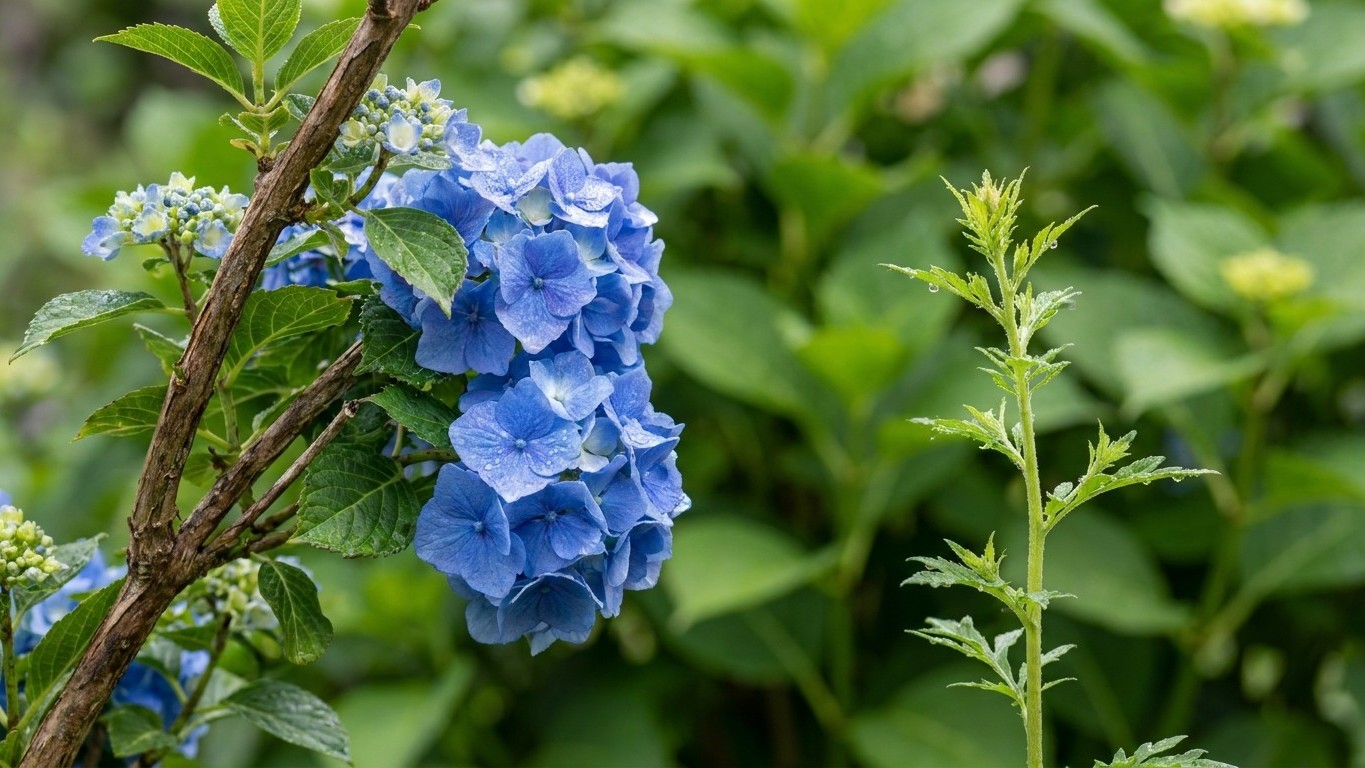

Nearly all hydrangeas survive a Missouri winter as plants. What varies is whether they flower the next summer. Smooth hydrangeas (the Annabelle types) and panicle hydrangeas (the Limelight types) bloom dependably across the state because they flower on stems grown this season. Oakleaf hydrangeas sit in the middle. Bigleaf hydrangeas, the blue and pink mopheads, usually live through winter but often lose their flower buds to a hard cold snap or a late freeze.
What this comes down to in Missouri

At Kansas City International Airport (MCI), the NOAA NCEI 1991-2020 Climate Normals put the average last spring freeze (32°F) in mid-April and the average first fall freeze in late October. A hydrangea that blooms on new wood only has to keep its roots alive through the winter, while one that blooms on old wood has to carry next summer’s flower buds through the whole winter and past the spring freeze as well.
The USDA Plant Hardiness Zone Map, which rates a place by its average annual extreme minimum temperature, runs from 5b to 7b across Missouri. Most hydrangea species are hardy through that whole range, so the plant rarely dies outright. The buds are what get lost. Here are seven cultivars, ordered from the most dependable to the riskiest for flowers.
Annabelle
A smooth hydrangea (Hydrangea arborescens) with big white mophead flowers on stems of the current year. Winter can kill the stems to the ground and it still blooms the following summer. The heavy blooms tend to flop after rain, especially in shade.
Incrediball
Another smooth hydrangea, bred as a sturdier Annabelle with thicker stems that hold the large white flowers upright. It has the same new-wood habit and the same cold tolerance. If a freeze burns back new shoots in April, it simply regrows.
Limelight
A panicle hydrangea (Hydrangea paniculata) with cone-shaped flowers that open lime green, turn white, then fade to pink in fall. It flowers on new wood and takes both cold winters and hot summers. It does best in full sun to part shade.
Bobo
A compact panicle hydrangea, usually about three feet tall, with white flowers that age to pink. Like Limelight, it sets blooms on the current season’s growth, so winter has little say over the show. It suits small yards and large pots.
Snow Queen
An oakleaf hydrangea (Hydrangea quercifolia) with white cone-shaped flowers, leaves shaped like oak leaves and red fall color. It blooms on old wood, but its buds usually come through Missouri winters better than those of bigleaf types. Expect a lighter flower year after an especially harsh winter.
Endless Summer
A bigleaf hydrangea (Hydrangea macrophylla) that blooms on both old and new wood. If winter or a spring freeze takes the old-wood buds, the plant still flowers on new growth, only later in summer. It is one of the more dependable bigleaf choices for Missouri.
Nikko Blue
A classic bigleaf that flowers on old wood only. Winters often leave the stems alive and leafy, but with no buds left to open. It can bloom well after a mild winter and skip a summer entirely after a harsh one.
Working it out for your own garden
The same method works for any hydrangea, though the freeze dates will differ in other places. Start with where the flowers come from, then hold that against the freeze window where you live.
How do you check a hydrangea against a Missouri winter?
First, find out whether the cultivar blooms on new wood, old wood or both. The plant tag or the nursery listing usually says. Second, find the mean last spring freeze and mean first fall freeze for the station nearest you. At MCI those are in mid-April and late October, and they are averages, so a later spring freeze or an earlier fall freeze happens in some years. Third, ask what a freeze at either end does to the part of the plant that makes flowers.
Take Nikko Blue as the worked case. Its flower buds form on stems grown the previous summer and sit exposed all winter. A warm spell in late March wakes them up, and a freeze in mid-April or later burns the swollen buds. The leaves come back from lower on the stem, and the flowers do not. Annabelle faces the same freeze with a different result. Its flowers have not formed yet, so the freeze costs a few new shoots, and the plant grows more and flowers on them. Endless Summer lands between the two: it loses the old-wood buds but flowers late on new growth.
| Cultivar | Type | Blooms on | Winter outcome in Missouri |
|---|---|---|---|
| Annabelle | Smooth | New wood | Reliable flowers |
| Incrediball | Smooth | New wood | Reliable flowers |
| Limelight | Panicle | New wood | Reliable flowers |
| Bobo | Panicle | New wood | Reliable flowers |
| Snow Queen | Oakleaf | Old wood | Usually blooms, lighter after hard winters |
| Endless Summer | Bigleaf | Old and new wood | Blooms, sometimes late |
| Nikko Blue | Bigleaf | Old wood | Often leafy with no flowers |
How can you tell if a hydrangea survived the winter?
Bare stems in April prove nothing. Scratch a thumbnail across a stem: green underneath means it is alive, and brown and dry means that stem is dead. Then wait until leaves open along the stems, ideally after the usual last spring freeze has passed, before you cut anything. Old-wood types in particular can look dead for weeks and then leaf out from the middle of the stem. The When to Prune Hydrangeas in Missouri guide covers the cutting schedule for each type.
What changes across the state
Missouri stretches a long way from north to south, and winter does not hit evenly. The colder end of the 5b to 7b range is in the north, where bigleaf buds are at their least dependable. The milder end is in the far south and southeast, where bigleaf hydrangeas flower more often and oakleaf types hold their buds more easily.
The MCI window is a starting point rather than a statewide rule. That station sits about 15 miles northwest of downtown, and the downtown area tends to run earlier in spring. Southern Missouri is milder still, so a gardener there may see leaf-out earlier. Earlier leaf-out cuts both ways, since tender growth meets any late freeze sooner.
Terrain shifts things inside each region. Cold air is heavy and drains downhill, so a hydrangea at the bottom of a slope or in a hollow can get frost that never touches the same shrub fifty feet uphill. Wind matters too: bigleaf stems on an open, windy side of the house dry out and die back more than the same plant tucked against a wall. Cities add a little warmth from pavement and buildings, which helps a shrub next to a foundation.
For a gardener in the northern counties, the safe path is to build the display around smooth and panicle types and treat bigleaf as a bonus. Farther south, bigleaf cultivars become a fair bet, especially in a sheltered spot.
The mistakes this state punishes

Missouri springs swing hard. A run of 70-degree days in March can be followed by a freeze in April, and the plants that suffer are the ones that moved too early. Pulling winter mulch off bigleaf hydrangeas at the first warm spell invites exactly that. Leaving it until the usual last spring freeze has passed gives the buds a cushion. The Protecting Hydrangeas Through a Missouri Winter guide covers mulch depth and wrapping.
Buying for the picture on the tag is the second mistake. Nikko Blue and similar old-wood bigleafs promise blue mopheads, but a gardener in the colder north may see that color only in mild years. A reblooming cultivar such as Endless Summer, or a switch to a panicle type, gives much better odds of flowers every summer.
Cutting at the wrong time is the third. Smooth and panicle hydrangeas can be cut hard in late winter because they flower on new wood. Old-wood types cut in fall or early spring lose the very buds they were holding. When in doubt about a bigleaf or oakleaf, leave it alone and remove only stems you have confirmed are dead.
Late feeding is the fourth. Nitrogen applied in late summer pushes soft, leafy growth just before the first fall freeze, which at MCI averages in late October. That growth does not harden off in time and dies back over winter. Stop fertilizing by midsummer and let the stems firm up on their own.
Checking this against your county
Dates for Kansas City International Airport are a starting point, not an instruction for every yard in the state. Your county’s frost dates, soil and exposure can all differ. Your county office at University of Missouri Extension can tell you what local gardeners see each winter and which cultivars hold their buds in your area. For the broader picture of site, soil and care, see the state guide to growing hydrangeas in Missouri.
Common questions
Will Annabelle die back in a Missouri winter?
Often the stems die back partly or fully, and that is fine. The roots survive and send up new shoots in spring, and the flowers form on those shoots. A hard cut in late winter tidies the plant and leaves flowering unaffected.
Can bigleaf hydrangeas grow in Missouri?
Yes, as plants they usually live through the winters. Flowering is the uncertain part, because old-wood cultivars can lose buds to a cold winter or a spring freeze. Reblooming bigleafs, a sheltered planting spot and a layer of mulch improve the odds.
Are oakleaf hydrangeas hardy in Missouri?
They are generally hardy across the state. Their buds also tend to come through winter better than those of bigleaf types. They still bloom on old wood, so a very hard winter can thin the display.
Do hydrangeas need winter protection in Missouri?
Smooth and panicle types need little beyond ordinary mulch, since their flowers form on new growth. Bigleaf and oakleaf types benefit from mulch around the base and a spot out of the wind. Plants in their first winter are more vulnerable, whatever the type, because their roots are not yet established.