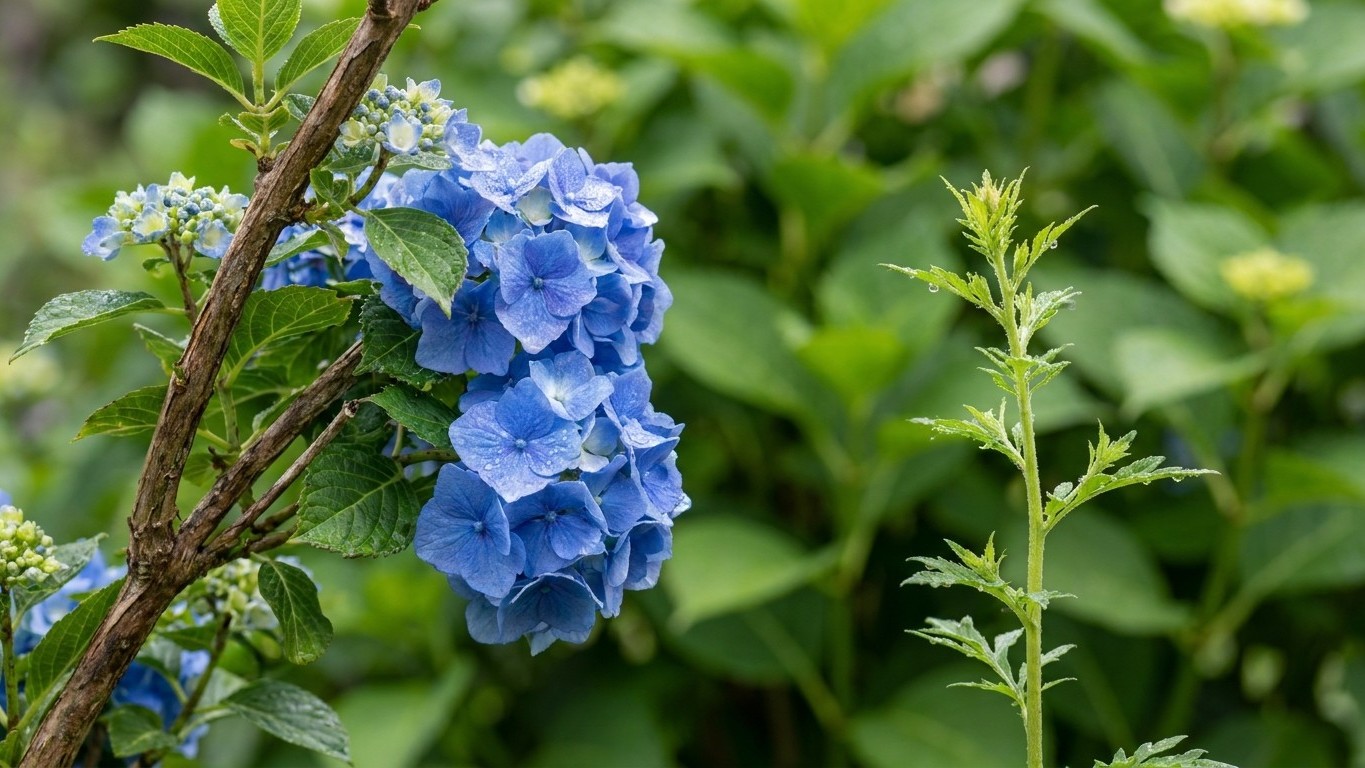

Smooth hydrangeas and panicle hydrangeas are the safe bets. They bloom on the current season’s growth, so a hard winter rarely costs you the flowers. Bigleaf types that bloom on last year’s wood are the gamble: the buds often die above the snow line. The reference city here is Moncton, in Canadian hardiness zone 5a (some sources list Moncton as 5b, so check the current map; a Canadian rating does not convert to a USDA zone). Below are named cultivars, a way to check them against your own garden, and common mistakes.
What this comes down to in New Brunswick

At the Moncton station, the last spring frost falls on average May 23 and the first fall frost on average October 2. Those are midpoints, not safe dates. Frost lands later than May 23 in one year out of two, and in one year out of two the first fall frost arrives earlier than October 2. The reference station has about 130 frost-free days between the two means.
That window decides two things. A shrub that flowers on new wood has to grow its stems and open its buds inside it, which these hydrangeas do easily. A shrub that flowers on old wood has already set its buds the previous fall, so it has to carry them through winter. Where the Canadian zone is 5a, with cold snaps and uneven snow cover, that is where bigleaf hydrangeas often fail. The plant itself usually survives and leafs out; the flowers are what disappear.
The cultivars below run from the most to the least reliable in a cold garden. Zones quoted are catalogue ratings, and many catalogues use the USDA system, so check which scale a plant tag uses before comparing it to the Canadian zone 5a of Moncton.
Annabelle
A smooth hydrangea (Hydrangea arborescens), a reliable choice for a cold garden. It carries white pom-pom flowers that open pale green, on new wood. Even if a hard winter kills the stems to the ground, it regrows and blooms the same summer, which makes it among the most dependable choices here. The stems flop after heavy rain.
Incrediball
Also a smooth hydrangea, with white flowers on new wood. Its selling point is stiffer stems that hold the big blooms upright. It has the same winter reliability as Annabelle, with less staking.
Quick Fire
A panicle hydrangea (Hydrangea paniculata), and one of the earliest of its group to open. The white flowers age to pink and then deep rose-red, on new wood. The early start gives it a head start before fall frost, which suits a short season.
Limelight
A panicle hydrangea. The flowers open lime green, fade to white, then blush pink in fall, all on new wood. It begins in midsummer and keeps going into autumn, so it needs a little more of the season than Quick Fire but fits the window comfortably.
Endless Summer The Original
A bigleaf hydrangea (Hydrangea macrophylla), blue or pink depending on soil acidity. It flowers on both old and new wood. In a cold winter the old-wood buds die, and the new-wood flowers come late in summer. Expect fewer blooms and a later show, and see Protecting Hydrangeas Through a New Brunswick Winter if you want to try it.
Nikko Blue
A classic bigleaf, blue in acid soil and pink in alkaline soil. It flowers on old wood only, so its flowers depend on buds surviving the winter. In zone 5a conditions, flower buds above the snow line are often killed, so many seasons bring leaves and no flowers. It is a clear example of a variety that does not suit the region.
| Cultivar | Type | Blooms on | Fit for zone 5a (Canadian) |
|---|---|---|---|
| Annabelle | Smooth | New wood | Very reliable |
| Incrediball | Smooth | New wood | Very reliable |
| Quick Fire | Panicle | New wood | Reliable |
| Limelight | Panicle | New wood | Reliable |
| Endless Summer The Original | Bigleaf | Old and new wood | Uneven, needs shelter |
| Nikko Blue | Bigleaf | Old wood | Poor |
Working it out for your own garden
A list of names goes stale when you move or when a winter runs colder than usual. The method lasts longer: match the bloom habit to the length of your growing season, then test the result on your own plants.
How do you check a cultivar against the frost window?
Start with the window, not the date. The last spring frost averages May 23, so frost can still come in early June. Planting a shrub from a pot after that risk has passed puts it in the ground from late May into mid June. The first fall frost averages October 2, so frost can arrive in late September in a cold year.
Now take Limelight. Catalogues list it as opening in midsummer, which in this climate means roughly July to early August. Plant it from late May to mid June, and watch for the first flowers. That leaves a good stretch of growing season before the earliest likely fall frost. Even if a cold spring pushes the bloom back a few weeks, it still opens ahead of the frost. Limelight passes the test.
Now run the same arithmetic for Nikko Blue. Its flowers do not depend on this summer’s growth at all. They depend on buds formed the previous season, which then had to survive the winter. Count backwards and the problem is not planting date; the plant needs those buds alive in May. A gardener whose bush leafs out with no flowers has hit the line. Planting earlier changes nothing, because the loss happens during the winter.
How do you tell whether winter killed the buds?
Wait for leaves. Old-wood buds that survived swell and show green tips in spring, and dead ones stay dry and shrunken. Scratch a stem with a thumbnail: green underneath means alive, brown means dead. Do not cut anything until you can see where growth starts, which is why When to Prune Hydrangeas in New Brunswick matters as much as the variety you chose.
What changes across the province
Moncton sits in the southeast, and the province is not a single climate. Coastal districts along the Bay of Fundy stay cooler in summer and milder in the depths of winter, with fog that delays spring warm-up. Spots right by cold water can warm later than inland gardens in spring, although the water often delays the first fall frost.
The Saint John River valley behaves differently. Its low ground and sheltered slopes often warm earlier and hold more summer heat than the coast, which helps a longer-season cultivar. But cold air also drains downhill on clear nights and pools in the valley floor, so frost pockets form in low gardens even where the surrounding hills stay clear.
Northern and upland districts can run weeks behind the Moncton station. Higher elevation shortens the season at both ends and brings deeper cold, so a plant rated for zone 5a may behave like a colder-zone plant on an exposed hill. Smooth and panicle hydrangeas still do well there, since they flower on new wood, while bigleaf types become a poor bet.
Snow cover changes the picture inside every region. A steady blanket insulates the lower stems and the crown, while a bare, windy site loses that protection even in a mild district. A garden with reliable snow can sometimes carry a marginal bigleaf where a neighbor on a windswept lot cannot. For winter protection that works with this, see Protecting Hydrangeas Through a New Brunswick Winter.
The mistakes this province punishes
A costly error is buying a bigleaf because the garden center tag shows a pretty blue flower. Those tags describe the plant in a gentler climate. If the plant is old-wood only and rated for a warmer zone, expect leaves and few flowers. Choose a smooth or panicle type for dependable bloom, and treat any bigleaf as a bonus.
The second mistake is planting after a warm spell in April or early May. The weather feels settled, but May 23 is only the midpoint, and in one year out of two the last frost falls later. New growth that has leafed out is tender and a late freeze blackens it. Wait until the risk has passed, or keep a sheet or box ready for cold nights.
Third, cutting back too early. Gardeners tidy up in March, then discover they cut off the buds of an old-wood hydrangea. Wait until leaves show where the living wood is, then prune. New-wood types can be cut harder, and they bloom on whatever grows back.
Fourth, ignoring fall frost. A late-blooming variety planted in midsummer may not get enough growth before cold arrives. If you buy a young plant in July or later, give it a mulch collar and keep it watered into fall so it enters winter with roots established. Fall feeding pushes soft growth that frost damages, so skip the nitrogen after midsummer.
The general principles for planting and care are in growing hydrangeas in New Brunswick.
Checking this against your county
A reference-city number is a starting point. Your garden may run a week or more earlier or later, depending on elevation, nearby water and shelter. Look up your municipality on the Natural Resources Canada plant hardiness site for its zone, and ask your local agricultural office or Agriculture and Agri-Food Canada where to find regional guidance. Local nurseries also know which hydrangeas have come through recent winters in your district. The province’s hydrangea guide covers the rest.
Common questions
Which hydrangea is the hardiest in New Brunswick?
Smooth hydrangeas such as Annabelle and Incrediball are among the toughest. They are typically rated down to USDA zone 3, bloom on new wood, and regrow from the ground after a severe winter. Panicle types such as Quick Fire and Limelight come very close.
Will a blue bigleaf hydrangea survive?
The plant often does, but the flowers are the problem. Old-wood buds get killed in a cold winter, so many seasons produce foliage only. Reblooming types such as Endless Summer The Original do better, since they can flower on new wood, though late and lightly.
Is Canadian zone 5a the same as USDA zone 5?
No. The Canadian system uses seven climate variables, while the USDA system uses one, and Natural Resources Canada states that the two do not convert simply. When a catalogue lists a zone, check which system it uses.
When can I plant hydrangeas without risking frost?
No date is safe. The last spring frost averages May 23 at Moncton, and in one year out of two it falls later. Plant after the risk has passed, usually late May to mid June, and watch the forecast for cold nights.