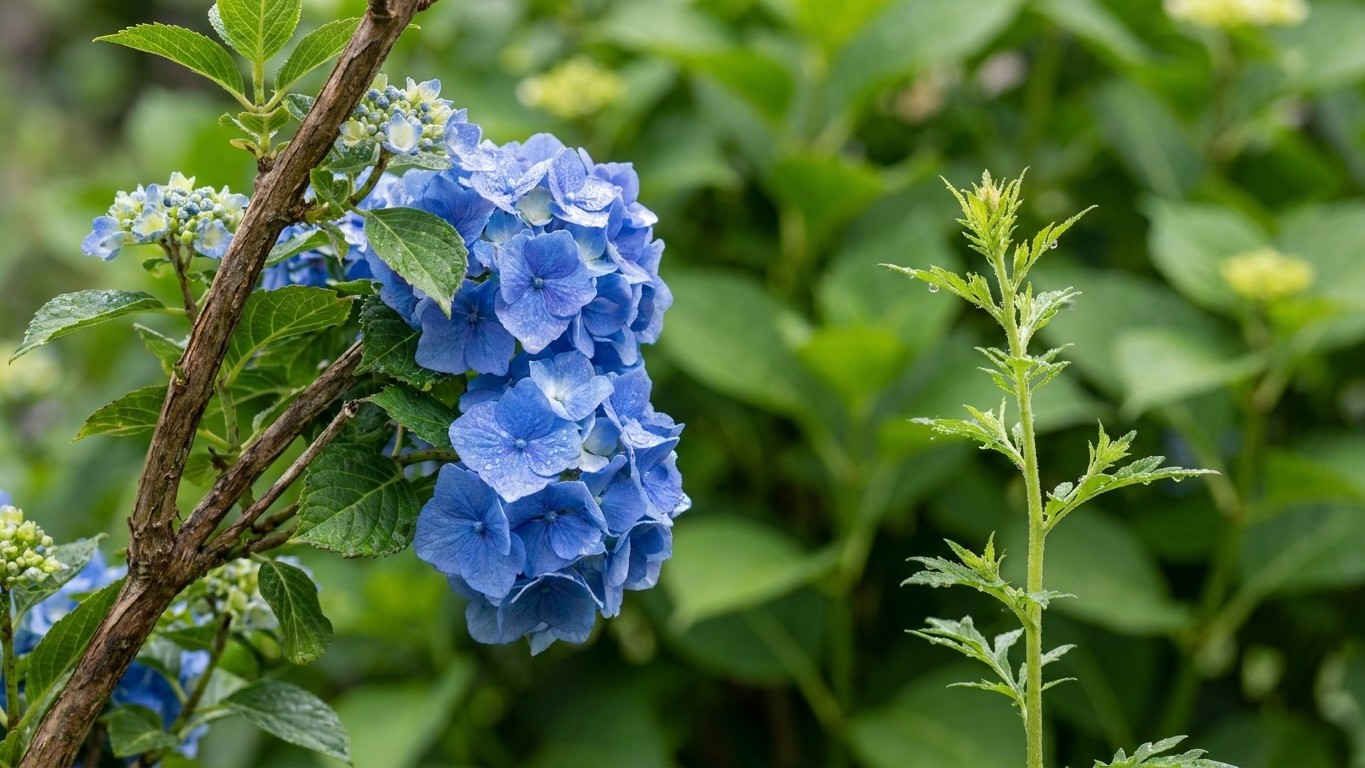

Prune hydrangeas that flower on new wood in late winter or very early spring, before the buds swell. Prune the ones that flower on old wood within a few weeks after the blooms fade. In Nova Scotia that usually means late March to mid April for the first group, and July to early August for the second. A cut at the wrong time costs you a season of flowers.
What this comes down to in Nova Scotia

At Halifax Stanfield, the reference station, the last spring frost falls on average May 7 and the first fall frost on average October 18, and the pruning year fits inside that window. Both dates are midpoints: in one year out of two the last frost comes later than May 7, and in one year out of two the first fall frost arrives before October 18. The station averages about 164 frost-free days between the two.
Which hydrangeas flower on old wood and which on new wood?
The difference is when the flower buds form. Bigleaf and oakleaf hydrangeas set next summer’s buds on stems grown this year, from late summer into fall. Cut those stems in winter or spring and the flowers go with them. Smooth and panicle hydrangeas grow their flowers on shoots that emerge in spring, so a late-winter cut only decides how many stems you get and how sturdy they are.
| Type | Flowers on | When to prune | How much |
|---|---|---|---|
| Smooth hydrangea | New wood | Late March to mid April | Down to a low framework, or by half |
| Panicle hydrangea | New wood | Late March to mid April | By about a third |
| Bigleaf (mophead, lacecap) | Old wood | Right after bloom, by early August | Spent flowers and a few of the oldest stems |
| Reblooming bigleaf | Old and new wood | After the first flush, by early August | Dead wood and spent flowers only |
| Oakleaf hydrangea | Old wood | Right after bloom | Light shaping |
How does the Halifax frost window shape the dates?
Halifax falls in Canadian hardiness zone 6 (6a or 6b, depending on the map edition and the exact spot), according to Natural Resources Canada. That is a Canadian zone, and it does not convert to a USDA zone, because the Canadian system weighs seven climate variables instead of one. Winter dieback on bigleaf stems is common in this climate. That is why spring pruning of old-wood types waits until buds open and you can see which stems are alive. For the rest of the growing basics, see growing hydrangeas in Nova Scotia.
Working it out for your own garden
Dates from a weather station will not travel well if you move or hit a cold year. A method will. The calendar comes from two midpoints, May 7 and October 18, and a bit of counting.
How do you count back from the frost dates?
Start with the fall cutoff for old-wood types. New growth forced by a late cut needs time to harden before frost, and the buds for next year form in late summer. Count back eight to ten weeks from a mid-October first frost and you land in mid to late August. Stopping by early August leaves a margin on top of that. Finish pruning old-wood hydrangeas by early August, and sooner if a cold, early fall looks likely.
Now the spring side. For new-wood types, count back four to six weeks from a May 7 last frost and you get late March to mid April. That is a good window for a smooth or panicle hydrangea, because the plant is still dormant and the cut heals as growth starts. Keep a margin, because the last frost lands after May 7 about half the time. Pruning a dormant shrub does not trigger growth by itself, so a late frost does little harm to a plant cut while it is still fully dormant.
Here is a full example. A smooth hydrangea such as Annabelle flowers on new wood. Cut it in early April to a low framework, and it makes fresh shoots in May and blooms in summer. A bigleaf that flowers in mid July should be pruned in late July or the first days of August. Wait until late September and you have removed next year’s flower buds. Any new growth the cut triggers will still be soft when the October 18 midpoint frost arrives, and the plant will not bloom the following summer.
How do you tell which hydrangea you have?
Check the flowers and leaves first. Cone-shaped flower heads mean a panicle type. Large round white heads on a shrub that is cut back hard each year are usually a smooth type. Glossy, rounded leaves with big mophead or flat lacecap flowers mean bigleaf. Oak-shaped leaves with a long white cone of flowers mean oakleaf. If a plant came with the house and you cannot tell, hold off pruning until it has flowered. Remove only dead wood in spring, then note the month it blooms.
What changes across the province
Halifax is a coastal station, so it is a starting point, not a rule for the whole province. Nova Scotia is a long peninsula with ocean on three sides, and the sea slows spring. Cold water along the Atlantic shore holds back warming, and fog can keep a garden cool well into May. Buds break later there than they do a short drive inland, even though winter lows stay milder.
Do inland and upland gardens prune later?
Yes. Upland districts and the north of the province often run later than Halifax in spring and see frost earlier in fall. For you that means shifting the whole calendar. Spring pruning of new-wood types moves later, and the August cutoff for old-wood types moves earlier. Cape Breton’s highlands sit at the extreme end of that shift. Sheltered spots such as the Annapolis Valley warm sooner, though their hillsides and low pockets still catch late frosts.
What does winter snow cover change?
Snow insulates the base of the plant. Where snow lies deep all winter, stems below the snowline often come through alive even when the tops die back. Along the coast, snow comes and goes with thaws, and stems are more exposed. Dieback is therefore more common on bigleaf plants in open, windy sites. Choosing a type that tolerates the cold is a separate decision, covered in which hydrangea types survive in Nova Scotia.
The mistakes this climate punishes
Many pruning failures in Nova Scotia come from a handful of habits. They are easy to avoid once you see how the season works.
What goes wrong in spring?
A common error is a spring tidy-up on a bigleaf. The shrub looks like a clump of bare sticks in April, so someone cuts it to the ground. That removes every flower bud, and the plant sulks all summer with leaves and no blooms. Wait for leaves, then cut only what is dead.
A second mistake is pruning on the first warm spell. A mild week in March can look like the start of spring, but cold often returns well into May. If you cut a new-wood hydrangea during a warm spell and a hard cold snap follows, the fresh cut ends can be damaged. Prune while the plant is still fully dormant, and work from the cold side of the window.
What goes wrong in summer and fall?
Late pruning of old-wood hydrangeas is the other big one. Many gardeners cut in September or October, when they finally have time for garden chores. By then the next year’s buds are set. Cutting them off means no flowers, and any tender regrowth meets the first frost in mid October, on average, with little time to toughen. Make the summer cut right after the blooms fade, and leave the fall for raking.
Pruning to change flower color does not work either. Cutting stems has no effect on bloom color, which depends on soil chemistry. See soil pH and hydrangea color in Nova Scotia for that.
Checking this against your county
A single station’s frost dates are a starting point for your garden, not an instruction. Your own site may run a couple of weeks ahead or behind, depending on its slope, shelter and distance from the water. Local agricultural advisors and the Nova Scotia Department of Agriculture can give you local timing and advice. Cross-check their guidance with the province-wide guide to growing hydrangeas in Nova Scotia.
Common questions
Can you prune hydrangeas in fall in Nova Scotia?
Only to remove dead or broken stems, or spent flower heads on types you want tidy. Fall cuts on bigleaf and oakleaf types remove next year’s buds. Fall cuts on any type can push tender growth right before the first frost, which averages October 18 at Halifax Stanfield.
What if a hydrangea shows no new growth by late May?
Give it more time, especially bigleaf types and plants in cold spots. Scratch a stem to check for green under the bark. If there is green, the stem is alive and will leaf out. If a stem is dry and brown to the base, cut it out. If the whole plant is brown, wait another couple of weeks before you give up on it.
How hard can you cut back a panicle hydrangea?
Cut it back by about a third each late winter to keep the framework strong and the flower heads from flopping. Panicle hydrangeas bloom on new wood, so a harder cut will still flower, though the stems will be fewer and the plant shorter. Leave at least a few pairs of buds on each stem you keep.
Does pruning change the color of hydrangea flowers?
No. Pruning changes the number and size of blooms, and in the case of old-wood types it decides whether there are any at all. Bigleaf flower color follows soil acidity and the aluminum available to the roots, so that is where to look if you want blue or pink.