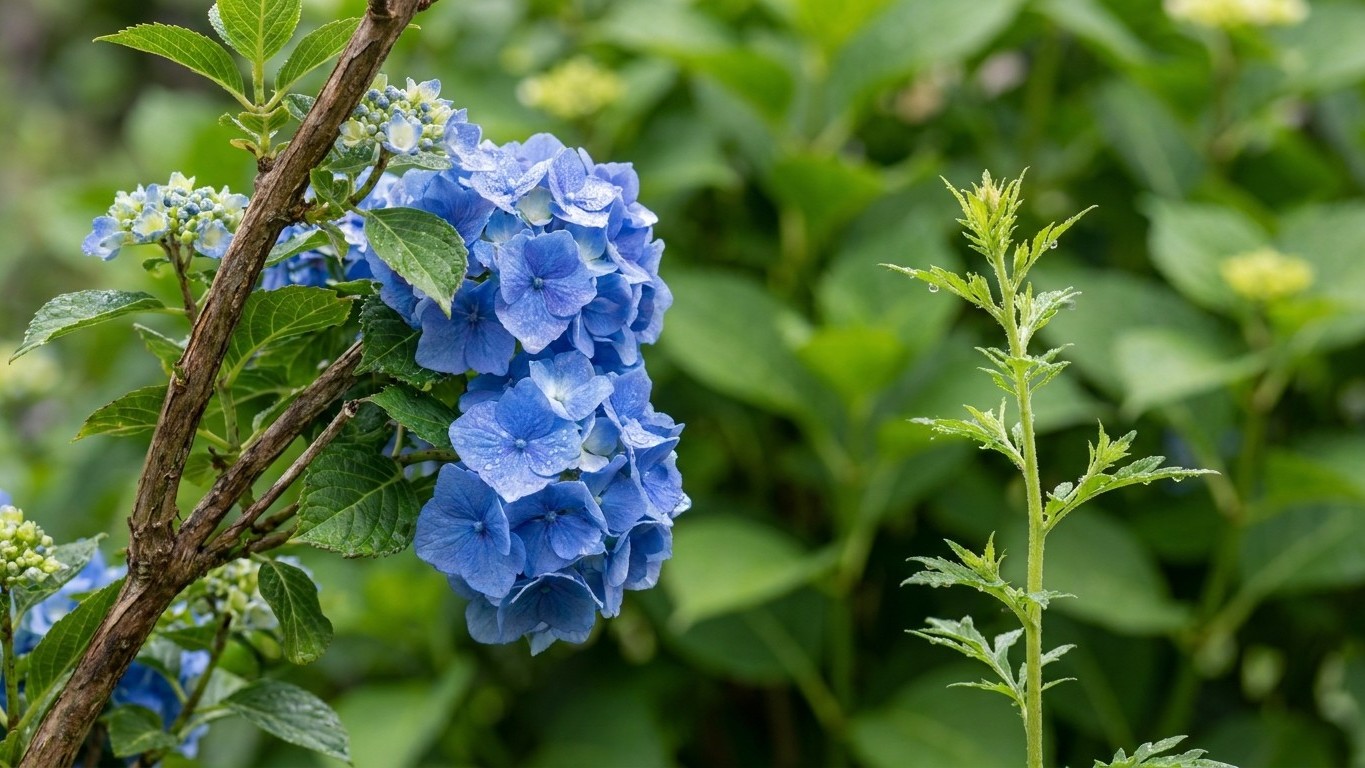

Hydrangeas turn pink in South Dakota because most garden soil here sits at neutral to alkaline pH, and that chemistry keeps aluminum out of the plant’s reach. Blue flowers need aluminum inside the plant. On bigleaf hydrangeas you can shift the color by acidifying the soil around the roots, but it takes a full season of steady work, and some hydrangeas will never change at all. A soil test comes before any product.
What this comes down to in South Dakota

Pink is the default color here because the soil’s pH, not the plant, controls the pigment, and the work of changing it begins once spring freezes are behind you. At Sioux Falls, the reference city for these dates, NOAA’s 1991-2020 climate normals put the last 32 F freeze between April 29 and May 9, and the first fall freeze between September 24 and October 4. Everything below fits inside that window, and gardens outside town can differ by a week or two on both ends.
What makes a hydrangea pink or blue?
The flower pigment is the same in both colors. It turns blue when it binds with aluminum that the roots have absorbed. Aluminum dissolves into a form roots can take up when soil pH is around 5.5 or lower. Above roughly 6.5, it locks into compounds the plant can’t use, and the flowers go pink. Between the two you get purple, or a mix of pink and blue on one shrub.
Why does South Dakota soil lean toward pink?
Much of the state’s soil formed over glacial deposits and prairie sediments rich in free lime, which keeps pH neutral to alkaline. Rural wells often deliver hard water full of dissolved calcium and carbonates, and every watering with it nudges pH higher. Even a bed you acidified last year drifts back. Concrete foundations also leach lime into the nearby soil, so a hydrangea planted against a house wall starts off with a pH advantage for pink.
Which hydrangeas can change color?
Only bigleaf hydrangeas (Hydrangea macrophylla) and the closely related mountain hydrangeas (Hydrangea serrata) respond to soil chemistry. Panicle types, smooth hydrangeas such as Annabelle, and oakleaf hydrangeas keep their white or cream-to-pink shades no matter what you add. White bigleaf cultivars don’t turn blue either, because they lack the pigment to begin with. Buying a plant tagged blue or pink in the nursery is a start, but the label tells you only the color the plant had in that nursery’s potting mix.
For the broader basics on siting, watering and winter protection, see our guide to growing hydrangeas in South Dakota.
Working it out for your own garden
Start with the soil, not the shrub. Take a sample from the top 6 inches under the plant’s drip line and either use a reliable pH kit or send it to a private soil-testing lab (SDSU Extension keeps a list of labs). If the result is 6.5 or above, you are in pink territory. A reading near 5.5 means blue is already possible, and you should look at the plant’s variety before blaming the soil.
Next, figure out how far the pH has to move. Dropping from 7.5 to 5.5 is a much bigger job than dropping from 6.5, and in the state’s limy soils it can be more than a bed in the ground will hold. If the test reads well above neutral, plan on growing the shrub in a large container, or in a raised bed filled with an acidic mix, instead of fighting native soil.
Then match the timing to the frost window. Aluminum sulfate works best when the plant is putting on new growth, so begin once leaves are open and the last spring freeze has passed. At Sioux Falls that means early to mid-May. Dissolve it in water at the label rate (a common rate is 1 tablespoon per gallon), soak the soil around the plant, and repeat every few weeks through early summer. Stop well before the first fall freeze window, because late-season growth is soft and needs to harden off for winter.
Example: a reblooming bigleaf cultivar
Take Endless Summer, a widely sold bigleaf that blooms on both old and new wood. In a South Dakota garden at zone 4b or 5a, it sends up new shoots after spring and produces flowers from early summer on, even if cold killed the older buds. Color is set as each new bud forms, so aluminum applications beginning in May reach the buds as they develop. Expect the first flush to look mixed and later flushes to run bluer.
Example: a marginal old-wood cultivar
Nikko Blue is a classic that sets flower buds only on old wood. In much of South Dakota, winter often kills those buds, and the shrub leafs out green with no flowers at all. Making the soil acidic doesn’t help if there are no blooms to color. In the colder parts of the state, a reblooming type is the realistic route to blue.
What changes across the state
A South Dakota garden near the Minnesota line, one on the plains west of the Missouri River, and one in the Black Hills live in different worlds. The USDA Plant Hardiness Zone Map, which rates zones by average annual extreme minimum temperature, runs from about 4a to 5b across the state. Bigleaf hydrangeas lean on the warmer end of that range for dependable blooms, and the colder north and the high country are where old-wood types fail most often.
Soil shifts too. Eastern South Dakota’s deep glacial soils tend to be neutral to alkaline. West of the Missouri, many soils are derived from shale and sediments that are also alkaline and often heavy clay, which makes acidifying even slower. The Black Hills are the exception. Forest soils under pine are naturally more acidic, so a hydrangea tucked into a woodland-style bed there may start closer to blue before you add anything. Elevation, though, shortens the season and sharpens winter, so the same bed that favors blue can be too cold for a marginal variety.
Water matters at both ends of the state. Municipal water can also be fairly hard depending on the source, and private wells in rural areas can be quite hard. Rainwater, if you can collect it, is acidic compared with either, and it’s one of the easiest ways to stop pushing pH back up.
The mistakes this state punishes

The first is applying aluminum sulfate too early. A warm spell in April can tempt you to start, but a late freeze after leaf-out can still kill the buds and new shoots. Wait for the last-frost window at your own location. Another is overdosing. Aluminum sulfate can burn roots, and heavy-handed applications on dry soil are a common cause. Water the bed well first, use the rate on the label, and spread the doses over several weeks.
Using the wrong fertilizer undoes your work. High-phosphorus fertilizers tie up aluminum in the soil, so choose a low-phosphorus, higher-potassium formula. Lime and wood ash push pH up. Pine bark or shredded oak leaves are safer choices.
Planting a panicle or smooth hydrangea and expecting blue is a waste of a season. So is planting an old-wood bigleaf in a cold corner of the state and judging it only by color. Finally, trying to change color with one application and giving up is common. Soil acidity changes slowly, and a full season or two is the usual timeline. Sulfur is slower still, working over months, so apply it the fall before.
Checking this against your county
The Sioux Falls dates are a reference point. Your own last and first freezes can differ by a week or two, and more at elevation or in open rural ground. A county Extension office can help you with your local soil type and point you to labs that test soil pH. Your state’s own resources, including South Dakota State University Extension, can fill in the rest of your plan.
Common questions
How long does it take to turn a pink hydrangea blue?
Plan on a full growing season at minimum, and often two. Flower color follows the soil chemistry at the time buds form, so a change you make this spring may show on later blooms or next year’s flowers.
Can I grow blue hydrangeas in a pot?
Yes, and it’s the easiest route in South Dakota. A container with an acidic potting mix lets you control pH from the start. Water with rainwater when you can, and use a low-phosphorus fertilizer.
Will white hydrangeas or Annabelle turn blue?
No. White bigleafs lack the pigment, and smooth, panicle and oakleaf hydrangeas don’t respond to soil pH at all.
Can I turn a blue hydrangea back to pink?
You can. Garden lime raises soil pH and shuts off aluminum uptake. In South Dakota’s alkaline soils, a blue bed left alone will often drift back toward pink anyway.