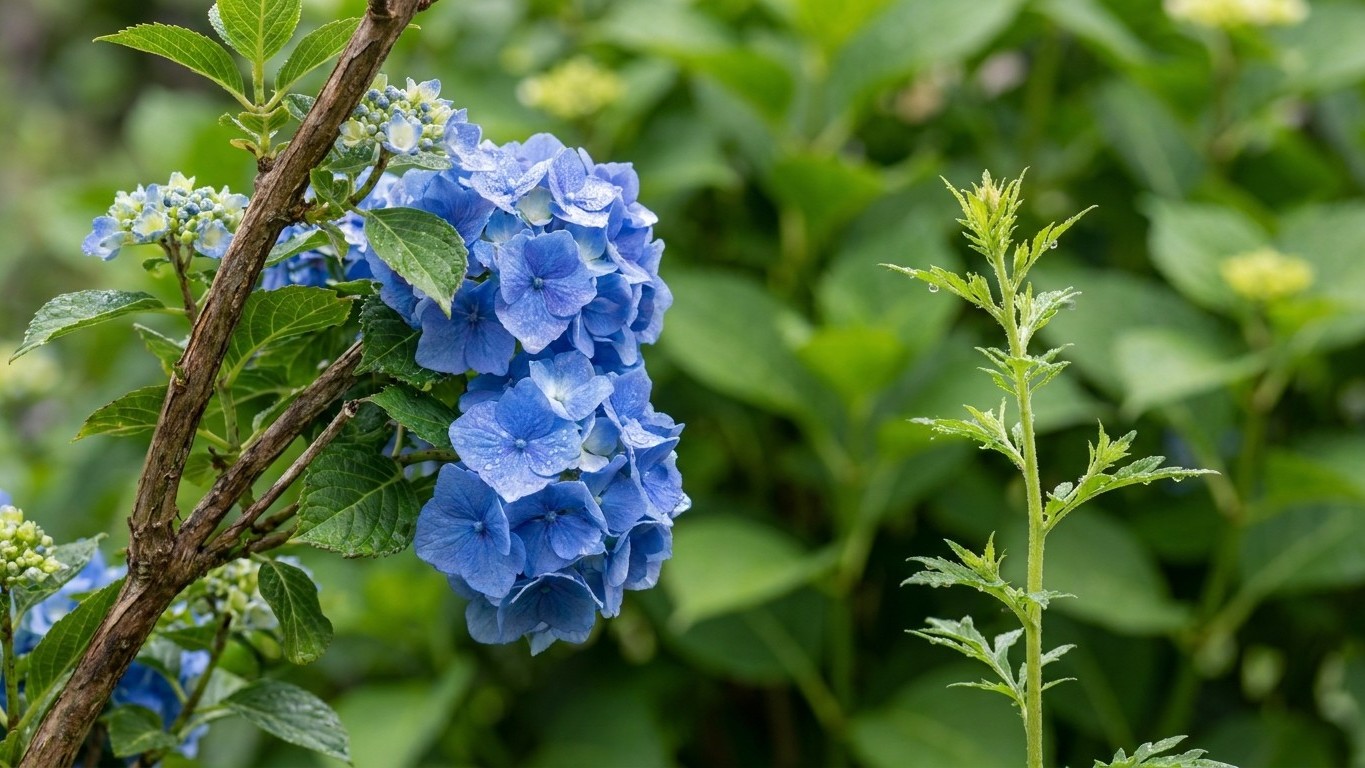

In Yukon, prune hydrangeas in late spring, once the buds swell and you can see which stems survived winter. Cutting in fall or early winter is the habit to drop. The growing season is too short for regrowth to harden, and stems left standing catch snow that protects the buds below. Dead wood is the only thing worth cutting on sight, and everything else waits until you can see green.
What this comes down to in Yukon

At Whitehorse, where the mean last spring frost falls in early to mid June (published figures run from about June 5 to June 12) and the mean first fall frost comes around August 24 or 25, hydrangea pruning belongs in a short spring window after bud swell and before the shrub starts pushing new shoots in earnest. Nothing gets cut after midsummer. Those two dates are means: in one year out of two, the last spring frost falls later than the mean date, and in one year out of two the first fall frost arrives earlier than the mean date. Treat them as the middle of a window.
The Whitehorse station has roughly 70 to 80 frost-free days between those two dates. Whitehorse sits in the lowest Canadian hardiness zones (published maps and sources give anywhere from 0b to 1b), a Canadian rating built on seven climate variables that does not convert exactly to a USDA zone. A shrub rated for a given USDA zone has no guaranteed match here, so the plant’s own behavior after winter is a better guide than any zone label.
That short season makes the type of wood your hydrangea flowers on the deciding factor. Hydrangeas bloom either on old wood (stems that grew last year and carry flower buds through winter) or on new wood (stems that grow this spring). Old-wood bloomers lose flowers when winter kills the stems or when you cut them. New-wood bloomers can be cut hard in spring, but the shoots then have only the frost-free stretch to grow and open flowers.
The table sorts the common groups by what they flower on and when the cut belongs.
| Type and example cultivars | Flowers on | When and how to cut in Yukon |
|---|---|---|
| Panicle hydrangea (Limelight, Bobo) | New wood | Spring, once buds swell. Remove dead tips and shorten to live buds. |
| Smooth hydrangea (Annabelle) | New wood | Late spring. Dead stems come out at the base, live ones can be shortened. |
| Bigleaf hydrangea (Endless Summer) | Old and new wood | Late spring. Remove only stems that show no live buds. Skip shaping cuts. |
Bigleaf types are the group most likely to lose stems to the snowline in a climate this cold. For them, a pruning shear mostly serves to clear winter damage rather than to shape the plant.
Working it out for your own garden
Start by identifying what you own. A plant tag or the nursery receipt usually gives the species. If it is gone, panicle hydrangeas have cone-shaped flower heads, smooth hydrangeas have round white heads on thin stems, and bigleaf types have large glossy leaves with either mop or flat lacecap heads. Once you know the group, the table above gives the rule. The next step is checking what survived the winter.
How do you tell live stems from dead ones?
Scratch the bark of a stem with a thumbnail. Green tissue underneath means the stem is alive, while brown and dry means it is dead. Another check is to bend a stem gently: live wood flexes, and dead wood snaps with a dry crack. The most reliable check is time. When neighboring stems have opened leaf pairs and a stem still shows nothing, cut it back to where green wood begins, or to the base if there is none.
How do you pick the date from the frost window?
Use the frost window as a guide to timing. The mean last frost at Whitehorse comes in early to mid June, and the mean first frost arrives in late August. A new-wood hydrangea cut at the start of that stretch has all of it to grow and bloom. Cut three weeks later, it loses three weeks of that stretch, and since half of all years bring frost after the mean date, the real margin is often smaller. Pruning does not need to wait for the last frost to pass, but a sharp cut that triggers new shoots a week before a late frost sets those shoots up for damage. The practical timing is when buds are visibly swelling and the forecast does not show a hard freeze.
Work an example with Limelight, a panicle hydrangea that blooms on new wood. Cut hard to a few buds above the ground in early June, and its new shoots must grow a full flowering framework inside the frost-free stretch. A cut that removes only the dead tips leaves a taller frame, so the flowering shoots start higher up and open earlier. In a short season the lighter cut is the safer one. A Limelight cut hard in late June has lost weeks of growth and may bloom close to the first frost or not at all.
Now a contrast: Endless Summer, a bigleaf hydrangea that sets flower buds on old wood and also on new growth. If winter kills its stems to the snowline, the old-wood buds are gone, and the new-wood buds may need a longer season than the frost window allows. The plant leafs out and stays green but does not bloom. If you also cut the surviving stems in fall, the old-wood flowers are gone by choice. In Yukon the safest pruning on this type is removing only what is clearly dead.
What changes across the territory
The Whitehorse numbers come from one station in the Yukon River valley, and the territory is far larger than that valley. Elevation can shift the dates a great deal. A garden on a bench or hillside above the valley floor has a shorter frost-free season, while a south-facing slope with good air drainage warms earlier in spring. Cold air pools in low spots and frost hollows, so a garden at the bottom of a slope can see frost after a hillside neighbor has been spared.
Latitude matters as well. Communities farther north often have colder winters and a shorter season than Whitehorse, and the south is somewhat different again. Towns such as Haines Junction sit in a different climate from the Whitehorse valley, so watch your own garden rather than the valley’s. Pruning dates in those places may shift later, and dieback may be heavier.
Snow cover is the other moving part. A deep, early snowpack insulates stems and keeps the lower buds alive even in a hard winter, so a garden that holds snow loses less wood than a wind-scoured site where the ground is bare. This is why the dead-wood test matters more than any calendar date: two yards in the same town can need pruning on different days, and one may need almost none.
The mistakes this territory punishes
A costly one is pruning in fall. With the mean first frost arriving in late August, any cut made in late summer or autumn can trigger soft new growth that frost kills, and on old-wood types it removes the buds that would have flowered next year. Wait for spring and let the old stems stand through winter, since they also trap snow around the base.
The second is cutting during a warm spell in April or early May. A thaw can make buds look ready, but the frost window shows freezing nights remain likely into June. Shoots forced out early by a cut are the first to be damaged. Hold off until buds are visibly swelling, and check the forecast first.
The third is cutting a bigleaf type to the ground as if it were a smooth hydrangea. That treatment suits Annabelle and not Endless Summer. A bigleaf cut to the base in a short season will likely give a green shrub with few or no flowers that year.
The fourth is cutting before checking for live buds. Take off only what is plainly dead, then wait a week or two and check again, because buds low on a stem often open later than those higher up. A stem that looks dead in mid May may still leaf out in early June. The growing hydrangeas in Yukon guide covers siting and winter protection, which reduce the amount of pruning you have to do in the first place.
Checking this against your local conditions
The Whitehorse dates are a starting point for a territory with a wide range of microclimates. Yukon has no county extension offices, so the best local check is the territorial agriculture branch, along with Agriculture and Agri-Food Canada for federal agricultural information. Local nurseries and garden societies can tell you when buds typically break in your own valley or town. Your own shrub is the final check: when its buds swell and the dead stems are obvious, that is your pruning date for the year.
Common questions
Can I prune hydrangeas in fall in Yukon? It is best avoided. Fall cuts can force soft growth right before frost, and on bigleaf types they remove next year’s flower buds. Leave stems standing through winter and cut in spring.
How far back should I cut a panicle hydrangea? Remove dead tips and shorten stems to live buds. A lighter cut keeps a taller frame, which helps flowers open earlier in a short season. Cutting to a few buds near the ground works but delays bloom.
Why did my bigleaf hydrangea leaf out but never bloom? The likely cause is winter dieback of last year’s stems, which carried the flower buds. The new growth is green, but a bigleaf type usually needs a longer season than the frost window allows to flower on new wood alone.
Should I wait until after the last frost to prune? Not necessarily, but watch the buds and the forecast. Pruning once buds are visibly swelling works well, provided no hard freeze is expected. Since frost falls later than the mean date in one year out of two, a cover for new shoots is useful if a cold night comes after the cut.