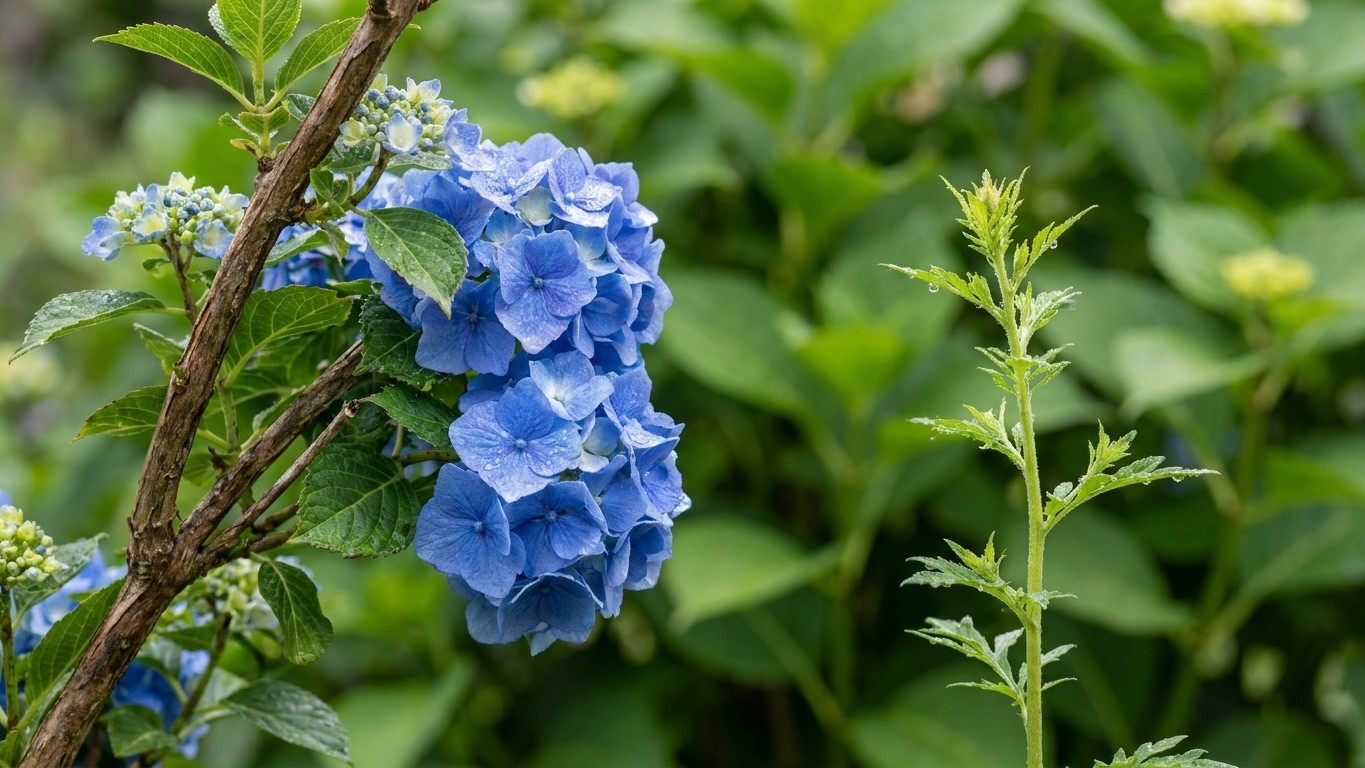

Bigleaf and mountain hydrangea flowers turn pink when the plant cannot take up aluminum, which happens when soil pH sits above about 6.5 or when phosphorus in the fertilizer ties the aluminum up. Blue needs a pH near 5.2 to 5.5, aluminum in the soil, and a fertilizer low in phosphorus. Only bigleaf and mountain hydrangeas respond to any of this. The panicle and smooth types that handle Yukon winters best flush pink on their own as the flowers age, and no soil amendment changes that, so the first job is knowing which kind is in your bed.
What this comes down to in Yukon
Color depends on the hydrangea type and the soil pH, and the short season at Whitehorse decides which types get to show it. Environment and Climate Change Canada’s 1991-2020 normals put the mean last spring frost at Whitehorse on June 3 and the mean first fall frost on August 28. Those are midpoints: in one year out of two the last frost comes after June 3, and in one year out of two the first fall frost arrives before August 28.
At the reference station the average frost-free period is 85 days. Natural Resources Canada’s hardiness map has rated Whitehorse around zone 1b in earlier editions, so check the current map; Canadian zones come from a different system than the USDA zones and are not interchangeable with them. In a window that short, a hydrangea that blooms on new growth has the best chance of finishing, and a bigleaf that must carry flower buds through winter has the worst. For siting and general care, see growing hydrangeas in Yukon.
Why do panicle and smooth hydrangeas turn pink without any soil change?
Panicle hydrangeas (Hydrangea paniculata) such as ‘Limelight’ open white to lime green and blush pink as nights cool and the flowers age. ‘Quick Fire’ opens earlier than most panicles and deepens to pink and red. Smooth hydrangeas such as ‘Annabelle’ stay white, while ‘Invincibelle Spirit II’ is pink by breeding. Soil pH has no effect on any of them, so pink panicle flowers in late August are the plant doing what it was bred to do.
What soil pH turns a bigleaf hydrangea blue?
Bigleaf (Hydrangea macrophylla) and mountain (Hydrangea serrata) sepals, the petal-like parts of the bloom, hold a pigment that turns blue when it binds aluminum. Aluminum dissolves into soil water only when the soil is acidic. At pH 5.5 or lower the flowers come out blue, between about 5.5 and 6.5 they land on purple or a mix of both, and above 6.5 they are pink. Phosphorus ties up aluminum, which is why a high-phosphorus fertilizer can keep a bed pink even at a good pH. White cultivars carry no pigment to shift.
| Type | Example | Soil pH changes the color? | Blooms on |
|---|---|---|---|
| Bigleaf | ‘Endless Summer’ | Yes | Old and new wood |
| Panicle | ‘Quick Fire’ | No, pink comes with age | New wood |
| Panicle | ‘Limelight’ | No, pink comes with age | New wood |
| Smooth | ‘Annabelle’ | No, stays white | New wood |
| Smooth | ‘Invincibelle Spirit II’ | No, stays pink | New wood |
Working it out for your own garden
Three checks settle the color question for any bed: what type the plant is, what the soil pH reads, and whether the season gives the plant time to bloom at all. Each one is cheap, and none depends on a map, so they still work after a move or a cold year.
How do you tell which pink you have?
Look at the flower first. Cone-shaped clusters that open white and slowly turn pink from the base upward in late summer are panicles aging. Round mopheads or flat lacecaps that open pink in midsummer are usually bigleaf or mountain types, and their color comes from the soil, though a pink smooth type such as ‘Invincibelle Spirit II’ can look similar. Then test the pH. Take a reading from the root zone, a few inches down and at the plant’s drip line, in two or three spots, using a meter or strips. A result above 6.5 explains pink on a bigleaf. A reading near 5.5 with pink flowers points to phosphorus in the fertilizer or to a cultivar bred pink.
Will a bigleaf bloom before the first fall frost?
Take ‘Endless Summer’, a bigleaf that flowers on old and new wood. In Whitehorse’s climate, winter often kills exposed buds on old wood unless the stems are well protected (see winter protection for hydrangeas in Yukon), so the bloom has to come from new growth. That growth starts after the last frost. Count from the second week of June, which allows for the half of years when the last frost lands after June 3. Frost can arrive by late August, so watch the plant and be ready to protect it. A cold summer can end that stretch with buds still tight, and then the color question never comes up.
Now run the same arithmetic for ‘Quick Fire’, a panicle that blooms on new wood and opens earlier than most others. The flowers will be pink at the end whatever the soil does. Anyone who wants true blue in this season is better off with a bigleaf in a container. Use a peat-based mix, set the pot outside after the frost risk passes, and bring it in ahead of the August frost window.
What changes across the territory
Whitehorse is the only reference point here, and Yukon is a large, varied territory. Elevation is the first thing that moves the season. Gardens on higher ground lose time at both ends, with a later last frost in spring and an earlier first frost in fall. Northern districts run weeks behind Whitehorse, which makes even an early panicle a gamble there and a bigleaf in the ground a poor bet.
Within one yard the differences can be as large as between towns. Cold air drains downhill on clear, calm nights and settles in valley bottoms and low corners, so frost hits those spots first and leaves them last. A south-facing wall or slope warms sooner in spring and holds heat into the fall, which buys time for a late bloomer. Reliable snow cover insulates roots and the base of the stems through winter, and a windswept, snow-free site loses that protection.
Soil pH varies as much as temperature does, because it follows the parent material and whatever has been added over the years. A bed that has received wood ash or lime will read higher than one dressed with peat or conifer needles. That is why each bed needs its own pH reading before you change anything. A neighbor two streets away may be growing the same plant at a pH a full point apart.
The mistakes this territory punishes
One costly mistake is planting out during a warm spell in May. The mean last spring frost is June 3, and in one year out of two it comes later, so tender bigleaf growth set out early can be cut back by a single clear night. Wait until the forecast shows no frost, and keep a sheet or row cover ready through mid-June.
Another is choosing a bigleaf for the ground and expecting blue. If winter kills the old wood, the plant has to rebuild and bloom within the frost-free stretch, and many seasons will not allow that. A panicle or smooth type gives a better chance of bloom, though its color will follow its own schedule.
Pruning a bigleaf hard in spring removes the buds it carried through winter. Wait until new leaves show where the live wood is, then cut only what is dead. The timing details are in When to Prune Hydrangeas in Yukon.
Aluminum sulfate also gets misused. A heavy dose on dry soil can burn roots, and using it on a panicle changes nothing. A fertilizer with a high middle number, and bone meal, adds phosphorus that locks aluminum away again. Look for a mix low in phosphorus and higher in potassium. Elemental sulfur works too, so work it in during the fall before the season you want blue. Starting in mid-August leaves too few weeks for any color change before frost.
Checking this against your own area
The Whitehorse frost dates and hardiness zone are starting points for your own yard, not instructions. Your elevation, slope and bed history can shift them by weeks, and your soil may sit well above or below the pH that suits the color you want. Yukon has no counties, so a nearby nursery or the Yukon government’s agriculture branch is the practical place to confirm what ripens at your elevation; Agriculture and Agri-Food Canada offers national background on growing conditions. For siting and planting, return to the growing hydrangeas in Yukon guide.
Common questions
- Can a white hydrangea be turned blue?
- No. White cultivars carry no pigment that reacts with aluminum, so they stay white at any soil pH. Only pink or blue bigleaf and mountain types shift.
- How long does it take for the color to change?
- Expect a full season. Flowers already open keep their color, and the next flush of buds shows the new chemistry. Aluminum sulfate acts faster, while elemental sulfur is slower to lower pH.
- Why are my panicle hydrangeas turning pink in August?
- That is normal aging, made faster by cool nights. Panicles such as ‘Limelight’ and ‘Quick Fire’ blush pink as the flowers mature, and soil pH has no influence on them.
- Is a container the best way to get blue flowers in Yukon?
- For a bigleaf, usually yes. You control the potting mix pH, and you can move the pot indoors before the first fall frost, which averages August 28 at Whitehorse. Stems left outside still need the protection described in winter protection for hydrangeas in Yukon.