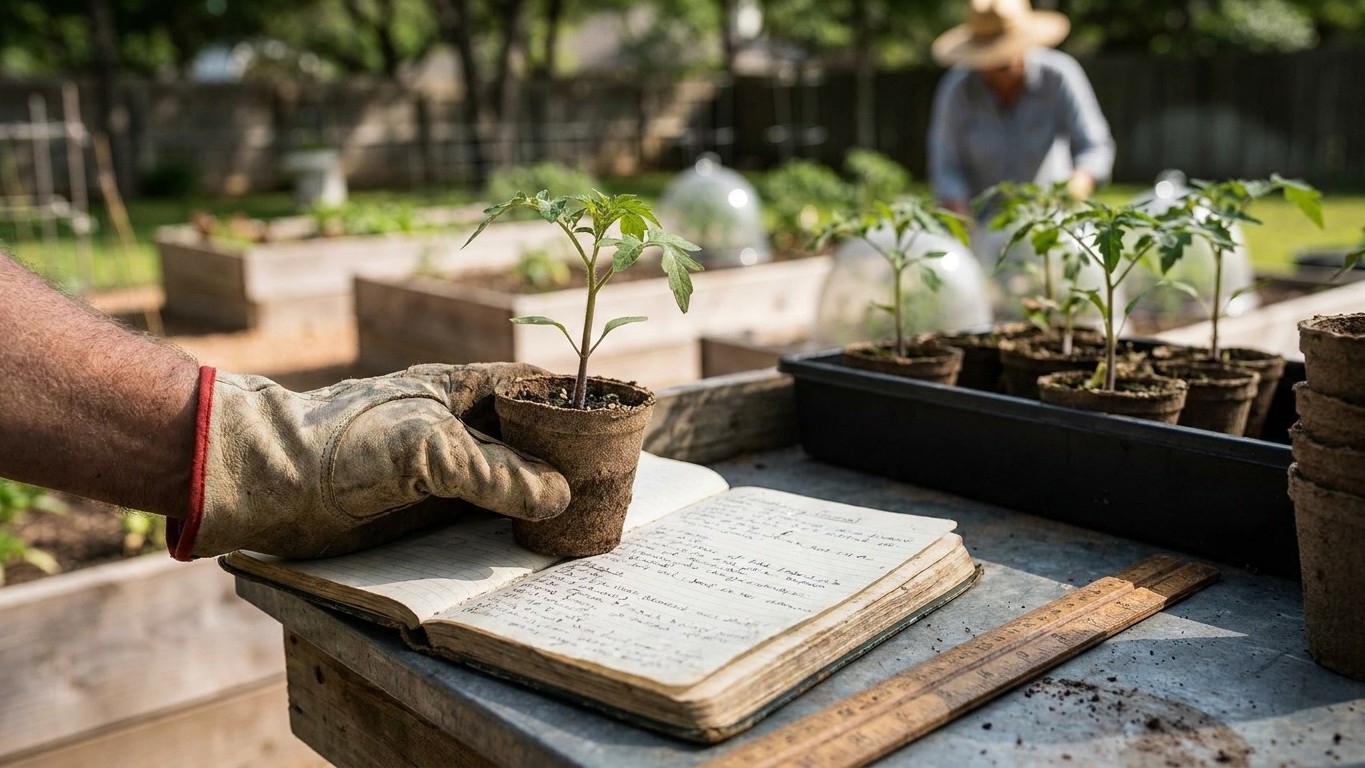

Houston’s tomato transplant window opens once the risk of a 32°F freeze has passed, which NOAA’s 1991-2020 climate normals put at February 4 to March 1 for the Houston (IAH) station. There is no single “planting day” for Texas: the state runs from USDA zone 6a in the Panhandle to zone 10a on the lower Gulf Coast, so a date that works near Houston can be six or more weeks off almost anywhere else. Check your own county’s frost data before you count backward from any calendar.
What this comes down to in Texas

The Houston frost window, and what it actually means
Near Houston, NOAA’s NCEI 1991-2020 climate normals put the last spring freeze in a range of February 4 to March 1, measured at the IAH weather station. That’s not a guess dressed up as a date. It’s a probability band: freezes still happen on either side of it in some years, just less often. The same dataset puts the first fall freeze at the IAH station in a range of December 1 to December 19, which is why the Gulf Coast growing season for tomatoes runs so long compared with the rest of the state.
Why one city’s numbers can’t stand in for the state
Texas spans USDA Hardiness Zones 6a to 10a, according to the USDA Plant Hardiness Zone Map’s 2023 edition, built on 1991-2020 normals. That’s four zones of difference between the Panhandle and the lower valley, which in practical terms means a gap of a season or more in when it’s safe to set out a tomato transplant. Even inside the Houston area, Hobby Airport runs about two weeks milder than IAH, so a homeowner five miles from the coast and one forty miles inland from the same city can be working from different frost windows without realizing it. Treat the IAH figures above as a Gulf Coast reference point, not a statewide instruction, and pull your own station’s data before you commit a tray of seedlings to the ground.
Working it out for your own garden
Counting forward from transplant to harvest
The method matters more than any single date, because it’s the part that still works if you move counties or the year runs unusually cold or warm. Start with your local last-frost window, not a single day pulled from a calendar. For Houston, that’s the NOAA range of February 4 to March 1. Then add the cultivar’s days to maturity, counted from transplant, not from seed.
Take ‘Celebrity‘, a determinate slicer that catalogs list at around 70 days to maturity. Seventy days is close to ten weeks. Add ten weeks to both ends of the February 4 to March 1 window and the harvest lands somewhere in a range spanning mid-April to mid-May. That’s a range built from a range, which is the only honest way to do this math. Actual timing will still shift a week or so with a cool spring or a hot one, so treat even that spread as approximate.
Now run a longer-season fruit through the same math to see where the line falls. ‘Cherokee Purple‘, an heirloom beefsteak, is commonly listed around 80 to 90 days to maturity. If you’re using it for a second, fall-targeted planting rather than the spring crop, and you transplant in late summer, counting 80 to 90 days forward can push harvest right up against the first fall freeze window of December 1 to December 19 near Houston. A freeze that lands at the early end of that range, combined with a slow-finishing fruit, is exactly how a fall crop gets caught unripe on the vine. This is the same arithmetic as the spring calculation, just run against the other end of the season, and it’s why Tomato Varieties That Ripen in Time in Texas is worth reading before you order seed for a fall planting rather than after.
- Find your own station’s last and first frost windows before you count anything
- Convert the cultivar’s days to maturity into weeks to make the addition easier
- Add that span to both ends of the frost range, not to a single date inside it
- Recheck the fall side of the calendar for any cultivar you’re tempted to plant late
What changes across the state
Distance from the Gulf, latitude, and elevation all push the frost window around, and they don’t move it by the same amount in the same direction. Coastal counties hold heat longer into the fall and lose it later into spring, which is part of why the Houston-area numbers above run mild. Move inland and north, and the window closes on both ends: spring frost risk lingers later into the year, and fall frost arrives earlier.
Elevation works against the coast’s advantage. The Hill Country sits high enough that cold air pools in the valleys on clear nights, so two gardens a short drive apart can see noticeably different frost timing. The Panhandle is its own climate entirely, closer to zone 6a on the USDA map than the 9a-10a range near the coast, with a spring frost season that runs later and a fall frost season that starts earlier by a wide margin. None of this changes the method from the section above. It only changes which numbers you feed into it, which is exactly why a single Houston-based date can’t serve as a statewide planting calendar, however convenient that would be.
The mistakes this state punishes

The most common error near the Gulf Coast is trusting a warm stretch in late January or early February as proof that the frost window has closed. NOAA’s 30 to 70 percent probability band for the last freeze, running February 4 to March 1 at the IAH station, means real freeze risk persists inside that range, not just before it. A week of 75-degree days in the middle of that window is normal, not a signal.
The second mistake is choosing a long-season heirloom for a location where the calculated harvest window runs too close to either frost boundary, spring or fall, as the ‘Cherokee Purple’ example above showed. Match the cultivar’s days to maturity to the frost math before you buy seed, not after the transplants are already in a flat.
The third is transplanting into cold soil right after a warm spell, which stalls root growth even when the air temperature looks fine on a thermometer. Tomato roots need the soil itself to have warmed, not just the afternoon high. If you’re unsure whether your plants are ready to go, a look at how growing tomatoes in Texas handles hardening off and soil temperature is worth doing before transplant day rather than after a setback.
Checking this against your county
The Houston-area figures in this piece are a starting point, not a substitute for your own county’s data. Texas A&M AgriLife Extension maintains county offices across the state, and its statewide site at agrilifeextension.tamu.edu is the right place to find a local horticulture agent who can confirm frost timing for your specific area. If you’re also weighing which pests show up early enough to affect a spring transplant decision, Tomato Pests in Texas: Which Ones Actually Show Up Here covers that timing separately from the frost calculations on this page.
Common questions
Can I just use the Houston dates if I live somewhere else in Texas?
No. The February 4 to March 1 and December 1 to December 19 windows on this page come from the NOAA station at Houston’s IAH airport, and Texas spans USDA zones 6a to 10a. Even within the Houston metro, Hobby Airport runs about two weeks milder than IAH, so treat these figures as a reference point and confirm your own county’s numbers through your local AgriLife Extension office.
What if I already planted before checking the frost window?
Watch the extended forecast rather than panicking. If a freeze is called, cover the plants overnight with a sheet or frost cloth that reaches the ground, and pull mulch away from the base during the day so the soil can radiate warmth back up around the stems at night.
Is it better to plant tomatoes in spring or fall in Texas?
Both are common along the Gulf Coast because the frost-free season runs long there, but each has a different failure point: spring crops risk a late freeze, and fall crops risk running out of time before the first freeze window in December. Run the days-to-maturity math against whichever season you’re targeting before you pick a cultivar.
Why does my neighbor’s tomato survive frosts mine doesn’t?
Microclimate differences are real even on the same street. A plant against a south-facing wall, under an eave, or in a raised bed that drains and warms faster can survive conditions that kill an exposed plant a few yards away, which is part of why a single frost date can never be more than an average for the area.