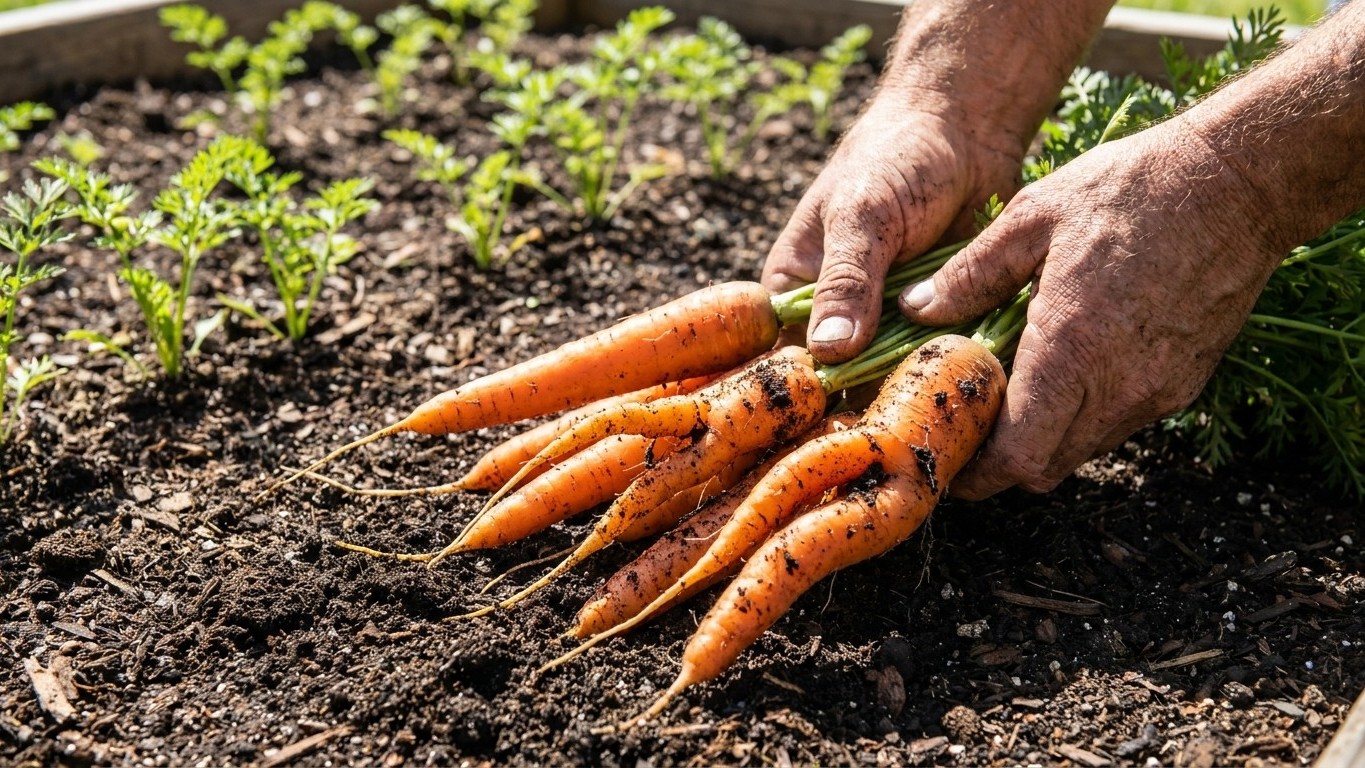

Carrots go into Alabama ground while it’s still cool, sown directly where they’ll grow, several weeks ahead of the local last frost date, since that date shifts a good deal depending on where in the state you’re gardening. Count 70 to 100 days from that seeding, never from a transplant, to reach harvest. Timing only gets you partway there, though. What actually decides whether those seeds become straight, edible roots or a tangle of forked stubs is what’s underneath them.
The short answer
Alabama’s official state soil, named by state law and carried in the USDA NRCS State Soils program, is the Bama series. It’s classified as an Ultisol, which means it’s old, heavily weathered, and leached of a lot of what plants want. The surface horizon runs strongly acid, with a pH around 5.3. Texture-wise it leans sandy: 67 percent sand, 14 percent clay, 19 percent silt. Organic matter sits low, around 0.8 percent. Drainage class is well drained.
| Property | Bama series (surface horizon) |
|---|---|
| Soil order | Ultisol |
| Surface pH | About 5.3 (strongly acid) |
| Sand | 67 percent |
| Clay | 14 percent |
| Silt | 19 percent |
| Organic matter | About 0.8 percent |
| Drainage class | Well drained |
Set that against what a carrot actually needs. Utah State University Extension puts it plainly: carrots want deep, sandy, well-drained soil rich in organic matter, and heavy or rocky ground makes the root fork. Heavy soil calls for plenty of compost worked in deep, or a double-digging job before you ever drop a seed.
By that measure, the Bama series isn’t the worst news for a carrot grower. Low clay at 14 percent and a well-drained rating mean the forking risk from sheer heaviness is lower than it would be in a true clay soil. The catch is the organic matter number. At roughly 0.8 percent, there isn’t much food or moisture-holding capacity in that ground on its own, and thin, acid soil like this tends to produce short, hairy, slow-starting roots even when the texture is friendly. Compost still earns its place here, not to fight clay, but to feed a soil that’s naturally running lean and sour.
None of this is a verdict on your particular garden. Alabama holds hundreds of mapped soil series, and the Bama figures above describe the surface horizon of that one series as mapped statewide, not a worked, amended garden bed. A river-bottom lot, a piece of hill country, or any yard a builder graded and refilled can carry soil nothing like this. Treat the state soil as a starting point for what the region tends to do, not a stand-in for your own dirt.
The test that settles it in your own garden
The only way to know what you’re actually working with is to go outside and check it yourself. None of the steps below need special equipment, and none of them require guessing at a number nobody has measured for your yard.
- Dig a hole roughly a foot deep in the bed you plan to use, and note how far down the ground stays loose before you hit a hardpan, a rock layer, or a dense clay lens.
- Look at what came out of the hole. Stones, tight clay chunks, or gray and orange mottled streaks are signs of restricted root room or poor drainage.
- Feel the texture by rubbing a moist handful between your fingers. Sandy soil feels grainy and falls apart. Clay feels sticky and holds a ribbon shape when you press it. Silt feels smooth, almost like flour.
- Check drainage directly. Fill the hole with water, let it disappear, then fill it again and watch how the second round behaves. Water that lingers and sits for a long stretch points to slow-draining ground; water that vanishes quickly points the other way.
- Send an actual soil sample to a testing lab for pH and nutrient levels instead of assuming the state soil’s numbers apply to your bed. A lab result tells you what’s really in front of you.
That combination, depth, obstructions, texture, and drainage behavior, tells you far more about whether your carrots will fork than any county-wide average ever could.
What goes wrong here
- Forking in heavy, compacted ground. Where clay layers, buried rock, or a builder-compacted subsoil sit close to the surface, the taproot hits resistance and splits into two or three legs instead of growing straight down. The fix is either a raised bed filled with loose, amended soil, or double digging the native bed and mixing in compost well past the depth the root is expected to reach.
- Poor germination during a hot spell. Carrot seed is small, shallow-sown, and slow to sprout, and if the surface crusts and dries out between waterings before the seedlings break through, a big share of the stand simply never comes up. Keeping the top inch of soil consistently damp with light, frequent watering, and a thin mulch layer to slow evaporation, gives the seed the steady moisture it needs to germinate.
- Splitting from uneven watering. A root that goes dry for a stretch and then gets a heavy soak swells fast on the inside while the outer layer can’t keep up, and it splits open. A steady watering schedule, plus mulch to even out moisture between waterings, keeps that swing from happening in the first place.
Common questions
Can I sow carrots directly in Bama-type soil without amending it?
You can try, since the sandy, well-drained texture isn’t the forking hazard a heavy clay soil would be. But organic matter around 0.8 percent is thin, and carrots grown in soil that lean will typically come up smaller and slower than roots grown in ground with compost worked in. Adding compost before sowing is still worth doing even where the texture itself is favorable.
What’s the exact last frost date for my part of Alabama?
That figure isn’t given on this page, because it varies noticeably from the northern part of the state to the Gulf Coast. This page focuses on what the soil does to the root once it’s in the ground, not on pinpointing a calendar date for any one county.
Does the state soil tell me which carrot variety to grow?
No, and no specific variety is recommended here. What decides success is how deep and loose the ground actually is where you’re planting, and that’s something the dig-and-feel test above answers far better than any general soil description can.
How long from sowing to harvest?
Carrots are sown directly where they’ll grow, with no transplanting step, and the 70 to 100 days to maturity are counted from that seeding date. There’s no separate transplant date to track for this crop.