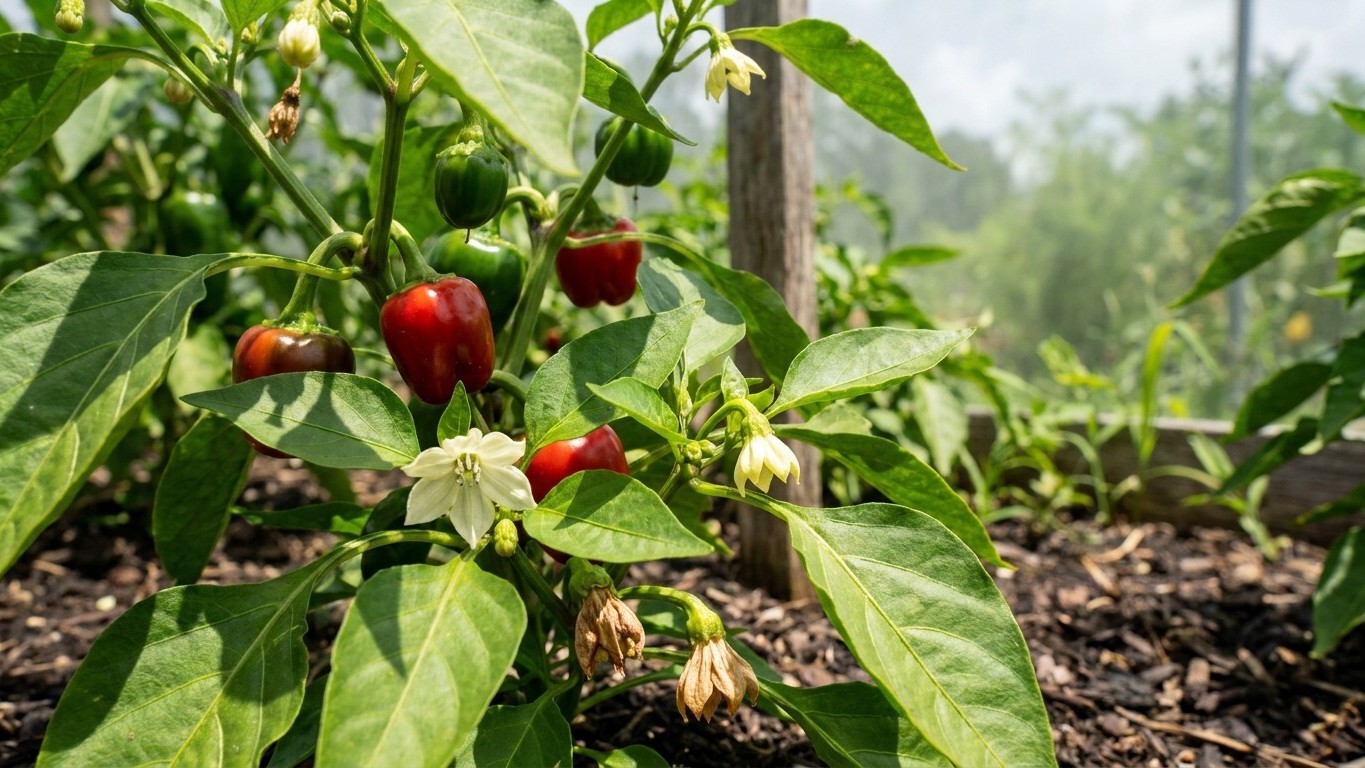

Pick peppers once the fruit is full size and firm. Clemson Extension puts that at about 70 to 85 days after transplanting. Then keep them out of the refrigerator. Peppers store best at 45 to 50 °F and 80 to 90 percent relative humidity, and a home fridge runs colder than that, so the skin pits and goes soft. In Alabama, timing is mostly a heat question, because a long run of 90-degree days decides how much fruit the plant holds long enough to pick.
The short answer
The hot end
Huntsville, the reference station for this state, averages 58.5 days a year at 90 F or more, according to NOAA NCEI’s latest 30-year climate normals. That is roughly one day in six. It measures summer heat load, which is different from average summer temperature, and it is the number that drives water demand and heat stress in a vegetable bed.
Utah State University Extension is blunt about where pepper fruit set breaks down: days above 90 F, or nights below 55 F. A plant can look perfect, deep green and covered in flowers, and still drop them all. Nearly two months’ worth of 90-degree days (58.5 is more than eight weeks) means Alabama gardeners will see this at some point. The first fruit often sets before the worst heat, then the plant pauses, then it sets again when the weather eases.
The cool end
The other half of the rule gets ignored. Nights under 55 F cause the same flower drop, and that is the part this site cannot size up for you. It does not carry summer night minima, so there is no honest number here for how many cool nights your county sees, and guessing from latitude would just be a guess. Watch your own. A min/max thermometer set at plant height near the bed will tell you more than any regional average, and it will show you which stretch of the season is hurting your set.
Picking and storing
Clemson Extension says peppers should be ready for harvest in about 70 to 85 days after transplanting. Count from the day the plant went into the ground, not from the day the seed went into the tray. That gap matters, because the seedling spent weeks indoors before the clock started.
For storage, Clemson gives the optimal conditions as 45 to 50 °F and 80- to 90-percent relative humidity, good for two to three weeks. Treat “two to three weeks” as a ceiling under ideal conditions, not a promise. A home refrigerator is colder than that range, and below about 45 °F peppers suffer chilling injury: the skin pits, the flesh softens, and the fruit breaks down fast once it warms back up. It is the mistake nearly everyone makes, because the fridge feels like the obvious place for produce. For peppers, a cool spot in the house works better, ideally one you have checked with a thermometer. Short of that, use them within a few days of picking.
When to start seed here
The calendar works backward from one date: the day your soil is ready for transplants. Start there, not with a January habit. Utah State University Extension says transplants need 8 to 10 weeks indoors, and that they go out when the soil reaches 60 F, after frost. Here is the arithmetic in order, so you can redo it for your county.
- Find your last spring frost. At the Huntsville airport station, NOAA NCEI’s 32 F freeze probabilities put the last spring frost between March 19 and April 3 (the 30 to 70 percent band). That is a reference-city figure, not a statewide guarantee. Suburban and rural gardens typically see the last frost one to two weeks later, and more at elevation, so a date as late as mid-April is realistic for many yards. Check your own county’s records.
- Wait for the soil, not just the frost. Frost-free is the minimum. Transplants go out when the soil reaches 60 F, and that usually comes later than the last frost. Push a soil thermometer a few inches down in the morning, and treat the first week it holds 60 F as your transplant date.
- Subtract 8 to 10 weeks. Take that transplant date and count back eight weeks for the late edge of your sowing window, ten weeks for the early edge. Seed started inside the window gives you a stocky transplant. Seed started much earlier gives you a leggy plant that is already flowering in its cell.
- Run an example. Suppose your soil hits 60 F on April 20. Eight weeks back is February 23, and ten weeks back is February 9. Sow between those two dates. This is an illustration, so swap in your own transplant date.
- Add 70 to 85 days to see your harvest. With that same April 20 transplant date, Clemson’s 70 to 85 days lands the first pickable peppers between June 29 and July 14. Compare that to your own thermometer once the plants are flowering.
That last step is where Alabama gets interesting. A plant set out on April 20 begins bearing right as the state’s 90-degree days pile up. You cannot control the weather, but you can shift the transplant date a little. Setting plants out as soon as soil and frost allow gives them more time to flower and set before peak heat arrives. Waiting an extra month “to be safe” pushes flowering straight into it.
For the broader picture of varieties, spacing and soil, see Growing Peppers in Alabama.
What goes wrong here
The failures below tend to arrive in the same order as the season: early flowers meet a cool night, summer flowers meet a heat spell, and ripening fruit meets strong sun. Most are fixable once you can tell which one you have.
- Blossom drop in a hot spell or a cool night. Flowers fall off with no fruit behind them when days climb above 90 F or nights dip below 55 F. The plant is not dying; it is protecting itself. Do not pile on fertilizer, which pushes leaves at the expense of fruit. Instead, water deeply and evenly, mulch to hold soil temperature steadier, and consider afternoon shade cloth during a long hot stretch. For cool nights, a row cover thrown over the plants at dusk and pulled off in the morning can take the edge off. Pull the cover off by midday so the plants do not cook. The full diagnosis is in Why Peppers Fail to Set Fruit in Alabama.
- Sunscald where the sun is strong. Pale, papery, sunken patches show up on the side of the fruit facing the sun, usually after leaves have been lost to disease, pests, or heavy pruning. Protect the canopy. A plant with a full leaf cover shades its own fruit, so keep leaves healthy and avoid stripping foliage. Shade cloth in the hottest part of the day also helps. Scalded areas will not heal, but the rest of the pepper is usually fine to eat once you cut away the damaged spot.
- Blossom-end rot. A dark, leathery, sunken patch at the bottom of the fruit points to calcium not reaching it, which is more often a water problem than a soil one. Swings between dry and soggy soil cut off calcium uptake. Mulch heavily, water on a steady schedule, and test the soil before adding anything. Pick off affected fruit so the plant puts energy into healthy ones.
- Pitting and soft spots after picking. Not a garden problem, but it ruins the harvest all the same. Peppers held below about 45 °F develop chilling injury, which is why fruit that looked perfect on the counter turns slimy after a few days in the fridge.
Chewed fruit or holes are a different category entirely. For that, see What Eats Pepper in Alabama, and When.
Common questions
How many days after transplanting are peppers ready?
Clemson Extension says about 70 to 85 days after transplanting. The count starts when the seedling goes into the garden, not when the seed was sown. Cool nights or very hot days can stretch it, because the plant stalls instead of setting fruit.
Can I store peppers in the refrigerator?
It is a poor choice. The best storage range is 45 to 50 °F with 80 to 90 percent relative humidity, and a domestic refrigerator runs colder. Below about 45 °F peppers pit and soften from chilling injury. Keep them somewhere cool but not cold, and use them quickly.
Is “two to three weeks” a reliable shelf life?
No. Clemson gives two to three weeks as what you can expect under optimal conditions, which means the right temperature and humidity together. Treat it as a maximum. A pepper picked after a stressful week, or held in a dry kitchen, will not make it that long.
My yard frosts later than Huntsville. What changes?
Everything shifts later. The March 19 to April 3 range is for the airport station, and suburban and rural gardens often see the last spring frost one to two weeks after it, more at elevation. Use your own last-frost date, wait for 60 F soil, then subtract 8 to 10 weeks for your seed-starting window.