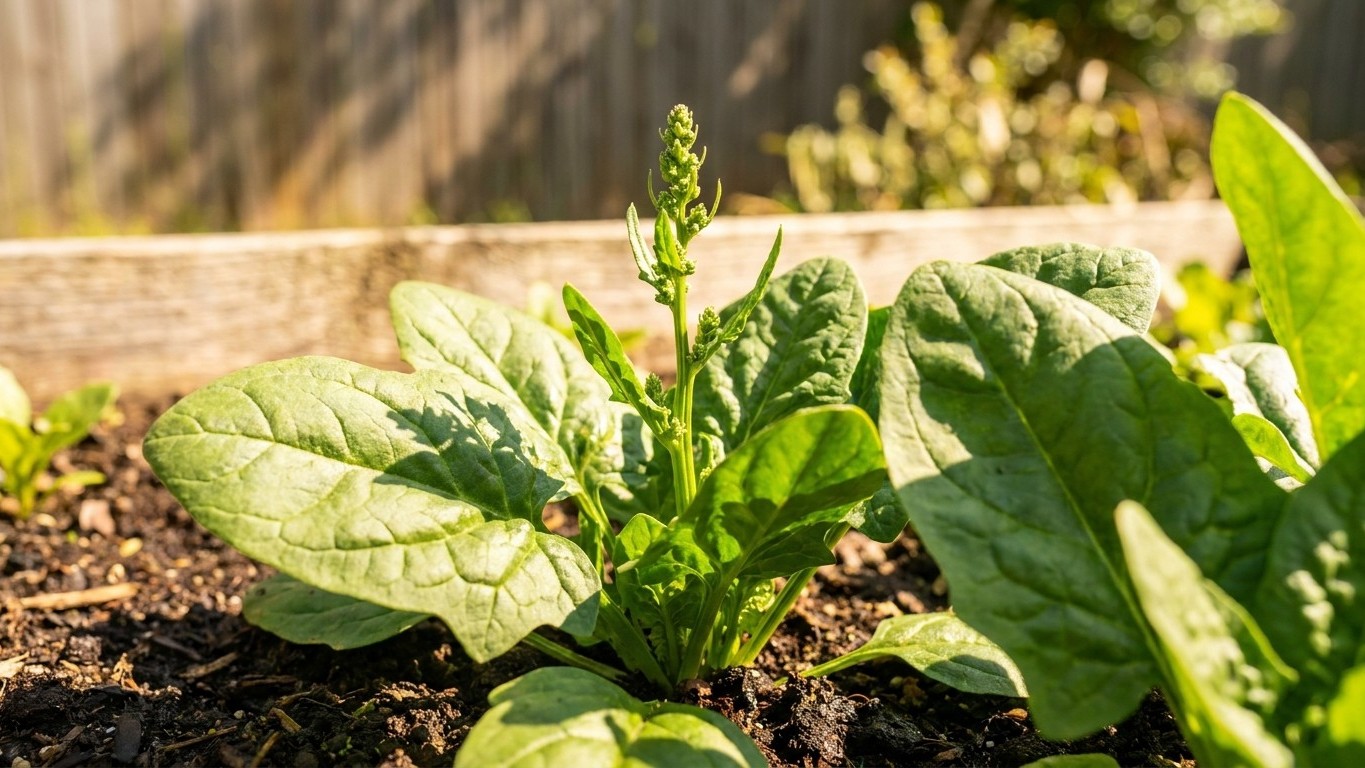

Yes, and for two separate reasons that hit at almost the same time. Around Huntsville and across most of Alabama, long summer daylight pushes spinach toward flowering just as spring temperatures climb past the point where the plant grows well. The spring crop is a short sprint, not a season, and the more reliable harvest sits in fall, once the soil finally cools down.
The short answer
On the longest day of the year, Huntsville gets 14 hours and 19 minutes of daylight. That number matters more to spinach than any thermometer reading, because flowering in this plant is triggered by day length: once days stretch past a certain point, spinach switches from building leaves to sending up a seed stalk, whether the weather cooperates or not. A cool, cloudy stretch in north Alabama would not slow that clock down. The days get long on the same calendar dates everywhere in the state, so the trigger fires on schedule no matter how mild the local weather happens to be.
That is the part gardeners rarely expect: length of day, not heat, is what starts the bolting process. But Alabama does not let the plant off easy on the heat side either. The reference station near Huntsville averages 58.5 days a year at 90°F or hotter, and that heat load lands heavily in April through June, exactly when a spring-sown spinach crop is trying to finish. Utah State University Extension notes that spinach grows best where temperatures stay at or below 75°F, and that same 75°F line marks the point where leaves start turning bitter. Alabama spring routinely pushes past both markers well before summer officially arrives.
So the limit here is not one thing, it is two, arriving almost together. Long days start nudging the plant toward flowering in April and May, and rising heat degrades leaf quality and slows growth at the same time. Neither problem waits for the other to finish. A gardener who beats the day-length trigger by sowing early can still lose the crop to an unusually warm April. One who dodges the heat with shade cloth still watches the plant bolt once daylight crosses its threshold, because shade does nothing to shorten the day. There is no single fix, since these are two different mechanisms that happen to converge on the same narrow stretch of the Alabama calendar.
That convergence is why treating spinach as a plant-once, spring-only crop in Alabama tends to disappoint. The plant is not fighting one enemy here, it is fighting a calendar and a thermometer that both reach the same conclusion from different directions. Knowing which limit is doing the damage in a given week (day length early on, heat by late spring) changes what a gardener can actually do about it, and mostly that comes down to timing the sowing date rather than trying to outlast either pressure.
How long the spring window really is
Lay the frost data next to the 75°F growth ceiling and the spring window for spinach around Huntsville comes down to a handful of weeks, not months.
- Last frost range: NOAA climate normals for the Huntsville-area station put the last spring freeze (32°F) between March 19 and April 3. That is a range, not a fixed date, and it is what a spring sowing has to work around.
- Sowing date: Spinach seed can go into the ground 2 to 3 weeks ahead of that last frost, since the plant tolerates cold soil far better than heat. Counting back from March 19 to April 3 puts a realistic sowing window somewhere between the very end of February and the middle of March.
- The 75°F ceiling arrives: Alabama afternoons climb past that growth ceiling well before the calendar reaches late spring. Once daytime highs settle above 75°F, growth rate and leaf quality both drop, and the long-day flowering trigger described above is already working in the background at the same time.
- What is actually left: Between a sowing date in late February or early March and the point where afternoons stop staying below 75°F, most Alabama gardens get somewhere near six to eight weeks of decent spinach growth before the crop turns bitter, stalls, or bolts outright.
That is a workable harvest, but it is a short one, and it closes from both ends at once rather than fading out gradually the way a summer crop might. Suburban and rural gardens typically see that last frost date later than the airport station shows, sometimes by one to two weeks, and even more at higher elevation, so it is worth checking your own county’s numbers before locking in a sowing date. A later local frost can push the sowing date back, which only tightens the window further against the rising heat.
The autumn crop, and when the soil lets you sow
The fall crop is where Alabama gardeners tend to get better results, but it comes with its own math. Utah State University Extension gives a single rule for timing a fall planting: sow 50 to 75 days before the date you want to harvest. Applied to Alabama, that rule runs into two separate obstacles, one at each end of the countdown.
Soil that is still too warm to germinate
The source does not publish a soil-temperature curve specific to Alabama, but the germination limit it does give is the one that actually controls the fall sowing date here: spinach seed struggles to germinate once soil temperature climbs above 80°F. With 58.5 days a year averaging 90°F or hotter at the reference station, most of them stacked between June and August, Alabama topsoil holds heat well past Labor Day in a typical year. That leaves a fall gardener waiting on the ground to cool rather than simply watching the calendar and counting days.
The frost that ends the season
Work backward from the other end and the picture tightens further. The Huntsville-area station’s climate normals put the first fall freeze (32°F) between November 2 and November 16. Counting back 50 to 75 days from that range lands a sowing date somewhere between mid-August and late September, depending on which end of the frost range and which end of the 50-to-75-day rule is used. Overlapped with the soil-temperature obstacle above, the practical sowing window narrows to a few weeks in September, after the ground has finally dropped below that 80°F germination limit but still early enough to reach a usable harvest before frost. Gardeners outside the immediate Huntsville station area, particularly in outlying counties or at higher elevation, should expect that first frost to arrive earlier, by a week or two, and plan the fall sowing date accordingly rather than counting on the station’s exact figure.
Spinach varieties commonly named for extended-season growing, including Bloomsdale, Melody, Teton, and Olympia, show up often in seed catalogs and garden guides, but the source behind this article publishes no bolt-resistance data, no days-to-maturity figures, and no heat-tolerance ratings for any of them. Choosing among them on bolt resistance alone is not something the available data supports, whatever a seed packet might claim.
Common questions
Can spinach survive an Alabama summer?
No. Both pressures work against it at once. Summer day length is long enough to trigger flowering regardless of temperature, and the reference station’s 58.5 days a year above 90°F guarantee that soil and air stay well past the 75°F growth ceiling for months. There is no summer window for this crop in Alabama.
What is the best time to plant spinach in Alabama?
Two windows work, both short. In spring, sow roughly late February into mid-March, 2 to 3 weeks ahead of the last frost. In fall, sow once soil temperature drops below 80°F, typically sometime in September, counting 50 to 75 days back from your target harvest date ahead of the first freeze in early to mid-November.
Does shade cloth stop spinach from bolting in Alabama?
It helps with only half the problem. Shade can lower leaf temperature and slow the plant’s approach to the 75°F bitterness threshold, but it does nothing to shorten the number of daylight hours, which is the trigger that starts the bolting process in the first place.
Which spinach variety resists bolting best in Alabama?
That data is not published in the source behind this article. Bloomsdale, Melody, Teton, and Olympia are all names that come up in general spinach growing guidance, but no bolt-resistance figures for any of them are given here, so timing the sowing date remains the more reliable lever than variety choice alone.