
Winter Squash in Alabama goes into the ground after the frost-probability window closes in spring, usually mid-to-late April once soil has caught up with the air, and the fruit needs to finish curing on the vine before the first fall frost lands sometime between early and mid-November. The state’s long, hot growing season favors vigorous vining types, but heat and humidity make disease resistance and airflow the real deciding factors, not the calendar alone.
When the soil is warm enough in Alabama

The question every Alabama gardener asks first is simple: when do I plant? The honest answer starts with the last spring frost, which at the Huntsville reference station (USW00003856) falls somewhere between March 19 and April 3, based on NOAA’s 1991-2020 Climate Normals using the 30-70% probability band for a 32F freeze. That’s a range, not a single day, and it’s a probability, not a promise. Some years the cold snap ends earlier, some years it lingers past that window entirely.
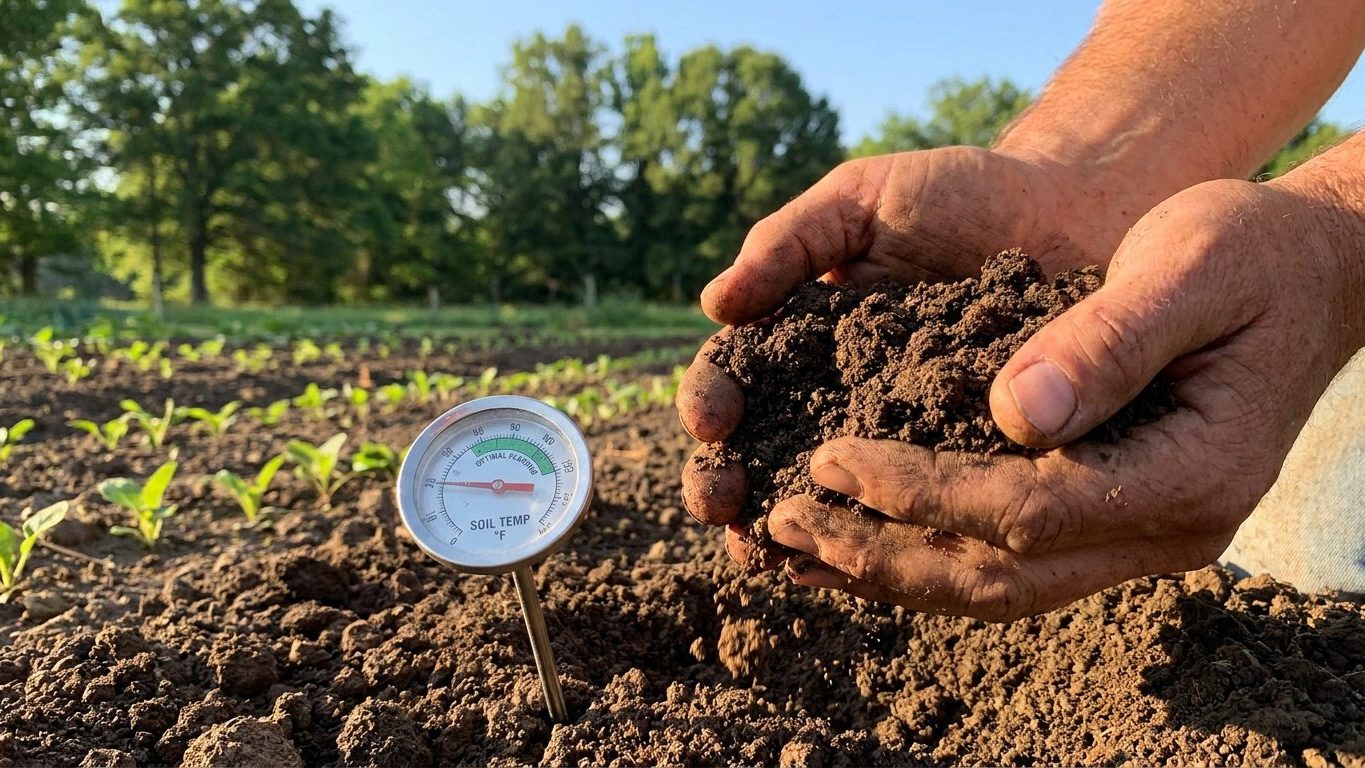
Frost is only a proxy for what actually matters, which is soil temperature. Winter squash seed rots in cold, wet ground long before the air itself threatens the seedling. Even after the last frost risk fades, soil often needs another one to two weeks of sun to warm enough for squash seed to germinate reliably and for young roots to grow instead of sulk. That’s why experienced growers in this region typically wait until late April, sometimes into early May, rather than rushing seed in the moment the frost date passes on a calendar.
There’s another wrinkle worth naming plainly. The Huntsville figures come from an airport weather station, and airport stations tend to run warmer than the surrounding countryside because of pavement and open exposure. Suburban yards and rural gardens across Alabama commonly see their last spring frost land later, sometimes by a week or two, and more if the property sits at higher elevation or in a low spot where cold air pools overnight. Treat the Huntsville dates as a regional reference point, then watch your own thermometer and soil before committing seed to the ground.
Alabama sits across USDA Hardiness Zones 7a to 9a, a range wide enough that a grower in the northern part of the state and one near the Gulf are working with meaningfully different winters and, by extension, different comfortable planting windows. That zone map is built entirely on average annual extreme minimum temperature, useful for perennial survival but not a substitute for tracking your local frost and soil conditions each spring. For the winter squash types trialed and recommended for your specific county, the Alabama Cooperative Extension System (aces.edu) keeps current, locally tested guidance that this page simply doesn’t have.
How long the season lasts here
Subtract the two frost dates from the Huntsville normals and you get a growing window that runs, at its shortest read, from around March 19 to November 2, and at its longest read, from April 3 to November 16. Either way, that’s somewhere in the neighborhood of seven and a half months of frost-free growing, one of the more generous windows available anywhere in the winter-squash-growing region of the country.
What does that length actually allow? For winter squash, which needs a long, uninterrupted stretch to bulk up and cure fully before frost, a seven-month window opens real options. A gardener here isn’t limited to a single sowing gambled on getting everything right the first time. There’s enough calendar room to direct-sow in late April, watch how the plants establish, and if a patch fails to germinate or gets hit by early pests, replant into May and still expect mature fruit well before the November frost arrives.
That cushion also changes the transplant calculation. In short-season territories, gardeners often start squash indoors and transplant early just to buy a few extra weeks, accepting the root disturbance that vining cucurbits generally dislike. In Alabama’s longer window, direct-seeding outdoors after the soil has warmed is usually the simpler, lower-risk choice, since there’s little need to rush the calendar by weeks that the season already provides.
The flip side is that a long window doesn’t automatically mean a second full crop of winter squash is worth planting behind the first. Winter squash takes considerably longer to mature and cure than a summer squash or a quick green, so while the calendar math allows for a second sowing in many parts of the state, especially with an early-maturing type sown by early July, the payoff depends on watching your own remaining frost-free days and being honest about what’s left. For guidance on staggering sowings and timing a second planting correctly, the site’s succession sowing guide walks through how to make that call crop by crop.
Heat and water in Alabama

Alabama earns its reputation for summer heat, and the numbers back it up. The Huntsville reference station logs an average of 58.5 days a year at or above 90F, a heat load that sits solidly on the demanding end for a garden, especially for a plant setting and filling fruit through the hottest stretch of summer. That’s not an average summer temperature, it’s a count of how many days the thermometer crosses that threshold, and it’s the figure that drives water demand and heat stress in the vegetable patch.
Rainfall doesn’t fully offset that heat load. Summer rain across June, July and August totals about 12.1 inches at the same reference station, out of 54.3 inches for the year, with June bringing 4.06 inches, July 4.49, and August dropping to the driest month at 3.55 inches. On paper that sounds like decent summer moisture, but it rarely arrives on a schedule the garden can count on. Much of it lands as thunderstorm bursts that run off a dry surface rather than soaking down to root depth, and 58.5 days of 90-plus heat accelerates evaporation from whatever moisture does infiltrate.
This is where winter squash separates itself from other garden crops. Timing and season length decide nearly everything with this crop: the fruit has to mature fully on the vine before frost, because an immature squash won’t cure properly and won’t store, no matter how carefully it’s handled afterward. Alabama’s long season removes most of the maturity-timing pressure that shorter-season territories face, but it replaces that worry with a different one: carrying fruit through weeks of heat stress and inconsistent rain without the vine faltering partway through fill.
Where the summer rain does arrive, it comes with a second cost. Heat combined with humidity and periodic heavy rain creates conditions favorable to powdery mildew and other foliar disease on squash vines, particularly as the canopy thickens in July and August. Soil type changes how far that August dip in rainfall actually bites, since a sandy garden bed drains that 3.55 inches away within a day or two while a heavier clay soil holds it far longer. Either way, a rain gauge on the actual property is the only way to know whether supplemental irrigation is needed weekly or more often during the driest stretch of summer.
Which winter squash suit Alabama
Given a long season, heavy summer heat, and periodic humidity, the reasoning for which type of winter squash suits Alabama points in a fairly clear direction, without needing to name a single variety. The generous frost-free window here doesn’t force a grower toward the earliest-maturing types the way a short northern season would; there’s room for types that take longer to bulk up and cure. Instead, the deciding factors become heat tolerance during fruit set, airflow through a sprawling vine to limit mildew, and, in more humid pockets of the state, resistance to the fungal pressure that builds through a wet, warm summer.
Vining types that can be trained up a trellis or given generous spacing tend to fare better here than compact bush forms, since improved airflow around the foliage matters more in a climate where 58.5 days a year cross 90F and summer humidity lingers. Types bred or selected for disease resistance to powdery mildew are worth prioritizing over ones chosen purely for size or novelty, given how consistently that pressure shows up in Southern gardens by mid-summer.
What this page won’t do is hand over a cultivar name, because doing so without local trial data behind it is the kind of shortcut that backfires the first season a gardener tries it. The Alabama Cooperative Extension System runs its own regional variety trials and publishes recommendations suited to the specific soils, humidity levels and pest pressures found across the state’s different counties, from the Tennessee Valley in the north to the Gulf Coast plain in the south. Their listings at aces.edu reflect what has actually performed in Alabama conditions, updated as new trials come in, which is a level of local accuracy this page can’t replicate from national climate normals alone. Starting there, armed with the type of squash that fits your season length, heat exposure and moisture pattern, is a stronger foundation than any single variety name could offer.