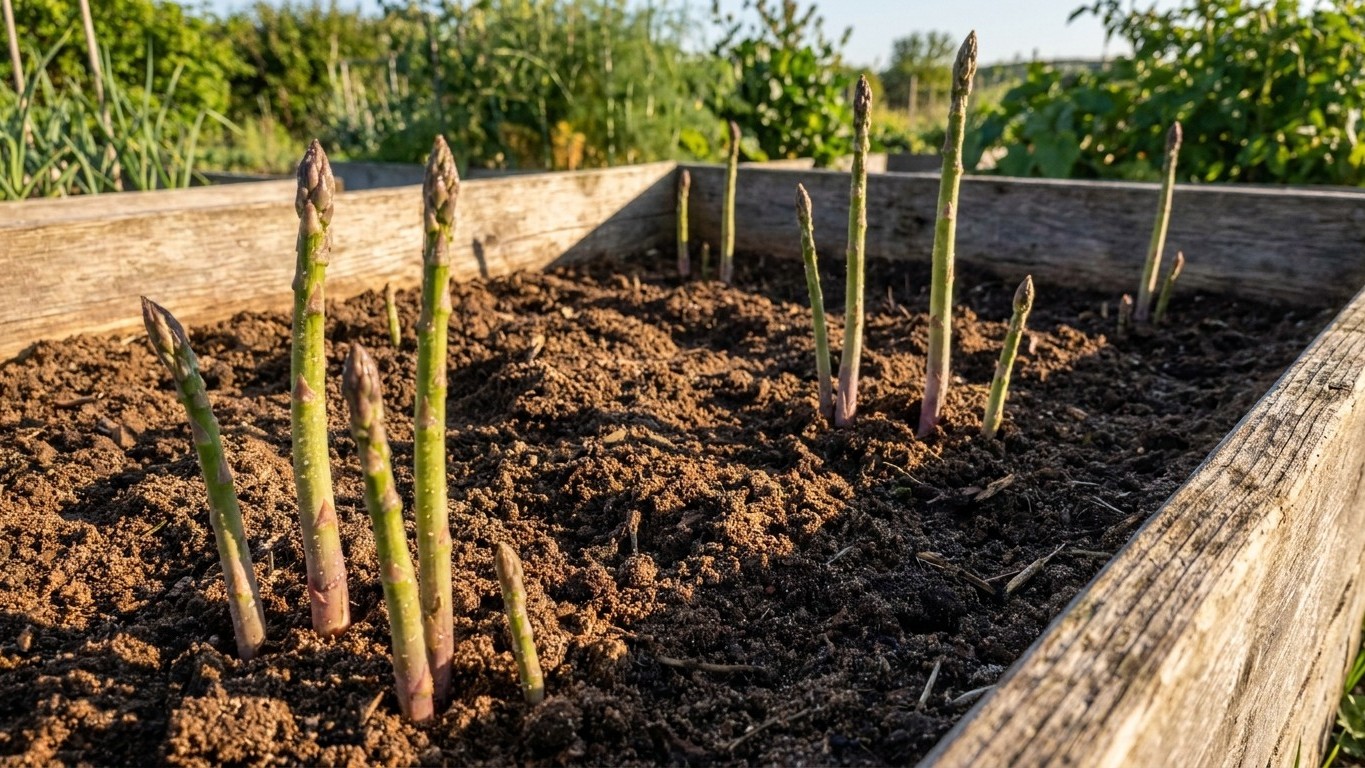

UAF Cooperative Extension documents five pests for Alaska gardens: aphids, cutworms, root maggots, slugs, and spruce beetle. Of those, four actually feed on asparagus. The fifth is a tree pest that has nothing to do with your asparagus bed, no matter how close it grows to the spruce line.
Which pests attack asparagus in Alaska

UAF Cooperative Extension documents five species for this territory, but only four have any business in an asparagus row. Spruce beetle belongs on the list because it’s a documented forest and landscape pest in Alaska, not because it touches vegetables. It bores into spruce bark, not into fern or crown tissue, so if you’re staring at damaged asparagus and blaming spruce beetle, look elsewhere. That leaves aphids, cutworms, root maggots, and slugs as the ones worth watching in the bed itself.
Aphids cluster on the soft new growth of the fern once the plant is past spear stage, sucking sap and leaving a sticky residue behind. Cutworms work at the opposite end of the plant’s life cycle each season, active low to the ground where they can sever a young spear right at the soil line overnight. Root maggots operate underground entirely, with adult flies laying eggs near the base of young plants and larvae tunneling into roots and crowns where you never see them directly. Slugs go after foliage and spear tips, and they do best where the ground stays damp.
That last point matters more here than in most places. Alaska’s representative state soil, the Tanana series, is described as poorly drained, which is exactly the condition slugs favor. A poorly drained bed doesn’t just risk root rot on a crop that stays in the ground for a decade or more, it also gives slugs the damp cover they need to stay active through more of the season. The extension service documents only five pests for this territory, and it’s worth taking that shortness at face value rather than assuming a longer list exists somewhere else. Fewer named pests means fewer things to rule in, but it doesn’t mean fewer things to rule out first.
When each one shows up, and what it does first
Alaska’s frost-free window runs roughly from the last spring freeze, which falls between May 3 and May 12 at the reference station used for these normals, and the first freeze of fall, adding up to about 143 frost-free days. That short, bright window is what Everything in the bed answers to, not a calendar month, because the same window shifts by location and elevation across the state.
Cutworms are usually the first sign of trouble, showing up as spears emerge early in that frost-free stretch. The tell is a spear that was standing one evening and lying severed at the soil line the next morning, with no chewing marks up the stalk, just a clean cut low down. Root maggots move in around the same early window, but their damage stays invisible above ground at first. What you actually see is a spear or young fern that wilts and yellows for no visible reason, because the feeding is happening on the roots and crown below the surface.
Aphids arrive later, once the ferny top growth is established rather than during the spear-cutting stage. Look for clusters on the undersides of fern branches and a faint stickiness on nearby foliage from the honeydew they leave behind. Slugs are less tied to a single point in the season and more tied to moisture, showing up whenever the ground stays wet, feeding on foliage and tender spear tips and leaving ragged holes and a telltale slime trail behind them.
None of this timing is harvest timing. Asparagus isn’t harvested at all until the third year after planting, so in those first two seasons any pest activity you catch is happening on fern growth and roots you’re deliberately not cutting, which is actually the easier time to deal with it, since you’re not choosing between treating the bed and losing your harvest.
Telling the damage apart from everything else
Insect damage gets blamed for a lot that insects never touched, and on a bed you’re committing to for over a decade, guessing wrong wastes a season you can’t get back. Check the soil before you check for bugs, since a wilting, yellowing spear in Tanana-type poorly drained ground is just as likely to be waterlogged roots as root maggot feeding.
| Symptom | Possible insect cause | What else it could be | What tells them apart |
|---|---|---|---|
| Spear cut clean at soil line | Cutworm | Mechanical damage, animal browsing | Cutworm cuts are clean and low; browsing tears foliage higher up |
| Wilting, yellowing spear or fern, no visible chewing | Root maggot | Waterlogged, poorly drained soil | Dig at the crown; maggot damage shows tunneling, waterlogging shows soggy soil and no larvae |
| Ragged holes in foliage, slime trail | Slug | Hail or wind damage | Slime trail is the giveaway; weather damage has no residue |
| Sticky residue, clustered insects on fern | Aphid | Not commonly confused with anything else | Visible clusters on the underside of fern branches |
None of this replaces a look from someone trained to identify it. If digging at the crown or checking for slime doesn’t settle the question, that’s the point to send a sample or a photo to your local extension office rather than guess your way through a bed you’ve committed fifteen years to.
What actually works here, and what is a waste of time
On a growing season this short, timing does more work than any treatment. Backfilling the planting furrow gradually, about two inches every other month across the year rather than all at once, isn’t just a planting instruction, it also buries the base of the plant in stages, which cuts down on the low, exposed soil line that cutworms and root maggot flies both target early on.
Physical barriers placed at the right moment beat most other options. A collar around young spears blocks cutworms from reaching the stem at the soil line, and floating row cover over the bed during the frost-free window’s early weeks keeps root maggot flies from laying eggs near the base in the first place. Hand-picking slugs in the evening, when they’re active, works better than any broadcast approach, especially in a poorly drained bed where the ground stays damp enough to keep them coming back.
What’s a waste of time is treating for spruce beetle anywhere near an asparagus bed, since it’s a tree pest and has no reason to be there. Amending soil pH before a test is another one, because the Tanana series surface pH of about 4.7 describes the state’s representative soil, not the bed you’ve actually dug, and correcting a number you haven’t measured in your own ground is guesswork twice over. This site doesn’t name products or active ingredients for a reason: what’s registered and legal to use changes by state, and your local extension office is the only place that keeps that current.
Where to check this for your own county
Everything above comes from UAF Cooperative Extension, and that’s exactly where the next step belongs too. A statewide pest list documents what’s been found somewhere in Alaska, not what’s in your specific garden, and the gap between those two things is often the whole answer. Your local extension office, organized by borough or district rather than by county in Alaska, keeps records closer to your actual ground, your actual drainage, and your actual season length.
That local layer matters more here than in most places, given how much the state’s frost-free window and soil conditions vary between the coast, the Interior, and the far north. A bed on well-drained ground near a milder coastal station will see a different balance of these four pests than one on Tanana-type poorly drained soil further inland, even though both fall under the same statewide list.
If you’re staring at a damaged spear and none of the general descriptions above quite fit, that’s not a sign to keep guessing. Bring a sample, or at minimum a clear photo, to your local extension office before you spend a season treating for the wrong thing on a bed you won’t be replanting for another decade.
Common questions
Does Alaska really only have five documented garden pests?
UAF Cooperative Extension documents five pests for this territory, and this page names all of them. A short documented list doesn’t mean nothing else is out there, it means these are the ones the extension service has on record here.
Can I treat for all four asparagus pests at once as a precaution?
Treating without a confirmed problem wastes effort on a bed where the real issues are more often drainage and timing than insects. Confirm the damage first, ideally with your local extension office, before choosing a response.
Does the state’s poorly drained soil mean I should raise my asparagus bed?
The Tanana series is the state’s representative soil and it is described as poorly drained, but it’s not a diagnosis of your own garden. Since asparagus needs well-drained soil for a planting that stays put for over a decade, testing your own bed’s drainage before committing is worth more than assuming either way.
Which asparagus varieties are named for growing in Alaska?
Utah State University Extension names four: Jersey Giant and Jersey Knight, both all-male, and UC 157 F1 and Purple Passion, both male and female. No flavor or yield differences between them are published, only their sex.