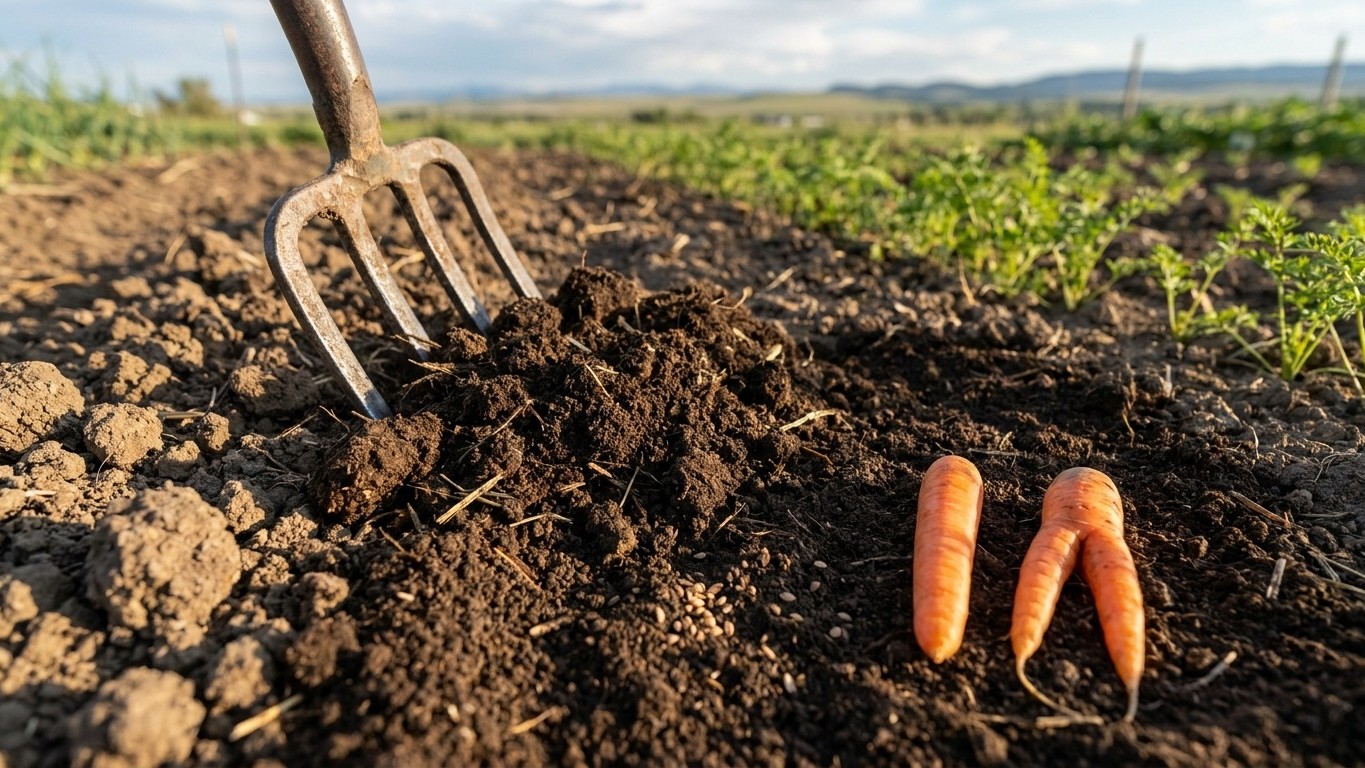

Carrots in Alaska come out of the ground when the shoulders push up through the soil surface and the tops start to yellow and flop, usually somewhere between 70 to 100 days after seeding. That window runs long here because a short, cool growing season slows root fill, so watch the plant rather than the calendar.
When carrots are ready in Alaska
Forget the seed packet date for a minute. The real signal is the top of the root itself: brush back a little soil at the base of the leaves and look for a shoulder about three-quarters of an inch across, with the foliage starting to lose its deep green and lean over. That’s the plant telling you it has stopped putting on size, not a countdown printed on paper.
Utah State University Extension puts the full maturity window at 70 to 100 days from seeding, and that number matters more in Alaska than almost anywhere else in the country, because carrots here are sown directly in place, never transplanted. There’s no earlier “start date” to borrow days from. Every one of those 70 to 100 days happens outdoors, at latitude, under a season that closes fast once September turns.
Clemson Cooperative Extension’s figure, harvest around 65 to 75 days after planting, sits at the front edge of that same range. Read the two together and a pattern shows up: the first pull can happen as early as day 65, giving you thin, sweet, snack-size roots, while letting the bed run closer to day 100 builds thicker, longer roots better suited to storage. Neither source names a specific variety or a soil pH target for this, so treat the day-count as a guide to check against the plant, not a guarantee stamped on a bag of seed.
Why the window runs wide here
Alaska’s growing season is short and the soil underneath it is working against the carrot from the start. The Tanana series, the soil USDA lists as representative of the state, is a Gelisol, meaning permafrost sits within reach of the root zone, and its surface horizon is poorly drained, strongly acid, and mostly silt. Cold, wet, acidic ground slows root development compared with the deep sandy loam a carrot actually wants, which is one reason the maturity window stretches toward the far end of the 70-to-100-day range for a lot of home gardens here rather than the near end.
No specific spring or fall frost-date figures are published on this page, so don’t lean on a calendar date at all. Use the shoulder-and-foliage check as your trigger, and plan to have the bed lifted before the ground itself starts to firm up with the first hard cold.
Keeping them, and for how long
Clemson Cooperative Extension’s Home & Garden Information Center gives the storage figures in plain terms: keep carrots at 33°F and high humidity to stop them wilting. That’s the number to write down, not a rough “cold and dark” instruction. Thirty-three degrees is barely above freezing, several degrees colder than most kitchen fridges actually hold, which is exactly why so many stored carrots go soft and rubbery well before anyone expects it.
The tops are the part people get wrong. Carrots stored with their leafy tops still attached, what Clemson calls bunched carrots, keep for about 10 to 14 days, full stop. The leaves don’t stop working once the root is out of the ground; they keep pulling moisture out of it, which is why bunched carrots wilt and shrivel so much faster than carrots with the tops cut off. Trim the foliage down to about half an inch above the root as soon as you pull them, and that single cut buys you months of storage life instead of two weeks.
That longer life span is not spelled out as a fixed number of months in the Clemson figures, and it comes with a hard condition attached: it’s a maximum under optimal cold, humid storage, not a promise. Let the temperature drift up into the 40s, or let the humidity drop and the roots dry out, and the actual storage life falls well short of anything close to that ceiling. Treat every stored-carrot figure as the best case, and check on the bin more often than you think you need to, especially in the first month.
High humidity matters as much as the cold does. Carrots stored dry, even at the right temperature, lose water through the skin and turn limp and bendable within weeks. Packing the trimmed roots in damp sand, damp sawdust, or perforated plastic bags keeps the moisture close to the root instead of letting it evaporate into dry cellar or fridge air, which is the practical way most home growers hit that high-humidity target without a dedicated root cellar.
Where in the house that actually is
A standard kitchen refrigerator runs colder than most people assume, but it’s still not the 33°F the Clemson figures call for. Most home fridges cycle somewhere in the high 30s to low 40s, warm enough that carrots stored loose in the crisper drawer soften faster than the published storage window suggests. The fix isn’t a different fridge, it’s the crisper drawer specifically, with the humidity control set high and the carrots bagged or wrapped so they aren’t drying out against the airflow.
A heated living space is the wrong end of the scale entirely. Room temperature sits 30 to 40 degrees above the target, and carrots left in a kitchen basket will go rubbery in days, not weeks, no matter how fresh they were at harvest. An attached garage swings the other direction and just as badly: in Alaska, an unheated garage can drop well below freezing overnight in the depth of winter, and a hard freeze turns stored carrots to mush the moment they thaw.
The closest match in most Alaska homes is an unheated but frost-protected space, an insulated entryway, a below-grade cellar, or a section of basement away from the furnace, somewhere that tracks cold outdoor air without actually freezing solid. That’s a description, not a guarantee, because every house is built differently. Put a thermometer in the actual storage spot for a few days before you trust it with the harvest — a cheap indoor-outdoor thermometer left on the shelf will tell you in a week whether that space is really running near 33°F or quietly drifting toward one extreme or the other.
Check humidity the same way. A space that feels merely cool can still be bone dry, especially near a furnace room or a drafty vent, and dry air undoes the benefit of getting the temperature right. Damp sand in a bin, or a lidded tote lined with a damp towel, raises the local humidity around the roots without needing a humidifier for the whole room.
What goes wrong here
Three problems show up more often in Alaska than in a milder climate, and all three trace back to the same short, cool, wet season the state runs on.
The first is a storage space that freezes solid instead of staying just above it. Alaska winters push outdoor temperatures far below the 33°F target for weeks at a time, and an unheated cellar, porch, or garage that isn’t insulated enough will follow the outdoor swing down with it. Frozen carrots turn to a soft, watery mess the moment they thaw, and there’s no saving them once that happens. Checking the storage temperature through a full cold snap, not just on a mild day, is what prevents this, since a space that reads fine in October can still freeze hard in January.
The second is a damp, cool harvest season that invites rot before the carrots ever reach storage. The Tanana series that represents Alaska soil is poorly drained by nature, and a wet fall leaves roots sitting in saturated ground right when they should be curing. Any carrot lifted with soft or split shoulders, or with soil clinging in a heavy, waterlogged clump, is a candidate for rot in storage rather than a keeper. Pulling the bed as soon as the shoulders and foliage show the maturity signal, rather than leaving roots in wet ground “just a little longer,” cuts this risk substantially.
The third is simply too many carrots at once. A short growing season concentrates the whole harvest into a narrow window, and a bed that all reaches maturity together can produce more roots than one household eats before storage life runs out. Staggering seeding by a couple of weeks, where the season allows it, spreads the harvest instead of dumping it all into one storage bin on the same day.
On pests, UAF Cooperative Extension documents aphids, cutworms, root maggots, and slugs as pests affecting Alaska gardens. Cool, damp soil conditions, the kind the Tanana series tends toward, favor slugs and root maggots especially, so a raised bed with better drainage does double duty: it fights the forking that Utah State University Extension warns comes from heavy, rocky soil, and it gives slugs and root maggots less of the damp ground they favor.
Common questions
Can I leave carrots in the ground over winter in Alaska instead of storing them indoors?
The Tanana series that represents the state’s soil sits over permafrost and is poorly drained, and no frost-date or overwintering figures for in-ground storage are published on this page. Given how cold and how wet that ground runs, lifting the crop and moving it to a controlled cold, humid space is the approach backed by the storage figures above.
Do I need to wash carrots before storing them?
That detail isn’t covered in the sourced figures here. What is confirmed is the tops: cut the foliage back to about half an inch above the root right after pulling, since the leaves keep drawing moisture from the root and are the main reason bunched carrots only last 10 to 14 days against a much longer life for trimmed ones.
Why do my carrots come out forked or split instead of straight?
Utah State University Extension traces this to heavy or rocky soil. Alaska’s representative Tanana series runs high in silt with poor drainage, conditions that push toward forking, and the fix is a raised bed or a well worked, loosened bed rather than switching seed.
How early can I start pulling carrots for eating instead of waiting for full size?
Clemson Cooperative Extension’s figure of 65 to 75 days after planting marks the earliest practical harvest, giving thinner, sweeter roots best eaten fresh rather than stored long term. Waiting toward the 100-day mark from Utah State University Extension’s range builds the larger, sturdier roots that hold up better in cold, humid storage.