
Four insects on Alaska’s documented pest list actually feed on carrots: aphids, cutworms, root maggots, and slugs. A fifth, spruce beetle, shows up in the same extension records but has no business in a vegetable bed. Timing runs off the seed date, not a transplant date, since carrots go straight into the ground and stay there.
Which pests attack carrot in Alaska

UAF Cooperative Extension documents five pests for this territory: aphids, cutworms, root maggots, slugs, and spruce beetle. That is the full list this service tracks here, and it is short on purpose. No padding, no extra names borrowed from other states’ guides.
Four of the five have a real reason to be in a carrot bed. Aphids cluster on the undersides of leaves and along stems, piercing tissue to feed on sap and weakening the top growth a carrot needs to build its root. Cutworms work at the soil line, usually right after seedlings break ground, cutting stems clean through before the plant has a chance to establish. Root maggots are the one that costs the most at harvest: the larvae tunnel directly into the developing root, and the damage happens out of sight, inside the carrot, long before the top growth shows any sign of trouble. Slugs feed on leaves and on any part of the root that sits proud of the soil, and they favor exactly the kind of wet, heavy ground this region tends to have.
Spruce beetle is the outlier, and it stays off this page for a reason. It attacks spruce trees, boring into bark to feed and breed there, and it has no feeding relationship with carrots or any other row crop. A gardener who spots bark damage on a nearby tree and worries it will spread to the vegetable patch can set that worry aside. The two problems don’t overlap.
Worth noting: the state’s representative soil, the Tanana series, is poorly drained and runs strongly acid at the surface, with a texture close to silt loam. Ground that stays wet longer than it should is exactly the condition slugs need to stay active and keep feeding, which is part of why they make this state’s list at all. That said, this is a description of the mapped soil series, not a measurement of any one backyard bed, and drainage varies a great deal between a river-bottom garden and a raised bed built on fill.
When each one shows up, and what it does first
Carrots are sown in place, so every timing question here runs from the seed, never from a transplant date. There isn’t one for this crop. Utah State University Extension puts the full run from seeding to harvestable root at 70 to 100 days, and that window is the backbone for reading when each pest is likely to be active.
Cutworms move earliest. They target seedlings in the first stretch after emergence, while the stem is still soft and low to the ground, and a row that looked fine one evening can show several plants severed at the base the next morning. That’s the signature: the top of the plant lying on the soil, cut clean, roots still in the ground.
Aphids build up over a longer stretch, once there’s enough leaf surface to support a colony. Their first sign isn’t a visible insect at all, it’s curled, sticky, or slightly deformed new growth at the tips of the foliage, sometimes with a faint shine from the honeydew they leave behind.
Root maggots take the longest to show themselves because their work happens underground. Damage tends to surface, literally, closest to the harvest end of that 70- to 100-day window, when the root has enough mass for the larvae to tunnel into. By the time a gardener sees wilting foliage above ground, the root below has usually already been compromised.
Slugs are the least predictable on a calendar and the most predictable on weather. They feed whenever the ground stays wet and the air stays cool, which in practice means they can show up early and keep showing up through the season, with feeding concentrated on nights after rain. Ragged holes in leaves, and chewed patches on any root shoulder poking above the soil, are the tell.
Telling the damage apart from everything else
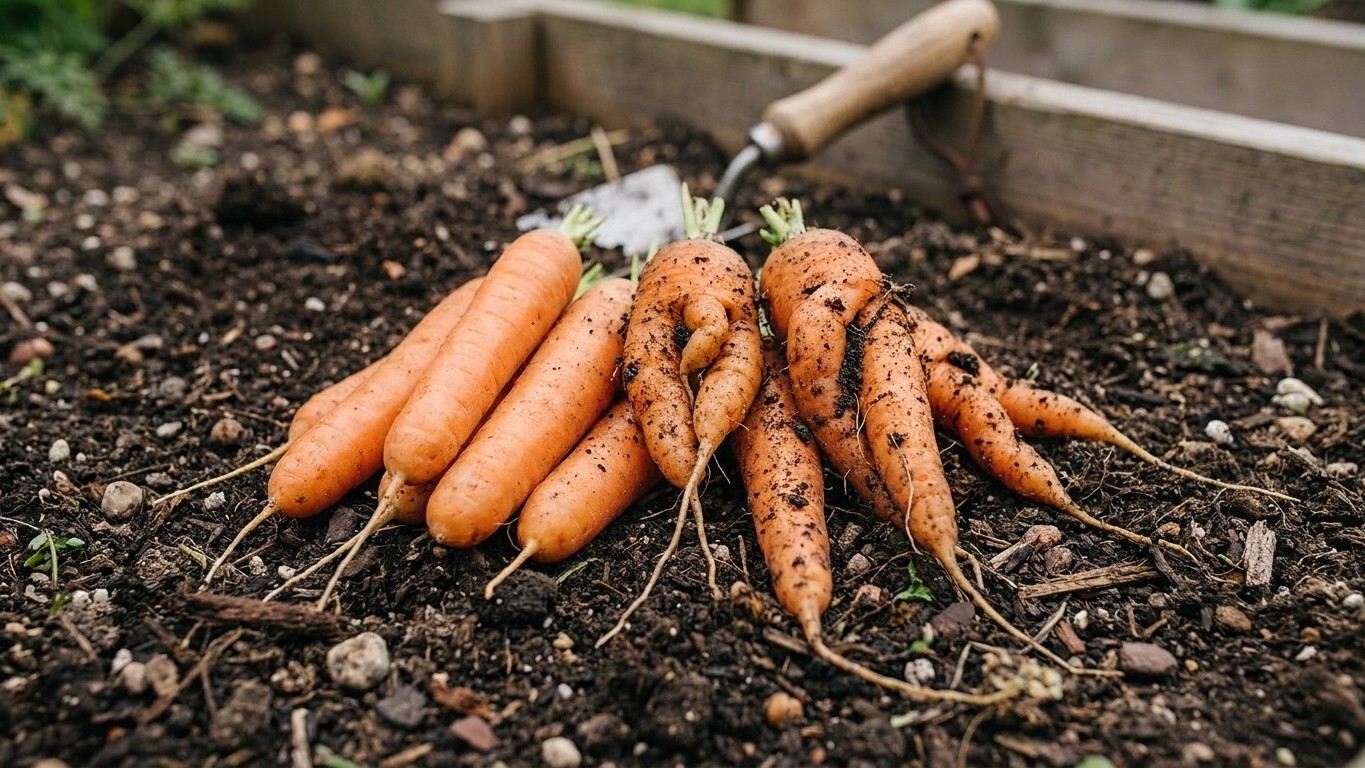
A carrot bed can look damaged without a single insect involved. A forked or twisted root with no chew marks anywhere on it is a soil problem, not a pest problem, and that distinction changes what a gardener does next entirely. Utah State University Extension is direct about this: heavy or rocky soil forces the root to fork as it grows around obstruction or compaction, and the fix is deeper, looser, more organic-rich soil, not an insecticide.
The table below separates the signs worth checking before assuming a pest is responsible.
| What you see | Likely cause | What settles it |
|---|---|---|
| Forked, twisted, or stunted root, no surface damage | Heavy, rocky, or compacted soil | Dig alongside the root: dense or rocky soil confirms it, no chew marks or tunnels present |
| Seedling cut clean at the soil line | Cutworm | Stem severed, not chewed ragged; larva often curled in soil nearby |
| Ragged holes in leaves, slime trail | Slug | Feeding worse after rain or overnight; slime visible in daylight |
| Tunnels inside the harvested root | Root maggot | Visible only when the root is cut or pulled; tiny entry holes on the surface |
| Curled new growth, sticky residue, sluggish plant | Aphid | Clusters visible on leaf undersides with a hand lens or close look |
| Uniform pale or yellowing foliage across the bed | Nutrient deficiency or waterlogging | No insects present anywhere; a soil test settles this, not a pest search |
None of this replaces an actual look at the plant. Extension offices exist specifically to confirm what a symptom means for a given garden, and a phone call with a description, or better, a sample, is worth more than guessing from a list.
What Actually Works here, and what is a waste of time
Timing beats product on a short growing season, and that’s especially true for the two pests that attack early. A physical barrier laid down before seedlings emerge blocks cutworm moths and root maggot flies from ever laying eggs in the bed; the same barrier put down after damage appears does nothing but trap the problem inside with the crop. Floating row cover, set at seeding and left on until plants are past the vulnerable early stage, is the single most reliable move for both pests.
Rotating the bed matters too. Root maggot larvae overwinter in soil that hosted root crops, so planting carrots, or any related root vegetable, in the same ground the following season gives the next generation an easy start. Moving the row to different soil breaks that cycle without any product involved.
For slugs, the practical fix is reducing the wet, sheltered conditions they need rather than chasing them after the fact. Clearing mulch or debris that holds moisture against the soil surface, and hand-picking at night when they’re active, does more over a season than a single treatment applied once damage is visible.
What doesn’t work: waiting until foliage wilts to deal with root maggots. By then the larvae are already inside the root, and there’s no barrier or treatment that reaches them there. Amending soil with compost helps prevent forking, but it does nothing against an insect, and treating the two as the same problem wastes a season. Any registered treatment for these pests is a question for the extension service, not a general gardening guide, since what’s legal to use varies by state and by product.
Where to check this for your own county
UAF Cooperative Extension is the source for every pest named on this page, and it’s also the office equipped to say what’s actually present in a specific garden, which this page cannot do. State-level documentation describes what’s been found somewhere in the territory, not what’s living in one particular yard. Bring the actual insect, or a clear photo of the damage, rather than just a description, when contacting a local office, since identification from a written symptom alone is often unreliable.
Soil is the same story. The Tanana series represents Alaska in USDA records, with a strongly acid surface near pH 4.7 and poor drainage, but that’s one mapped series among hundreds across the state. A garden on river-bottom ground, a raised bed built with amended soil, or a yard on fill will behave nothing like that profile. A soil test through a county extension office gives an actual number for actual ground, rather than a state average standing in for it.
The next step is straightforward: find the county office covering the specific garden, and bring both a soil sample and a pest sample, if one is on hand, rather than treating either as settled by a list.
Common questions
Does spruce beetle ever damage vegetable gardens?
No. It feeds on spruce bark and breeds under it. It has no documented connection to carrots or any other garden crop.
Can carrots be transplanted to get ahead of pests?
No. Carrots are sown directly in place, so there’s no transplant date to plan around, only the seed date, with the root maturing 70 to 100 days after that.
Is a forked carrot root always a pest problem?
Usually not. Forking most often traces back to heavy, rocky, or compacted soil, not insect feeding. Check for chew marks or tunnels before assuming a pest is involved.
Does the state’s documented soil pH mean a garden bed is that acidic?
No. The pH 4.7 figure describes the mapped Tanana series surface, not a cultivated garden bed. A soil test is the only way to know an actual bed’s pH.