
Collards grow well in southcentral Alaska as a summer-into-fall crop. Seedlings go out once the soil has warmed in late spring, the leaves are picked through the cool months, and the planting ends at the first hard freeze. Nothing stands through the winter. Long summer daylight helps, a cool damp summer sets the disease risk, and the types that suit your valley matter more than any national list.
When the soil is warm enough in Alaska

Anchorage’s reference station puts the mean last spring frost between May 3 and May 12. That comes from the NOAA NCEI 1991-2020 Climate Normals, station USW00026451, using the 30 to 70 percent band of 32 F freeze probabilities (NOAA NCEI data for the station). Those dates are odds. Some springs bring a 32 F night after them, and some spring freezes arrive earlier.
The date matters less than what lies under the mulch. Frost tells you when the air stops freezing. Collards care about the soil, and it warms after the frost risk ends, sometimes by a couple of weeks. Cold ground slows root growth, so a seedling set into it sits still while the calendar runs.
How do you tell if the soil is ready for collards?
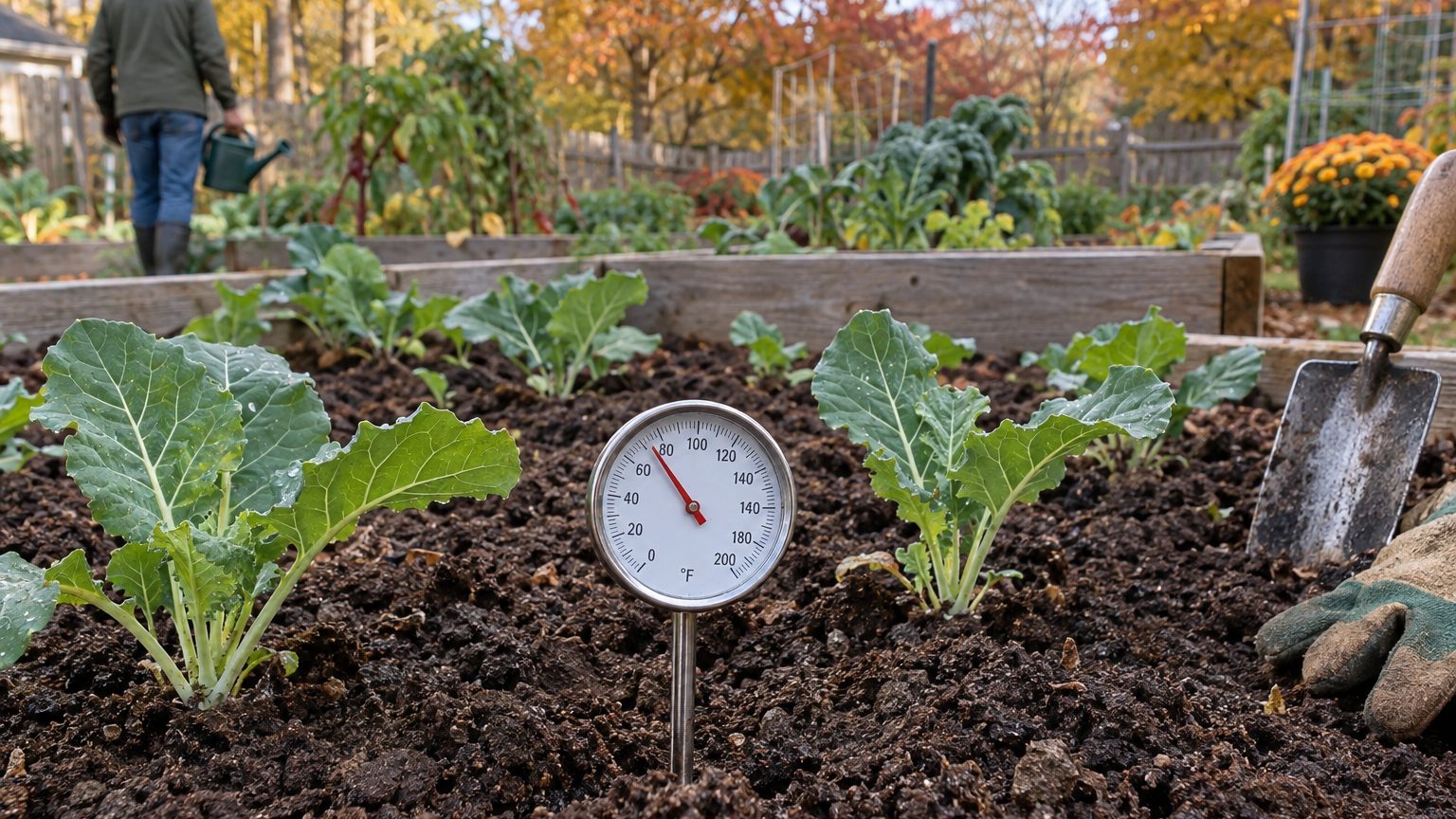
Push a soil thermometer into the bed in the morning, when the bed is at its coolest. Collard seed germinates in cool soil, but it comes up slowly and unevenly near the bottom of its range. Readings that hold steady, with the ground thawed and workable, are a sensible green light for transplants. A bed that crumbles in your hand instead of forming a wet ball is ready to plant.
Collard transplants that have been hardened off tolerate a light frost. Many gardeners set them out near the frost window with a floating row cover over them for that reason. Covers help twice, because they hold a few degrees of warmth at night and keep cabbage root maggot flies away from the stems. The seedlings are not the problem. The cold ground is.
Raised beds and dark soil warm earlier than ground-level beds that are shaded or heavy with clay. A raised bed on a south-facing slope may be workable days ahead of a flat bed beside it. Black plastic laid over the bed before planting warms it further. Pull it back or cut planting holes through it once the soil is up to temperature, and plan to mulch over it with straw once summer sets in so roots stay cool.
These dates belong to Anchorage, which is among the mildest inhabited places in the state. In the Interior and the far north the ground thaws later and the frost dates move with it. The coldest sites can be weeks behind. The University of Alaska Fairbanks Cooperative Extension Service can give timing for your own valley, borough or village.
How long the season lasts here
The reference station has about 143 frost-free days between the mean last spring frost (May 3 to May 12) and the mean first fall frost (September 22 to October 1). That is a moderate window for a brassica. It is long enough for a full collard crop from transplants, and it falls short of what most of the country enjoys.
The window shrinks fast as you leave Anchorage. The Interior and the north have far fewer frost-free days. A garden near Fairbanks, or in a high valley, plays by different rules than a south-facing lot in Anchorage. Long summer daylight partly makes up the difference, since plants get many more hours to photosynthesize in June and July than they would farther south.
Can you plant collards twice in Alaska?
At the Anchorage station, yes, with a modest second sowing after the first. Staggering plantings spreads the harvest so every plant is not at the same stage when the first hard freeze arrives. The second planting does not have to reach full size. Young leaves picked after cool nights are tender and mild, and a small collard leaf in October is worth eating.
Where the window is shorter, the first sowing is the only one. The season has no room for a recovery, so transplanting is worth the extra step. Started indoors ahead of time, seedlings go out already growing instead of starting from seed in cold ground. The catch is the roots. Before planting, slide a seedling from its pot or cell and look at the root ball. White roots reaching the sides are fine. A tight mat of circled roots should be loosened with your fingers so the plant can grow outward. A seedling left too long in a small cell also stalls after transplanting, and sustained cold can push some brassicas toward flowering early.
Succession sowing, including how far apart to space plantings, is covered in Growing Collards: One Planting, Months of Harvest. Gardeners comparing northern conditions can also read Growing Collards in Yukon for a shorter, colder season, and Growing Collards in Newfoundland and Labrador for a cool, damp, maritime one.
Heat and water in Alaska

Heat stress, the main worry for collards across the South, is not what limits a crop in most of Alaska. Summers here run cool, and a collard planted in a sunny bed is rarely too hot. The trouble in a cool, damp summer runs the other way. Growth slows, leaves stay small, and moisture sits on the foliage. That brings mildew and leaf spots, and slow-growing plants invite aphids and root maggots.
The practical answer is to give plants room. Space them far enough that air moves between leaves, water at the base in the morning so foliage dries by evening, and keep weeds down. A layer of straw or other organic mulch holds soil moisture through dry spells and keeps splashing soil off the lower leaves. Check moisture with your finger before watering, because a cool soil that already feels damp does not need more.
Can collards stay in the ground over winter in Alaska?
No, and the winter low explains why. At the Anchorage reference station the mean daily minimum of the coldest month is 11.0 F. Collards in milder places stand through winter and are picked leaf by leaf. With nights that cold, a collard bed here behaves as an autumn crop that ends at the hard freeze. Plants may shrug off several light frosts and taste better for them, since cold pushes sugars into the leaves. A deep freeze finishes them.
That shapes the whole bed. Plan to harvest steadily from summer through fall and finish before the ground locks up. A hoop house or cold frame can stretch the autumn, but it will not carry a crop to spring. Anyone dreaming of Southern-style winter greens should plan on a good fall instead, and on freezing or blanching the surplus.
The USDA Plant Hardiness Zone Map (2023, built on 1991-2020 normals) runs from zone 1a to 8a across the territory, which makes a single zone number meaningless for a statewide recommendation. Winter hardiness there is based on the average annual extreme minimum temperature. Anchorage is one reference point, and the Interior, the coast and the north all sit elsewhere on that range.
Collards share their troubles with the rest of the cabbage family, including cabbage, kale and mustard, and turnips and rutabagas belong to the same group. A bed that held any of them is not a fresh bed for collards. Rotate collards to ground that has gone without a brassica, because root maggots and clubroot linger in the soil of a cool, damp garden.
Which collards suit Alaska
A short season favors the earliest types, so look for collards sold as quick or early, with plants that make usable leaves while the days are still long. Compact, open-leaf types suit cool conditions better than large, late-maturing ones that need a long run to fill out.
Damp summers make disease resistance the first criterion. Choose seed or transplants labeled with resistance to the common leaf diseases of the cabbage family, and give every plant airflow. Resistance does not replace spacing, and spacing does not replace resistance. Types that shrug off a few light frosts also pay off, because the best flavor comes in the cool nights of autumn.
Where can you find collard varieties trialled in Alaska?
Ask the University of Alaska Fairbanks Cooperative Extension Service. It publishes vegetable guidance for Alaska’s gardeners and has local offices that know which types come through a short, cool season. A variety that does well in a Georgia summer says almost nothing about a Palmer bed in June, and a list copied from a southern site can send you toward plants that never size up before the freeze. Naming a single variety here would be a guess. A locally trialled recommendation is something you can plan around.
When you shop, read the seed packet for the days-to-harvest range and compare it to your own frost window. Collards are normally transplanted, so those days count from transplanting. If the range is long and your season is short, pick an earlier type. Garden centers in Alaska stock transplants chosen for local conditions, and the staff are often a good source on what has worked in recent summers.
Common questions
When should I plant collards in Anchorage?
Plant after the soil has warmed and the frost risk has mostly passed. The mean last spring frost at the reference station falls between May 3 and May 12, and the soil warms after that. Check the bed with a thermometer rather than the calendar, and use row cover if the forecast dips near freezing.
Do collards survive an Alaska winter?
Not outdoors in the ground. The mean daily minimum of the coldest month at Anchorage is 11.0 F, which is too cold for collards to stand through winter. Treat them as an autumn crop that ends at the hard freeze, and harvest or preserve what remains before it arrives.
Does cool weather hurt collards?
Light frost does not, and it often improves the flavor. Prolonged cold soil in spring slows root growth, and a hard freeze in fall ends the crop. The bigger risk in a cool, damp summer is disease on crowded, wet foliage.
Can I grow collards where a cabbage bed was last year?
Avoid it. Collards, cabbage, kale and mustard share the same pests and diseases, and so do turnips and rutabagas. Moving collards into a bed that held any of them rotates nothing, so give the ground time away from the whole family.