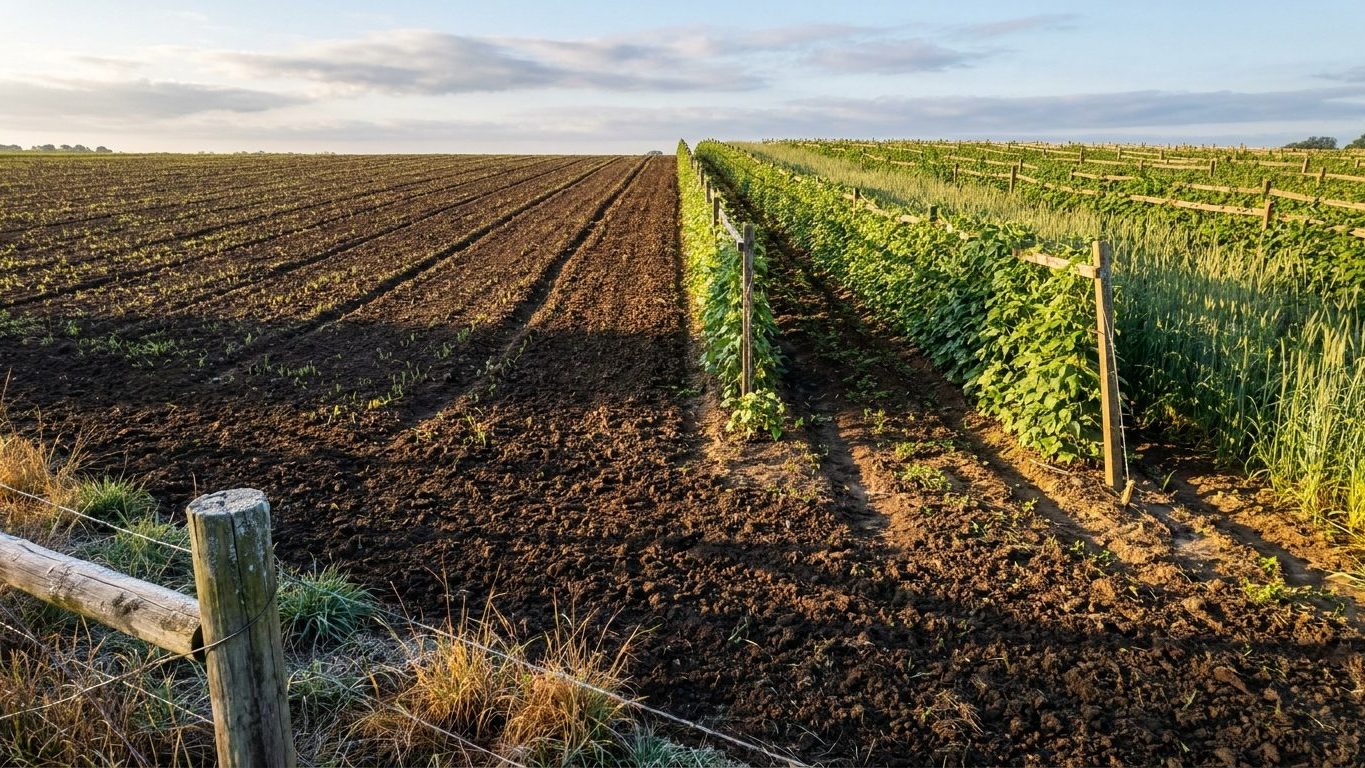

Sow Cover Crops in the Anchorage area only after the last spring frost, expected between May 3 and May 12, and get seed in by mid-July so roots and top growth can establish before the first fall frost, expected between September 22 and October 1. Those dates are 30 to 70 percent freeze probabilities, not promises, and they describe Alaska’s mildest inhabited corner, not the state as a whole.
The short answer for Alaska
The window above comes from one weather station: Anchorage’s USW00026451, the reference point NOAA uses for its 1991-2020 Climate Normals. That station’s freeze data gives a last spring frost of May 3 to May 12 and a first fall frost of September 22 to October 1, which works out to roughly 143 frost-free days. Both dates sit in the 30 to 70 percent probability band, meaning frost still has a real chance of showing up inside that stretch, just less often than outside it. A gardener who plants on May 3 is taking a bigger risk than one who waits until May 12, and the same logic runs in reverse at the fall end.
One hundred forty-three days is short next to most of the Lower 48, but Anchorage doesn’t play by the same rules as, say, a Midwest garden with a similar frost-free count. Summer daylight here runs close to around-the-clock in June, and that extra light speeds up early growth even when soil and air temperatures lag behind. It doesn’t erase the calendar, though. Growth still depends on accumulated warmth, and a long-daylight day that stays cool contributes less than a shorter, warmer one would elsewhere.
What actually changes the answer is location within the state, not variety choice within a single garden. This page’s window is built on Anchorage’s numbers specifically. Move away from that station, toward the Interior, the coast, or higher ground, and both frost dates shift, sometimes by weeks rather than days. Treat the May-to-mid-July window as a starting point tied to one city, and confirm it locally before betting a season on it.
What will not work here
A 143-day frost-free season defeats any cover crop that needs a long, steady run of heat to complete its cycle. Species and blends marketed for warm-season growth, the kind that thrive on sustained 80-degree stretches, simply don’t get that kind of heat in an Anchorage summer no matter how much daylight is on offer. Long daylight speeds up photosynthesis during the hours it’s available, but it can’t substitute for the accumulated warmth those crops are bred around. Expect thin, slow stands from anything sold as a heat-lover, not a failure of technique but a mismatch of climate.
Winter survival is a separate problem from the growing season, and it runs on a different number. The mean daily minimum of Anchorage’s coldest month sits at 11.0°F, and that figure, not the record low and not a monthly average, is what decides whether a cover crop planted for overwintering actually makes it to spring. A legume or grass advertised as winter-hardy in a milder region can still die back here if it isn’t rated for cold at or below that mean minimum, unless snow cover happens to insulate it through the coldest stretch. Snow is doing real work in Alaska gardens; bare, exposed ground in a low-snow winter changes the outcome for the same seed that survived fine the year before.
Timing mistakes fail just as reliably as the wrong species. Seed going into cold, wet soil before the last frost risks rot rather than an early start, since soil temperature in early May is often still catching up to the calendar. On the other end, anything sown after mid-July is racing a closing window: roots and canopy need real time to establish before that September 22 to October 1 frost arrives, and a cover crop that’s still tender when the first hard freeze hits gets no benefit from the season it barely used.
What changes across Alaska
Alaska spans USDA hardiness zones 1a to 8a, under the USDA Plant Hardiness Zone Map’s 2023 update built on 1991-2020 normals. That is one of the widest internal spreads of any state in the country, and it means there is no single sowing calendar for “Alaska,” only one for whichever part of it a gardener is standing in. The dates in this article are anchored to Anchorage, sitting toward the milder end of that range, and they should not be borrowed wholesale by a reader gardening somewhere colder.
Move toward the Interior and the frost-free season shrinks fast, since that region loses the coastal moderation that keeps Anchorage’s winters and shoulder seasons comparatively gentle. Push north toward the Arctic and the growing season compresses further still, sometimes to a fraction of what a south-central garden gets. Elevation does similar damage on a smaller scale: a garden a few hundred feet higher than a nearby valley floor can see frost arrive earlier in fall and linger later in spring, shrinking the safe sowing window without the gardener moving more than a few miles.
None of that can be resolved from a state-level page. The USDA hardiness zone map exists precisely to sort out where a given zone number actually falls, and it’s the right tool for a reader trying to place their own garden inside Alaska’s 1a-to-8a spread. This page can describe the range and explain why it matters; it can’t tell an individual reader which end of it they’re standing on.
Where to check this for your own county
The state-level answer above is a starting point, not a final one. For anything closer to a real recommendation, the right stop is the University of Alaska Fairbanks Cooperative Extension Service. Alaska organizes its local offices by district and borough rather than by county, but the principle is the same one that applies anywhere in the country: a local extension office publishes calendars and trial results tuned to conditions a state page can’t capture.
Two things are worth hunting for once there. The first is a local or regional planting calendar, if one exists for the district covering the reader’s own garden, since it will reflect frost dates and season length specific to that area rather than to Anchorage’s station data used here. The second is any list of cover crop or forage varieties that extension agents have actually trialled in that district. Alaska’s climate range is wide enough that a variety performing well near the coast can struggle or fail outright in the Interior, and local trial data catches that kind of mismatch before a gardener’s own season does.
A district recommendation beats a state one every time, because it’s built on conditions closer to the reader’s actual garden. This page works at the state level by design, using one reference station’s frost data to describe a broad window. That’s useful for understanding the mechanics of the calendar and why the dates land where they do, but it isn’t a substitute for whatever the local extension office has already worked out for a specific district or borough.
Checking this against your own garden
Calendar dates describe averages across three decades of weather records, not this particular spring in this particular yard. A reader’s own observations, made without any special equipment, tend to outrank the calendar once the growing season is actually underway.
Soil warmth is the first and most reliable check. Digging down a few inches with a hand trowel and feeling the soil in the morning tells a gardener more about whether it’s actually ready for seed than any date on a page like this one. Cold, clammy soil in mid-May, even after the average last frost has passed, is a sign that this particular garden is running behind the station data and that waiting a little longer will pay off.
The first flush of flowers on a legume cover crop is worth watching too, since it marks the shift from vegetative growth into the stage where nitrogen fixation and biomass production really pick up. A crop that flowers noticeably earlier or later than expected is signaling something about how this specific spot’s microclimate compares to the regional average, whether that’s a sun trap warming things up or a low pocket holding cold air.
The appearance of the first true leaves, distinct from the initial seed leaves, tells a gardener the seedling has moved past its most fragile stage and is drawing on its own root system. Watching for that milestone, rather than counting days since sowing, gives a more honest read on how this particular season, in this particular garden, is actually unfolding.