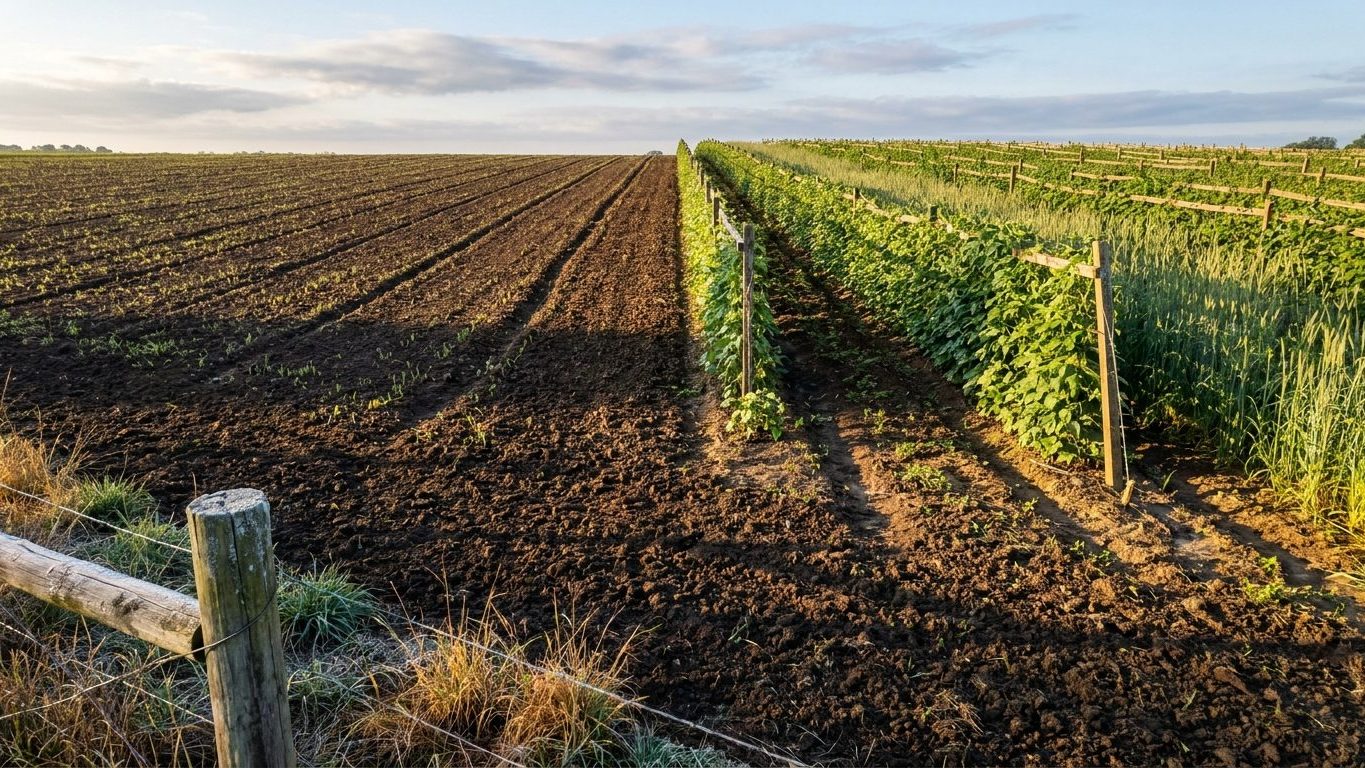

Arizona doesn’t have one cover-crop calendar, it has two entirely different ones. In the low desert around Phoenix, sow in fall and grow straight through a mild winter, because frost almost never shows up to force a spring planting date. Up in the high country, the old frost-to-frost rule still applies, and it applies hard.
The short answer for Arizona
Start with the number that changes everything: NOAA’s 1991-2020 records at station USW00023183 (the Phoenix reference station) show a 32°F freeze in only 6 of the last 30 years, and when it does happen it lands anytime between late December and mid-January. NOAA’s own normals list the frost-free season here at 365 days. That’s not a typo, and it means the question every cover-crop calendar in a colder state leans on, “when’s my last spring frost,” simply doesn’t organize the year in the low desert.
So the sowing window isn’t built around frost risk. It’s built around heat. The mean daily minimum for the coldest month sits at a mild 45.3°F, warm enough that cool-season covers like clover, vetch, oats, and field peas keep growing right through winter instead of going dormant. That gives low-desert gardeners a fall window, roughly the first cool break after the worst of the summer heat, to sow those cool-season species and let them build biomass for months, terminating them before the heat returns rather than after a spring thaw.
Summer sowing is a different game entirely. It only makes sense for genuinely heat-tolerant, fast-cycling species, and it needs to be timed to actual monsoon moisture rather than a fixed calendar date, since the heat itself, not any cold snap, is what stalls growth for months at a stretch in the low desert. Treat the 6-in-30-years frost figure as exactly what it is: a rare-event probability, not a planning date. Building a spring-after-frost calendar around a freeze that shows up one year in five is planning around noise.
None of this applies uniformly across the state. This answer is anchored to the Phoenix reference station specifically. Arizona’s hardiness zones run from 4b to 10b, a spread wide enough to cover both a nearly frost-free desert floor and genuinely cold, snow-holding high country. The rest of this page works through what changes when you’re not gardening at that reference point, and where to check the specifics for your own ground.
What will not work here
Borrowing a frost-based calendar from a cold-winter state is the single most common mistake, and the 6-in-30-years figure explains why. A gardener who waits for “two weeks after last frost” in the low desert is often waiting for an event that isn’t coming, missing the actual fall window while a cover crop that could have been growing for months sits in the seed packet.
Slow, thirsty cover crops are the second failure point. Species that need steady, consistent soil moisture to establish struggle in the low desert without real irrigation discipline, because desert air pulls moisture out of bare soil fast, faster than a once-a-week watering habit replaces it. A cover crop calendar written for a humid state assumes rainfall does most of that work. Here, it doesn’t, and a seedbed that dries out between waterings simply won’t germinate evenly, regardless of what the packet says about timing.
Sowing warm-season, heat-loving covers on a fixed summer calendar date, ignoring monsoon arrival, is the third trap. A species that tolerates 100°F-plus days can still fail as a seedling if it’s sown into a dry heat spell with no monsoon moisture behind it yet. The plant that would thrive once the summer rains arrive can die establishing a few weeks too early.
Fourth, don’t expect a true winter dormancy period to reset anything here. With a coldest-month mean minimum of 45.3°F, the low desert simply doesn’t deliver the sustained cold that some cover-crop guidance assumes will suppress pests, reset disease pressure, or force a hard dormancy break. Plan pest and disease management as an active, in-season task through the mild winter, not as something the cold will handle for you.
Finally, a species picked because it’s “fast and easy” in a milder climate, buckwheat is the classic example elsewhere, can bolt, wilt, or simply stop performing once true desert summer heat sets in. Fast-growing isn’t the same as heat-tolerant, and conflating the two is how a reliable cover crop in one climate becomes a disappointment in another.
What changes across Arizona
A hardiness zone spread of 4b to 10b is not a rounding error. It’s the difference between the near-frost-free floor of the low desert and mountain country cold enough to sit deep in single-digit winter zones. There is no single sowing calendar that honestly covers both ends of that range, and any page, including this one, that gives you one set of dates for the whole state is oversimplifying.
| Region type | Winter behavior | Governing factor |
|---|---|---|
| Low desert (Phoenix reference station) | Frost in only 6 of 30 years; mild coldest-month minimum of 45.3°F | Summer heat, not frost |
| High country / higher elevation | Reliable hard freezes each winter | Frost dates, spring planting window |
If you’re gardening in the north of the state or at real elevation, the entire framework in the sections above flips. Instead of a fall-sown, heat-driven calendar, you’re back to the conventional model: wait for a real last-spring-frost date, plant your cool-season covers in spring, and expect winter to actually stop growth rather than just slow it down. The mild 45.3°F coldest-month minimum quoted above describes the low desert, not the high country, and treating it as a statewide figure would be a mistake in the other direction.
This page can’t tell you which zone your own property sits in, and it shouldn’t try to guess from a county name alone, since elevation inside a single Arizona county can shift the local climate as much as driving to a different state. Check the USDA Plant Hardiness Zone Map directly for your address before choosing which half of this page applies to you.
Where to check this for your own county
Everything above is a state-level answer, anchored to one reference station. Arizona’s actual growing conditions vary by elevation and by county enough that a county-level recommendation will beat this page every time it exists, and it usually does. The University of Arizona Cooperative Extension is the right place to look.
Once there, look specifically for two things. First, a local planting calendar for your county office, whether that’s Maricopa, Yuma, Cochise, Coconino, or another district, since those calendars are built from local station data rather than a single statewide average. Second, look for variety trial results run in your county, which tell you which specific cover-crop species have actually performed well on soils and in a climate like yours, rather than which ones perform well somewhere in the state generally.
This page exists to explain the mechanism, why frost dates matter so little in the low desert and so much in the high country, and to give you the state-level reasoning behind a sowing decision. It was never meant to replace a county office that has your local frost data, your local soil type, and your local trial results on file. Treat this as the framework, and the extension office as the specific answer for your address.
Checking this against your own garden
Every date on this page is a probability built from decades of averaged data. Your own patch of ground, sitting exactly where it sits, will tell you something more current every time you check it directly.
Start with soil warmth by feel. Push a hand a couple of inches into the seedbed in the morning before the sun has heated it. Soil that feels genuinely cool to the touch, even in what the calendar calls a warm month, means microclimate factors, shade, elevation, wind exposure, are keeping your ground cooler than the reference station, and warm-season sowing should wait.
Watch for the first flush of flowers on a fast-cycling test patch, whether that’s a quick legume or another early bloomer. Flowering triggered by heat and day length arriving earlier or later than the calendar above suggests tells you your specific spot runs warmer or cooler than the state-level pattern this page describes.
Finally, track how fast true leaves appear after sowing. Quick, even emergence across a seed row means the soil temperature is genuinely in range for that species right now. Slow, patchy, or uneven emergence is the ground telling you the timing was off, regardless of what the calendar said it should be.