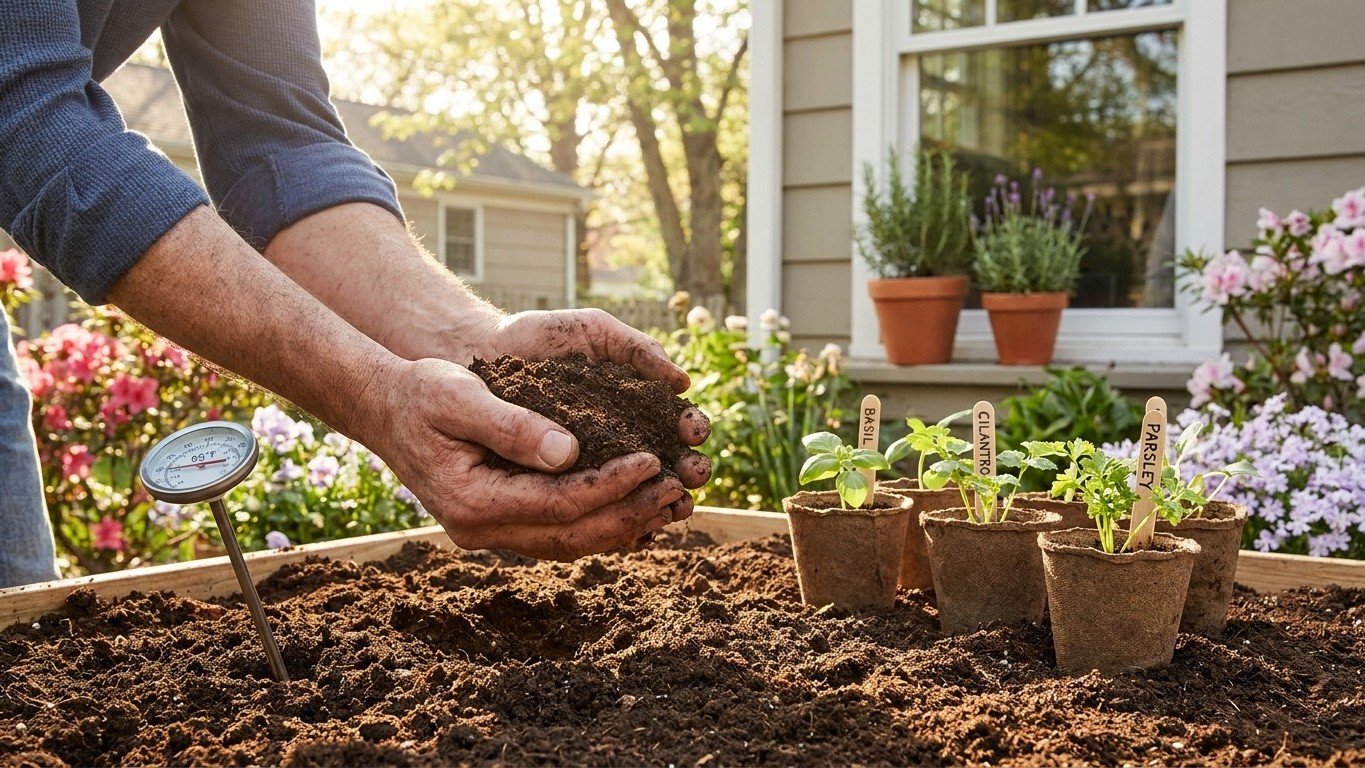

Anchorage’s soil rarely reaches herb-friendly warmth before mid-May, and the growing window that follows runs a little under five months, bookended by frost dates that arrive earlier and leave later than most of Alaska ever sees. That gap between “frost-free” and “warm enough” is where most transplant mistakes happen here.
When the soil is warm enough in Alaska
NOAA’s 1991-2020 Climate Normals put the last spring frost at Anchorage’s reference station (USW00026451) between May 3 and May 12, based on the 30-70% probability band for a 32F freeze. That’s a real date range from a real station, not a rounded guess, and it’s worth sitting with for a second: even at the low end, it’s a full month later than gardeners in much of the Lower 48 are already setting out basil.
But a frost date only tells you when the air stops freezing. It says nothing about the dirt. Soil holds cold far longer than air does, especially in a state where snowpack can linger into April and the ground underneath stays chilled well past the point where the thermometer reads safe. Herbs that like heat at the root, basil and dill are the classic examples, will simply sit and sulk if you tuck them into cold, wet soil the same week the frost risk drops below 30%. The frost date is a probability, not a promise, and treating it as the day soil suddenly wakes up is the single most common reason transplants stall in Southcentral Alaska.
What actually signals readiness
A soil thermometer pushed a few inches down beats a calendar every time. Cold-tolerant herbs in the mint and chive family will tolerate soil in the 50s. Heat-loving annual herbs generally want soil closer to the 60s before they’ll grow instead of just survive. Given Anchorage’s short, cool run-up to summer, that threshold often lands a week or two after the last frost date itself, not on it.
This is also where long daylight does some quiet compensating. Alaska’s summer sun angle and day length push growth harder, hour for hour, than the same soil temperature would produce farther south. It doesn’t erase the cold-soil problem, but it does mean a herb that finally gets going in late May can close the gap faster than the calendar suggests it should.
None of this changes the caution worth repeating: this is a probability window centered on one weather station, and gardeners in the Mat-Su Valley, the Kenai Peninsula, or further into the Interior are working with a different, generally shorter, calendar entirely.
How long the season lasts here
Running the two NOAA-sourced dates together, Anchorage’s frost-free window spans from the May 3-12 last spring frost to a first fall frost of September 22 to October 1. NOAA’s own figure for the result is about 143 frost-free days, and the station notes something else worth knowing: Anchorage is one of the mildest inhabited parts of Alaska, so this window is close to the best-case scenario for the state, not the average one.
143 days sounds workable, and for herbs it mostly is, but it’s a tighter number than it first appears once you subtract the two or three weeks most annual herbs need to establish after transplant and the week or two of cold soil lag described above. That leaves a working season closer to four months of active growth rather than five, which matters when you’re deciding whether a second round of seeding is realistic.
One sowing, or two
A longer window, say five-plus months, usually supports succession sowing: a spring batch of a fast annual herb like dill or cilantro, harvested and pulled, followed by a second batch that matures before fall frost. Anchorage’s 143 days sits right at the edge of that math. Quick-cycling herbs sown directly in late May can sometimes support a second sowing in early July, but slower annuals, and anything started from seed rather than transplant, generally get one shot before the September frost date closes things out.
That edge case is exactly why the timing math matters more here than in longer-season Territories. If you’re weighing whether your particular herb and your particular sowing date leave room for a second round, the succession sowing guide on this site walks through how to count backward from a known fall frost date to see what fits.
It also changes how much transplanting is worth the trouble. In a short window, a herb that resents root disturbance, cilantro is the standard example, may be better direct-sown even though transplants would normally save a few weeks. Losing a week to transplant shock in a 143-day season is a bigger loss, proportionally, than the same setback in a six-month one.
Heat and water in Alaska
Anchorage doesn’t post meaningful days above 90F in a typical summer, and that absence is itself the data point worth using. For a page usually built around summer heat stress, Alaska simply doesn’t supply that variable. What it supplies instead is a cool, often damp growing season where the real risk to herbs is fungal, not heat-related: powdery mildew on crowded plantings, slow-ripening seed heads on herbs grown for their flowers or seeds like dill and coriander, and root rot in beds that don’t drain well after a wet week.
The number that actually organizes an Alaska herb bed is winter cold, not summer heat. The USDA Plant Hardiness Zone Map (2023 edition, built on the 1991-2020 normals) places the state across an enormous range, zone 1a to zone 8a, which is less a single answer than a reminder that Alaska is not one climate. For Anchorage specifically, the more useful figure is the mean daily minimum of the coldest month: 11.0F. That’s not the record low and not a monthly average, it’s the typical overnight floor in the depth of winter, and it’s the number that actually decides which herbs can live outdoors year-round here.
Why that number reorganizes the herb bed
At a coldest-month minimum of 11F, most of the herbs gardeners think of as “perennial”, rosemary, bay laurel, many lavenders, simply cannot survive an outdoor Anchorage winter. They’re perennial in name and grown as annuals here, or better, grown in containers that come indoors before the first fall frost. A handful of genuinely hardy perennial herbs, certain mints, chives, and some thyme types among them, can tolerate that cold with reliable snow cover acting as insulation, but even those depend on where exactly in the 1a-8a range a given yard actually sits.
That’s the practical shift a short, cool, cold-wintered territory forces: the question stops being “how do I keep this herb cool enough” and becomes “does this herb come inside for eight months, or does it stay in the ground at all.” Every other decision, spacing for airflow against mildew, siting for the little extra heat a south wall offers, follows from that one answer.
Which herbs suit Alaska
Given a roughly 143-day window, a cool damp summer, and a coldest-month minimum around 11F, the herbs that suit Alaska best sort by type rather than by any particular variety. Fast-maturing annual herbs that don’t need blistering heat to finish, dill, cilantro, parsley, chervil, generally fit the season without a fight. Herbs from the mint family tend to tolerate the cool, moist air well and, depending on hardiness within a given yard, some can persist outdoors year to year. Herbs that want sustained heat to develop real flavor, basil especially, need every available advantage: warm soil, a sheltered spot, and acceptance that they’re annuals here regardless of what a seed packet from a warmer region implies.
Disease resistance matters more than it would in a drier territory, given how much of an Alaska summer stays damp. Airflow between plants, morning sun to dry dew off leaves quickly, and avoiding overhead watering late in the day all do more work here than in a hot, arid climate where the same herb would face the opposite problem.
This page won’t name specific varieties, and that’s a deliberate choice rather than an omission. Variety trials, the kind that tell you which basil actually holds up to Anchorage’s short warm stretch or which dill resists bolting in the long daylight, are run locally, and the results don’t travel well between climates even within the same state. The University of Alaska Fairbanks Cooperative Extension Service maintains that local trial knowledge, and it’s the only source positioned to turn “which type of herb” into “which specific one to plant this year.”
Some herbs common to home gardens also carry long-standing medicinal reputations. This page doesn’t evaluate those claims one way or the other; it sticks to how the plants grow in this climate, not what they’re said to do once harvested.