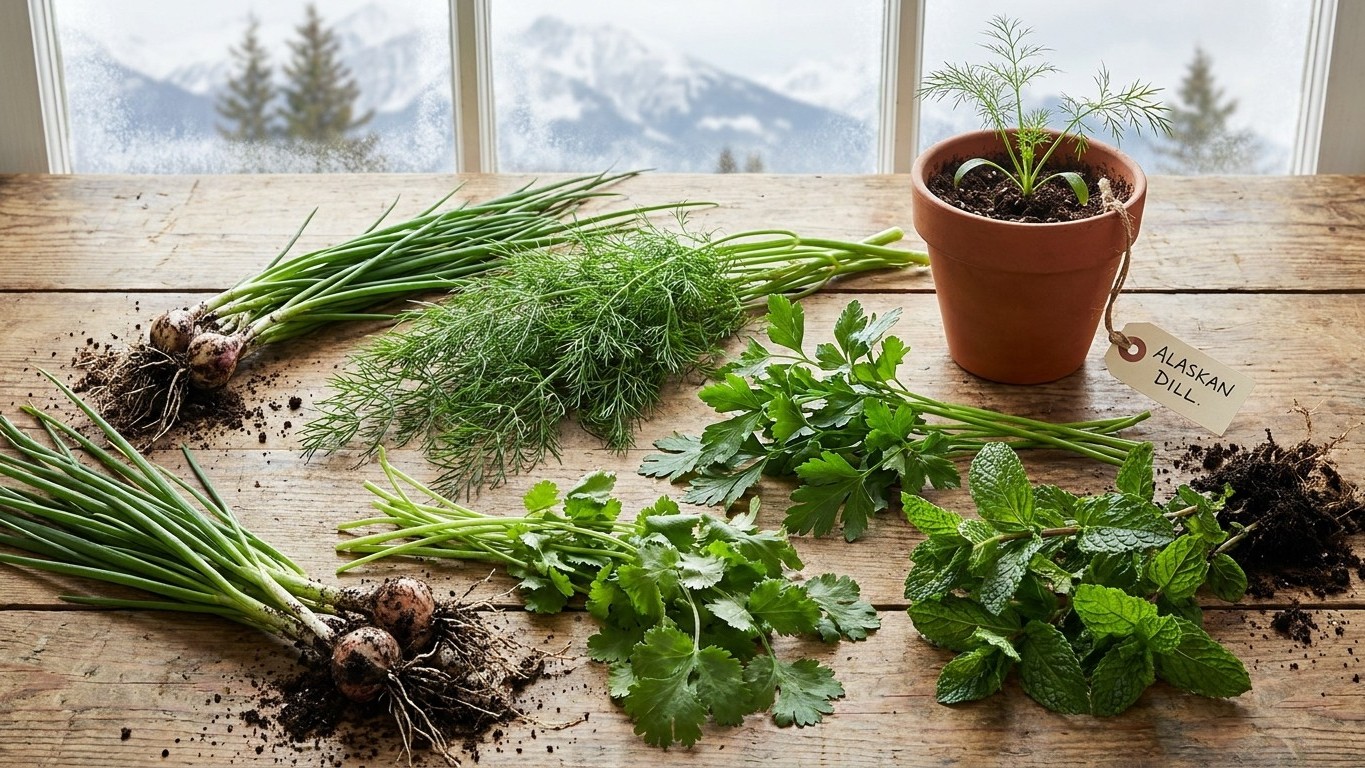

Chives, dill, parsley, cilantro, and mint are the herbs that consistently succeed in Alaska’s short, bright growing season. Slow Mediterranean herbs like rosemary, bay, and lavender struggle here, both from lack of season length and from winters too cold for them to survive outdoors.
The short answer for Alaska
Anchorage’s growing season runs roughly 143 frost-free days, with the last spring frost landing between May 3 and May 12, and the first fall frost arriving between September 22 and October 1. That window decides every herb choice: anything that needs a long, hot stretch to bulk up or set seed is fighting the calendar before it even sprouts.
Herbs that finish fast and tolerate cool soil are the reliable performers. Chives push up within weeks of the last frost and keep producing right through fall. Dill and cilantro grow quickly enough to harvest multiple cuttings before the season closes, though both will bolt to seed faster than gardeners farther south expect, a quirk tied to Alaska’s long summer daylight rather than heat. Parsley is slower but still fits comfortably inside a 143-day window, especially if started indoors a few weeks before the last frost date. Mint, notoriously aggressive everywhere, behaves itself somewhat here simply because the season doesn’t give it time to run wild the way it does in warmer states.
Basil sits in a gray zone. It’s not a fast herb, and it actively resents cool soil, so outdoor starts in open ground often stall for weeks after transplanting. Gardeners who want basil in Alaska generally succeed by starting seed indoors under lights six to eight weeks before the frost-free window opens, then moving transplants into containers that can be pulled inside on cold nights. That workaround is the difference between a basil harvest and a basil disappointment.
Perennial herbs are where the season length matters less than winter survival. The coldest month here averages a daily minimum of 11°F, which is the number that actually decides whether a perennial herb makes it through winter outdoors, not the record low or a seasonal average. Chives and mint, both cold-hardy perennials, come back reliably. Anything marketed as a Mediterranean perennial herb needs a different plan, covered in the next section.
What will not work here

Rosemary is the clearest failure case. It’s slow to mature from seed, it wants a long warm season to build woody growth, and it has no tolerance for a winter where the coldest month averages 11°F at night. Even gardeners who baby a rosemary plant through summer in a container lose it the first winter it spends outdoors here. The same goes for bay laurel and most true lavenders bred for Mediterranean climates: they’re built for winters that rarely dip below the 20s, not for one that spends weeks with nightly lows in the teens.
Sage occupies a middle ground worth flagging honestly. Common sage has better cold tolerance than rosemary, but it’s still a slow-establishing perennial, and a 143-day frost-free season doesn’t give it much runway to size up before winter arrives. Gardeners who try it outdoors here often find it survives but never reaches the bushy size it would in a longer, milder season.
The other trap isn’t cold, it’s crowding. Alaska’s summers aren’t hot and dry the way a Texas or Arizona summer is, so the usual warning about weekly watering under blazing heat doesn’t apply the same way here. What does apply is the opposite problem: cool, often overcast summers keep soil moist longer, and herbs planted at the spacing recommended for a hot, dry state can develop damping-off and fungal rot in Alaska’s cooler, damper ground. Parsley and cilantro, both prone to crown rot in soggy soil, are the two most likely to suffer if planted too close together here.
Lemongrass, tarragon in its French form, and most tropical or subtropical culinary herbs are non-starters outdoors in any part of this state. They need heat accumulation that a 143-day cool season simply doesn’t provide, and none of them tolerate the winter lows recorded here. If a reader wants to grow these, a heated indoor setup isn’t a workaround, it’s the only option.
What changes across Alaska
Alaska doesn’t have one climate, it has a spread from USDA hardiness zone 1a to 8a, which is one of the widest ranges of any state in the country. That’s not a rounding difference. Zone 1a describes winters cold enough to kill nearly anything without deep protection, while zone 8a describes a mild coastal winter that would let a gardener push the boundaries of what’s normally considered a Lower 48 perennial. Anchorage, the reference city for the frost dates and winter minimum, sits closer to the milder end of that spread but is still far colder in winter than the true zone 8a pockets of Southeast Alaska.
A gardener in the Interior or in northern Alaska is working with a season shorter than Anchorage’s 143 frost-free days, sometimes considerably shorter, and winters that make even chives and mint riskier without mulch or raised beds. For that gardener, the fast-herb strategy in this article isn’t optional, it’s the only strategy, and starting seed indoors even earlier than an Anchorage gardener would is worth considering.
A gardener in the milder coastal Southeast, closer to that 8a end of the range, has more room to experiment.
The USDA Plant Hardiness Zone Map is the tool for that, and it’s worth checking directly rather than guessing from a town’s general reputation for cold or mild weather.
Where to check this for your own county
The University of Alaska Fairbanks Cooperative Extension Service is the source that goes beyond what a statewide page like this one can offer. This article works from Anchorage-referenced frost dates and a statewide hardiness range, both useful for a general picture, but neither replaces information tied to a specific borough or growing district.
What to look for once there is specific. First, a local planting calendar built for the reader’s own district, whether that’s the Matanuska-Susitna Valley, the Fairbanks area, the Kenai Peninsula, or Southeast Alaska. These local calendars account for microclimate effects, like the growing-degree-day advantage the Mat-Su Valley gets from its long summer daylight, that a state-level frost date can’t capture. Second, look for variety trial results specific to the reader’s growing district. Extension services in Alaska have tested which herb varieties actually mature within a local district’s shorter or longer version of the frost-free window, and that trial data is more useful than a general recommendation for “fast-maturing herbs.”
A district-level or borough-level recommendation will always beat a statewide one. Anchorage’s frost dates and a range spanning the whole state’s hardiness zones are useful for understanding the general logic of what works and what doesn’t, but they aren’t a substitute for a recommendation built around a reader’s own growing district. That distinction is worth taking seriously before betting a season’s harvest on it.
Checking this against your own garden
Every date here is a regional average built from decades of weather records, not a promise about what’s happening in a specific backyard this particular spring. A reader’s own observations, done with nothing more than a hand and a pair of eyes, outrank all of it.
Soil warmth by feel is the first check. Push a bare hand a couple of inches into the planting bed in the morning before working outside. If it still feels cold and heavy rather than just cool, seeds like dill and cilantro will sit and sulk rather than germinate, regardless of what the calendar says about the last frost date having passed.
The first true leaves on young seedlings are the second signal. The initial leaves that emerge from a seed aren’t the plant’s real leaves, they’re seed leaves running on stored energy. Once the next set appears, shaped like the plant’s actual mature foliage, that’s the sign the seedling has connected with the soil and started growing on its own terms, a more reliable green light for thinning or transplanting than counting days since planting.
The third signal is specific to Alaska’s long summer daylight: watch for early flowering or bolting on herbs like dill and cilantro. Because daylight here runs far longer than the string of hours that trigger bolting farther south, these herbs often flower and go to seed sooner than a seed packet’s days-to-maturity figure suggests. Catching that first flush of flower buds early means the difference between a second cutting of leaves and a plant that’s already committed to seed production for the season.