
Four insects and mollusks are documented as potato feeders in Alaska: aphids, cutworms, root maggots, and slugs. A fifth species sometimes seen in the same UAF Cooperative Extension records, the spruce beetle, doesn’t touch potato plants at all. Timing for all four tracks the short frost-free window rather than a calendar month.
Which pests attack potato in Alaska

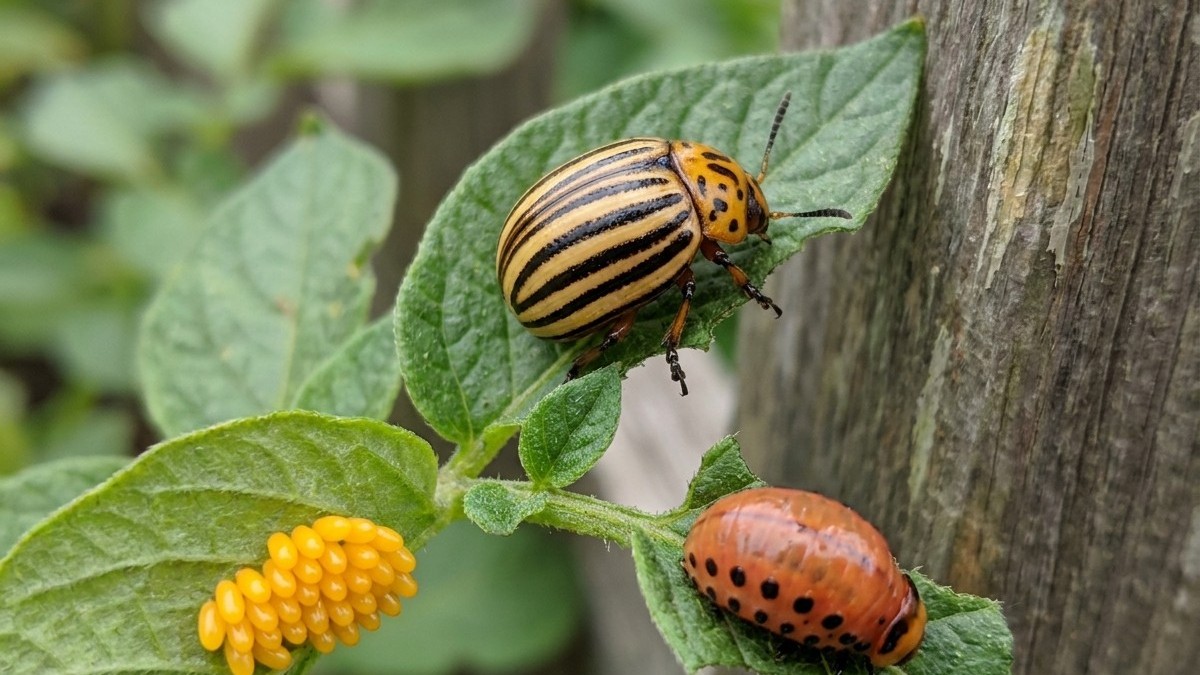
UAF Cooperative Extension documents five species tied to Alaska gardens and landscapes: aphids, cutworms, root maggots, slugs, and spruce beetle. That’s the full list for this territory, and it’s worth being blunt about what it doesn’t include. No colorado potato beetle, no wireworm, no flea beetle showing up in these records the way they do in warmer states. Alaska’s isolation and its short growing season keep several common lower-48 potato pests out of the picture, at least according to what’s documented here.
Of the five, one doesn’t belong on a potato page at all. The spruce beetle is a bark beetle that attacks mature spruce trees, boring into the trunk to lay eggs under the bark. It has no relationship to potato foliage, roots, or tubers, and a gardener who spots spruce beetle damage on a windbreak tree shouldn’t connect it to problems in the potato patch. It’s on the extension list because it’s a major forest pest in Alaska, not because it eats potato.
That leaves four species that actually feed on potato plants. Aphids are small, soft-bodied insects that cluster on the undersides of leaves and along stems, feeding on plant sap and excreting a sticky residue that can attract sooty mold. Cutworms are the larvae of night-flying moths, living in the soil during the day and coming up after dark to chew through stems at ground level. Root maggots are fly larvae that tunnel into roots and developing tubers, leaving feeding scars and open wounds that invite rot. Slugs, common in Alaska’s cool, damp gardens, rasp holes in leaves and can also chew into tubers that sit close to the surface.
The short growing season doesn’t mean a light pest load. With roughly 143 frost-free days at the Anchorage reference station, there isn’t much room for a plant to outgrow early damage the way it might over a five- or six-month season farther south. A cutworm that takes out a seedling in the first two weeks after emergence can cost the gardener the whole plant, not just a setback.
When each one shows up, and what it does first
Alaska’s frost-free window runs from a last spring frost dated May 3 to May 12 at the Anchorage reference station, and everything that follows is keyed to that window rather than to named months, since the same window shifts earlier or later depending on where in the state a garden sits.
Cutworms tend to show up early, in the first few weeks after seedlings emerge from the ground. What a gardener notices first isn’t the worm itself, since it hides in the soil by day, but a young plant that’s been severed at or just below the soil line, sometimes toppled over completely with the stem cut clean through.
Root maggots follow a similar early pattern, working underground where their damage stays hidden until harvest or until a plant suddenly wilts despite adequate soil moisture. The first visible sign above ground is often a plant that looks stressed for no obvious reason, followed later by scarring or tunneling discovered when tubers are dug.
Aphids build up as the season progresses and foliage matures, favoring the tender new growth at stem tips and the undersides of leaves. The first sign is usually a curling or yellowing of leaves, followed by a sticky film on the foliage below the infested spot, and sometimes ants moving up and down the stems to collect the honeydew aphids leave behind.
Slugs are most active during cool, wet stretches, which in Alaska can happen at almost any point in the growing season rather than a fixed window. Damage shows up as irregular holes in leaves, often with a silvery slime trail nearby, and on tubers as shallow gouges where a slug has fed on exposed or shallow-set potatoes. Checking under mulch or boards in the early morning, when slugs are still active, is the most reliable way to confirm they’re present before damage gets serious.
Telling the damage apart from everything else
Not every damaged leaf or stunted plant means an insect is involved. Alaska’s cool soils, variable rainfall, and short season create plenty of look-alike problems, and mixing them up leads to the wrong fix. The single most useful habit is checking for the pest itself, not just the damage, before deciding what caused it.
| Symptom | Possible cause | What helps tell them apart |
|---|---|---|
| Stem severed at soil line, young plant toppled | Cutworm, or mechanical injury from cultivation | Dig an inch or two of soil right around the base; a cutworm is often curled up nearby |
| Plant wilts despite moist soil | Root maggot, waterlogged soil, or disease | Pull the plant and check roots and young tubers for tunnels versus soft, rotted tissue |
| Yellowing, curling leaves | Aphids, nitrogen deficiency, or drought stress | Check leaf undersides for clusters of small insects and sticky residue before assuming a nutrient problem |
| Irregular holes in leaves | Slugs, hail damage, or wind-whipped foliage | Look for slime trails and check at night or early morning when slugs are actively feeding |
| Shallow gouges on tubers | Slug feeding, or mechanical damage during hilling | Fresh mechanical cuts have clean edges; slug feeding leaves a rougher, chewed texture |
None of this replaces an actual look by someone trained to tell these apart. A soil sample, a magnified look at leaf undersides, or a plant dug up and examined root to tip settles far more than guessing from a photo does. When the cause isn’t obvious after checking for the pest directly, that’s the point to bring the plant, or a clear photo, to the local extension office rather than treating for a guess.
What Actually Works here, and what is a waste of time
On a season this short, timing does more work than any single treatment. A physical barrier installed before a pest arrives beats almost any response applied after damage is already visible. For cutworms, a simple collar pushed into the soil around each young stem, extending an inch or two below and above ground, blocks the larvae from reaching the plant at the one stage when they can do the most harm.
For slugs, keeping mulch and debris away from the base of plants removes the damp hiding spots they need during the day, and hand-picking after dark or early in the morning, when they’re active and exposed, removes them directly rather than waiting for chewed leaves to show up. Copper barriers and diatomaceous earth around bed edges are commonly used, though their performance depends heavily on staying dry, which is a tall order in a climate prone to frequent rain.
For aphids, a strong spray of water directed at leaf undersides knocks down small populations before they build up, and checking new growth regularly catches an infestation while it’s still small enough to manage without any product at all. Root maggot management leans on prevention through crop rotation and clean planting stock rather than a treatment applied once maggots are already established, since by the time tunneling is visible in tubers, the damage is done.
What wastes time is treating on a fixed date rather than on what’s actually present. Spraying for aphids before any are seen, or setting out slug bait every week regardless of moisture and activity, burns effort without matching the pest’s actual behavior. Any product decision, including what’s legal to use and how, belongs with the local extension office, which knows what’s registered for use in Alaska and how it applies to a home garden rather than a commercial field.
Where to check this for your own county
UAF Cooperative Extension is the source for what’s documented on this page, and it’s also the right first call for anything specific to a particular garden. A pest list built at the state level never describes what’s actually present on one property, since soil, drainage, nearby vegetation, and even how sheltered a yard is all shift which of these four pests shows up and how badly.
Alaska’s extension service operates through district and county offices that handle questions specific to local conditions, from soil testing to plant and pest identification. Reaching out to the office covering a particular borough or census area is the direct way to get an answer for one garden rather than for the state as a whole, and staff there can also confirm whether a suspected pest matches what’s actually being seen locally that season.
It’s also worth remembering that documented presence doesn’t mean uniform presence. A borough with a longer frost-free stretch, more rainfall, or denser tree cover can see heavier slug pressure than a drier, more open site just a short drive away, even though both fall under the same statewide extension records. The four pests named here are the ones with a documented history of feeding on potato in Alaska, but which one shows up first, and how bad it gets, depends on the specific plot of ground being planted.
The next useful step for anyone dealing with unclear damage is contacting the county extension office directly, ideally with the plant or a clear photo in hand, rather than working from a general list alone.
Common questions
Do colorado potato beetles occur in Alaska?
They aren’t part of the pest list UAF Cooperative Extension documents for this territory, so they aren’t something to plan around based on the records used for this page.
Can slugs really damage the tubers, not just the leaves?
Yes. Slugs feed on shallow or exposed tubers, leaving gouges in the skin, in addition to the leaf holes they’re better known for.
Is the spruce beetle a threat to a home vegetable garden?
No. It attacks mature spruce trees, not potato plants, so its presence on a property doesn’t indicate a risk to the potato patch.
How much does the frost-free window actually vary within Alaska?
The May 3 to May 12 last-frost range and roughly 143 frost-free days come from the Anchorage reference station, and the Interior and northern parts of the state run considerably shorter, so a garden’s actual window should be checked against local extension data rather than assumed from a single reference point.