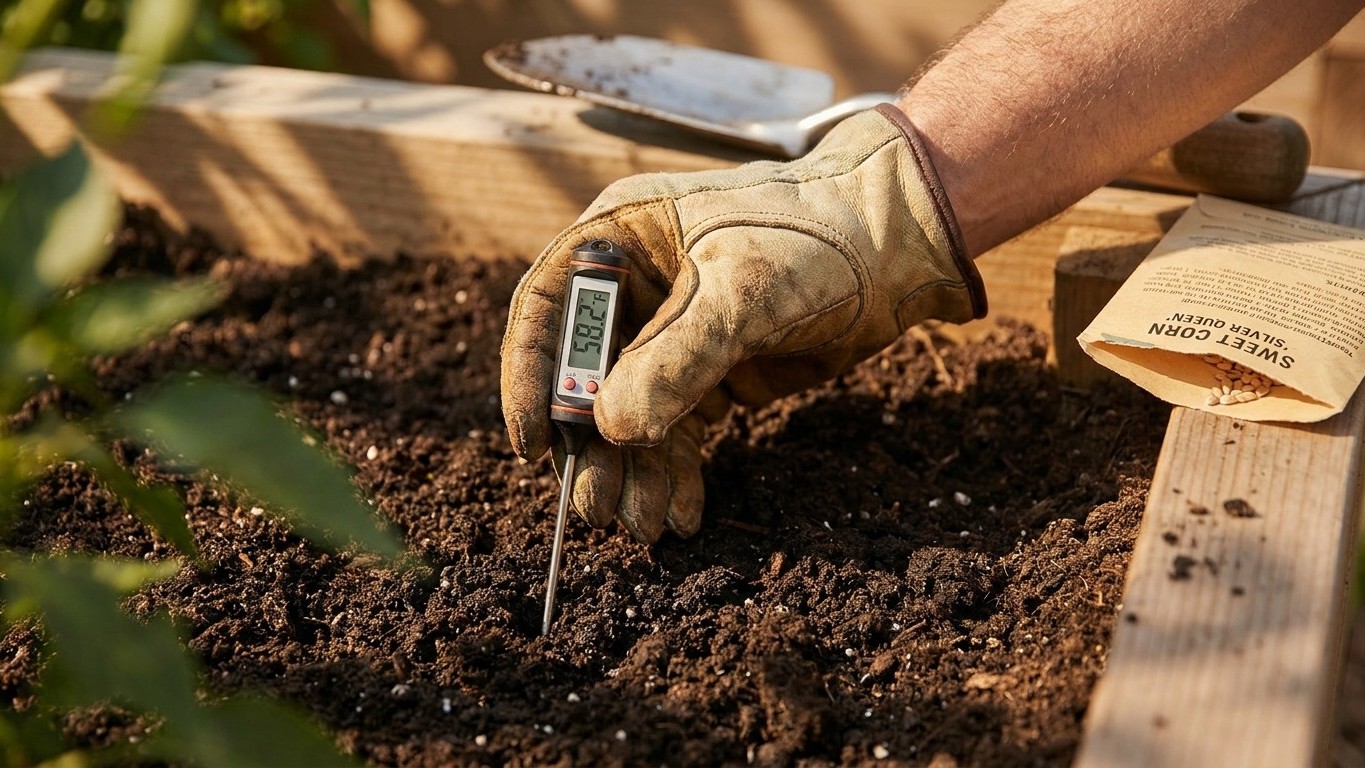

In most of coastal south-central Alaska, soil doesn’t clear the 60 F mark sweet corn needs until weeks after the last spring frost has passed. That gap, not the frost date itself, is what decides whether a 60-day or 90-day variety has any real chance of finishing before the first fall frost arrives between September 22 and October 1.
The short answer
Growers here tend to fixate on the last frost date, May 3 to May 12 at the reference station, and assume that’s the green light for corn. It isn’t. Air temperature and soil temperature don’t move together in spring. Bare ground, especially anything with clay or heavy organic content, lags behind the air by weeks, so soil in this region typically doesn’t cross 60 F until well into the following month, sometimes later depending on how the bed is prepared and whether it’s covered.
That lag matters because sweet corn seed sown into cold soil doesn’t just grow slowly, it often rots or fails to germinate at all. So the real planting window doesn’t open on the last frost date. It opens whenever the soil itself, not the air, reaches that 60 F threshold.
Once that happens, the clock most gardeners know starts: sweet corn needs 60 to 90 days from planting to reach harvest. The question is whether that window closes before the first fall frost, September 22 to October 1. With roughly 143 frost-free days total in this area, on paper there looks to be plenty of room. But the corn clock doesn’t start on the frost-free calendar. It starts on the soil-temperature calendar, and that shrinks the usable stretch considerably, likely down to something closer to 100 to 110 days between soil warming up and the first fall frost.
There’s a second complication that has nothing to do with dates directly. This location records zero days a year at 90 F or above. That’s the measure of summer heat load, and it’s essentially flat here. Corn is a warm-season crop that accumulates growth fastest under heat, and without those hot spikes, plants tend to move through their stages more slowly than the seed packet’s day count assumes. A variety rated at 60 days elsewhere may simply take longer here, not because the calendar changed, but because the heat that normally speeds things along never shows up.
Put together, the short answer is this: wait until soil is reliably above 60 F, not just until frost risk has passed, then count 60 to 90 days forward and check that total against September 22 at the earliest. A shorter-day variety gives far more margin than a longer one, and the flat summer heat means it’s worth padding the estimate rather than trusting the printed number outright.
Does a late variety fit here?
The difference between a 60-day and a 90-day sweet corn variety isn’t just thirty days on paper. In a climate with no heat spikes to push growth along, that difference can be the entire margin between a harvest and a frost-killed field.
A 60-day variety
Assume soil finally clears 60 F sometime after the frost-free season has already begun, and count 60 days forward from there. Even with some slippage from the region’s flat summer heat, that timeline lands comfortably in August, a full month or more ahead of the September 22 to October 1 frost window. A short-day variety has real breathing room here. Even if growth runs a bit behind the printed number, because there are zero days above 90 F to accelerate it, there’s enough cushion left to absorb that delay without losing the crop.
A 90-day one
Run the same math on a 90-day type and the picture changes. Ninety days forward from a soil-warming date that already falls weeks after frost pushes the estimated finish line right up against, or past, the September 22 start of the first fall frost window. That’s before accounting for the slower pace of growth this climate produces. A variety rated for 90 days under warmer conditions elsewhere is very likely to need more than 90 actual days here, since the accumulated heat driving it toward maturity simply isn’t available in the same quantity.
Plainly stated, a 90-day variety does not reliably fit this territory’s window. There’s too little margin between a realistic soil-warming date and the first fall frost to absorb the slower growth that comes with a summer that never reaches 90 F. Anything rated close to that upper end of the 60 to 90 day range should be treated as a poor match for this climate, not a marginal one.
| Variety length | Estimated finish | Fits before Sept 22 to Oct 1 frost? |
|---|---|---|
| 60-day type | Roughly August, with cushion | Yes, with margin to spare |
| 90-day type | Late September or later | No, too little margin under this climate |
What goes wrong here
- Soil sown too cold. Planting on the calendar date of the last frost, rather than waiting for the soil itself to clear 60 F, is the most common failure. Seed sits in cold, wet ground, germinates poorly or rots outright. The remedy is patience: check soil temperature directly rather than trusting the frost date, and hold off until it’s reliably above that threshold before putting seed in the ground.
- A variety too late for the season. Choosing a 90-day type because the frost-free season looks long enough on paper ignores that this climate has zero days above 90 F, which slows the plant’s pace toward maturity. The remedy is choosing varieties rated toward the shorter end of the 60 to 90 day range, and treating the printed day count as a minimum rather than a guarantee.
- Sweetness lost through timing, not weather. This one has nothing to do with soil or frost. Su, se and sh2 sweet corn types lose their distinct sweetness when they tassel at the same time as each other, because they cross-pollinate. The remedy is to plant sweet corn in blocks of three or more rows as usual for good pollination within a single type, but keep different sweetness types from tasselling together, staggering planting dates or choosing only one type per season if space is tight. No isolation distance is published for this; the fix is entirely about timing, not feet of separation.
Common questions
Is the last frost date the right time to plant sweet corn?
No. The last frost date, May 3 to May 12 here, marks when air temperature risk drops, but soil temperature lags behind and typically doesn’t reach the 60 F sweet corn needs until weeks later. Planting on the frost date alone usually means sowing into soil that’s still too cold.
Why does a 60-day variety make more sense here than a 90-day one?
Because the usable window between the soil clearing 60 F and the first fall frost, September 22 to October 1, is tighter than the frost-free season suggests, and because this climate records zero days above 90 F, which slows growth compared to warmer regions. A shorter-day variety leaves margin for that slower pace; a 90-day variety generally doesn’t.
How do I know when sweet corn is actually ready to pick?
Look for three signs together: dry, brown silks, husks that are still moist and green, and milky juice from a punctured kernel. Any one sign alone isn’t a reliable indicator; all three need to line up.
Do I need to keep sweet corn varieties a certain distance apart to protect sweetness?
The published guidance doesn’t give a distance in feet or rows. What it does say is that su, se and sh2 types lose their sweetness if they tassel at the same time. The fix is managing timing, staggering plantings or growing a single type, rather than relying on any specific separation distance.