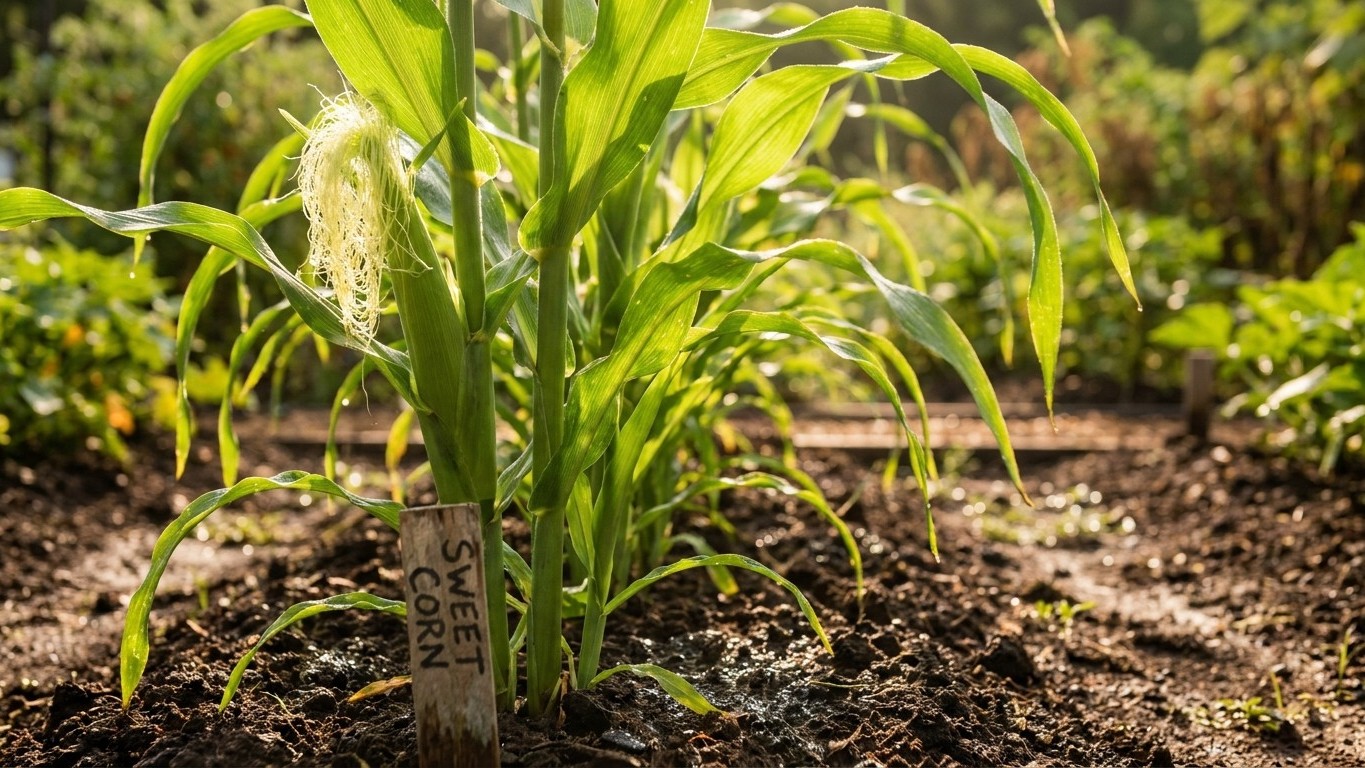

Yes, sweet corn can ripen in the Anchorage area, but only if you pick a short-season variety and hit the planting window exactly. The region’s growing season is short and cool by corn standards, so there’s little room for error. A late variety, a cold planting date, or careless spacing between corn types can each cost you the harvest. Here’s what actually determines whether your ears fill out before the first fall frost.
The short answer
Corn seed does not care about the last frost date the way tomatoes or peppers do. It cares about soil temperature, and sweet corn specifically wants that soil above 60 F before it germinates well. In the Anchorage area, the last spring frost typically clears between May 3 and May 12, according to NOAA’s 1991-2020 climate normals for station USW00026451. But soil doesn’t warm to 60 F on that same day, or even that same week. Ground heats up slowly after air temperatures rise, so the 60 F mark for sweet corn planting lands well after the frost has already cleared. That gap is the first thing gardeners misjudge here.
Treat the last-frost date as a starting line, not a green light. The soil needs its own separate check, ideally with a simple soil thermometer pushed a couple inches into the bed, before seed goes in the ground.
Once the soil is warm enough to plant, the clock that matters is the one on the seed packet: sweet corn needs 60 to 90 days from planting to maturity, per Utah State University Extension. The other end of the season is the first fall frost, which arrives in this area between September 22 and October 1. That gives a planting-to-frost window that is real but not generous. If soil doesn’t reach 60 F until deep into the growing season, a 90-day variety can end up racing the calendar and losing.
There’s another wrinkle specific to this location. The reference station records a mean of 0.0 days a year reaching 90 F. Corn is a warm-season crop, and it grows fastest with real heat, not just frost-free days. Long summer daylight in this part of Alaska helps offset the missing heat, but the days-to-maturity number printed on a seed packet was tested somewhere warmer. Here, that number is closer to a floor than a guarantee. Budgeting extra slack, rather than planting on the assumption everything ripens exactly on schedule, is the safer approach.
Does a late variety fit here?
The 60-90 day figure isn’t a single number, it’s a range, and where your variety falls in that range decides whether it has a real shot at ripening before the season ends.
A 60-day variety
A variety at the short end of the range is the one built for this kind of climate. If soil hits 60 F sometime after the frost clears in early-to-mid May, a 60-day type still has a comfortable buffer before the first fall frost lands between September 22 and October 1. Even accounting for the region’s cool summers slowing growth below the catalog pace, there’s enough cushion in most years for the ears to fill out and the husks to dry down properly. This is the maturity class that makes sweet corn a realistic crop here rather than a gamble.
A 90-day variety
A variety at the long end of the range is a much harder sell. Even in a best-case year, where soil warms promptly and summer stays mild but steady, stacking 90 days onto a planting date that already trails the frost-clear date pushes harvest right up against, or past, the September 22 to October 1 fall frost window. Add the fact that this area logs essentially zero days of real heat (0.0 days above 90 F on average), and growth likely runs slower than the seed packet assumes. Put plainly: a 90-day sweet corn variety does not reliably fit this territory’s season. It may occasionally get lucky in a warm, early year, but it isn’t a dependable choice here the way a 60-day type is.
| Criteria | 60-day variety | 90-day variety |
|---|---|---|
| Fits soil-60F-to-frost window | Comfortably, most years | Rarely, with no margin |
| Tolerance for a cool, slow summer | Good buffer remains | Buffer is used up |
| Risk from first fall frost (Sept 22-Oct 1) | Low | High |
| Recommended for this area | Yes | Not reliably |
What goes wrong here
- Soil sown too cold. Planting sweet corn as soon as the last frost clears, before the ground itself reaches 60 F, is the most common mistake in this climate. Seed sits in cold, wet soil, germinates unevenly, or rots outright. The remedy is simple: check soil temperature directly with a thermometer rather than trusting the calendar, and hold off until it reads 60 F, even if that means waiting well past the frost date.
- A variety too late for the season. Choosing a 90-day type because it sounded sweeter or came recommended for a warmer state sets the harvest up to race the first fall frost and lose. The remedy is choosing from the short end of the 60-90 day range and treating maturity length as the first filter when picking seed, not an afterthought.
- Sweetness lost to the wrong neighbor. This failure has nothing to do with Alaska’s climate. Sweet corn comes in different sugar types, su, se, and sh2, and if two different types tassel at the same time nearby, cross-pollination ruins the sweetness of both. There’s no published isolation distance to hide behind here; the fix is about timing, not feet of separation. Grow only one sugar type at a time, or stagger plantings so the different types never shed pollen in the same window. Plant in blocks of three or more rows rather than a single skinny row, since that shape improves pollination within the block itself and helps the ears fill out evenly, regardless of what’s growing nearby.
Common questions
How do I know when to actually pick the ears?
Look for three signs together, not just one: the silks should be dry and brown, the husks should still feel moist and green, and a punctured kernel should release milky juice rather than clear liquid. That last check is the most reliable one, since silk color alone can mislead.
Is the 60-90 day figure the same as the days from silk to harvest?
No, and mixing these up causes real confusion. The 60-90 day window runs from planting to overall maturity, and it’s what tells you whether a variety fits this area’s season at all. A separate, much shorter window, roughly 17 to 24 days from when silks first emerge, is what tells you which week to start checking ears for ripeness once the plant is already tasseling. Treat them as two different clocks answering two different questions.
Does the last frost date tell me when to plant?
Not by itself. The last spring frost in this area clears between May 3 and May 12, but sweet corn seed wants soil at 60 F, which arrives later than that. Planting on the frost date alone, without checking soil temperature, is one of the more common ways this crop fails here.
Can I grow two different sweet corn types in the same garden?
Only if you keep their tasseling times apart. The sugar type of sweet corn, whether su, se, or sh2, is what determines sweetness, and it gets compromised if two types release pollen at the same time nearby. There’s no published distance figure to rely on for this; the safeguard is timing your plantings so the tassels never overlap, not counting rows or feet.