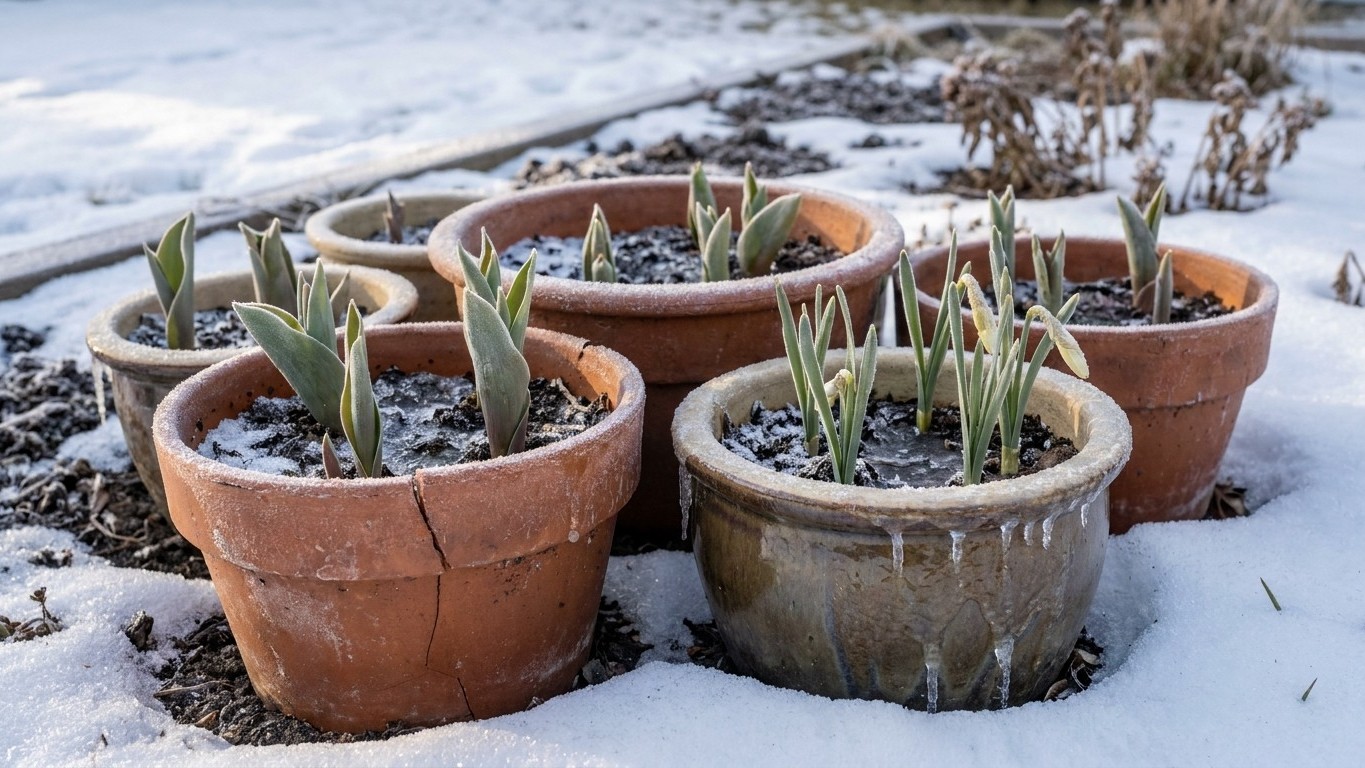

In Alberta, the threat to spring bulbs in pots isn’t a lack of cold winter chill. It’s the opposite: a container left outside freezes solid, roots and all, in conditions the ground never reaches. With a coldest-month average minimum of 8.2°F and a Canadian hardiness zone of 4a, an unprotected pot can kill bulbs that would sail through the same winter in a garden bed.
Why this matters in Alberta

Start with the number that decides everything: 8.2°F. That’s the mean daily minimum temperature for the coldest month at the Calgary reference station, per Environment and Climate Change Canada’s 1981-2010 Climate Normals. It’s not a record low, and it’s not a seasonal average, it’s the typical overnight floor, month after month, all winter long. Compare that to the 45°F threshold that spring bulbs need to drop below for their twelve to fourteen weeks of chilling, and it’s obvious this territory has no shortage of cold. Alberta winters deliver that chilling requirement outdoors, naturally, with room to spare. Forcing bulbs by manufacturing extra cold in a refrigerator isn’t something this climate demands.
The problem here is the opposite kind of exposure. Garden soil is a poor conductor of heat, which means a frost line advances slowly and rarely reaches more than a foot or two down even in a hard winter. A bulb planted at a normal garden depth sits below that line, insulated by the mass of earth around it. A container has no such buffer. Surrounded by open air on every side, the soil inside a pot tracks ambient air temperature far more closely than garden soil does, which means a pot outdoors in Alberta can sit near that 8.2°F average minimum, colder still on the sharpest nights, right through the root ball.
That’s the gap between a hardiness rating and a container’s real-world risk. The Canadian zone 4a rating for this reference city (Natural Resources Canada, Plant Hardiness Site, 1991-2020 normals) describes what a bulb can survive planted in the ground. It says nothing about what happens when that same bulb is potted up and left on a deck. A tulip or crocus rated hardy for zone 4a in a bed can still die in a container in the same yard, the same winter, because the pot exposes it to a cold it was never tested against.
So the situation in Alberta splits cleanly in two. Forcing, solving a shortage of natural cold, isn’t the local problem; there’s cold here in abundance. The container problem is real and specific: a pot needs either a bulb rated well beyond what the ground requires, or protection that brings its effective exposure back down to something closer to garden conditions.
How to do it here
The steps below assume a container that will stay in Alberta’s outdoor conditions for at least part of the winter, plus the option of forcing a display indoors on a set schedule. Each step is something you can check yourself, with a thermometer or a calendar, rather than take on faith.
- Match the bulb to a hardiness rating at least two Canadian zones colder than 4a, look for stock rated for zone 2 or lower, before it ever goes into a pot meant to sit outdoors all winter.
- If nothing in that hardier range comes in the size, color, or species you want, plan on moving the container rather than betting on the pot’s own insulation.
- Move it into an unheated garage, shed, or enclosed stairwell that reliably stays above freezing. Confirm this with an ordinary thermometer left in that space for at least a week before trusting it with bulbs.
- If moving isn’t an option, cluster several pots together against a heated foundation wall and bank them with straw, dry leaves, or bagged soil up to the rim. Ground next to a heated wall rarely falls as low as that 8.2°F outdoor air minimum.
- For an indoor display on a schedule, treat the pot like a forced bulb: give it twelve to fourteen weeks below 45°F in a dark refrigerator crisper drawer, kept well away from apples, pears, or any ripening fruit, the ethylene those fruits release kills the flower bud before it ever opens.
- Check the pot’s moisture roughly once a month. Barely damp is the target; a soaked, frozen pot rots the bulb as surely as a bone-dry one shrivels it.
- Bring the container into indirect light and room temperature only after the full cold period is done. A bulb rushed to warmth early ends up on a stem too short to reach above the pot’s rim.
Which bulbs are worth it
Not every spring bulb rewards the extra work a container demands here. The ones that force and pot up well share a trait: a shorter chilling requirement and a stem sturdy enough not to topple once it’s exposed above a small root run. The ones that disappoint tend to need either a longer cold period than a typical container schedule allows, or grow tall on a stem the pot simply can’t anchor.
Bulbs that force reliably here
- Crocus — a short chilling requirement and a naturally low, stocky habit that doesn’t need much anchoring
- Muscari (grape hyacinth) — chills quickly and stays compact enough for a small pot without staking
- Species and botanical tulips — shorter and sturdier stems than the large hybrid types, so they hold up in shallow container soil
- Snowdrops (Galanthus) — low-growing and tolerant of the faster warm-up a pot goes through compared to garden soil
- Hyacinth — a heavy flower spike, but a stem thick enough to carry it once forcing is done on schedule
Bulbs that sulk
- Large trumpet and Darwin hybrid daffodils — tall stems that topple once the shallow root run in a pot can’t anchor them against wind
- Ornamental onion (Allium) — a heavy, globe-shaped flower head sitting atop a stem disproportionately tall for most container sizes
- Tulips left in the same pot a second year — a container restricts how well the bulb can rebuild its food reserves after flowering, so bloom shrinks or fails outright
- Paperwhite narcissus left outdoors — not hardy to Canadian zone 4a at all; it won’t survive an Alberta winter in a container or in the ground
Where tulips are concerned, the second-year decline in a pot isn’t a flaw in the gardener’s method. It’s how container culture treats that bulb regardless of hardiness. Since most potted tulips were never going to rebloom well a second season anyway, forcing them for one display, or accepting a one-time purchase, costs nothing extra in the long run.
What goes wrong, and when you can still fix it
Leaves but no flower
The bulb put up healthy foliage and stopped there. That means the cold period ran short of the full twelve to fourteen weeks below 45°F needed for the flower bud inside to finish developing. There’s nothing to recover this season, the bud already failed to form. Let the leaves die back naturally, and if the bulb is a genuinely hardy variety, move it into the ground where a complete natural winter can rebuild it for a future season.
A flower stem too short to see above the pot rim
This one was warmed too early, before its chilling requirement was actually complete. Stem elongation happens once the cold period finishes, not during it, so an early move to warmth locks in a short, stunted stalk. This season’s display is fixed at whatever height it reached; there’s no rescuing it now. The fix applies to the next planting: hold the pot in the cold the full recommended stretch before bringing it into light and warmth.
Soft, rotted bulb in a frozen pot
Rot in a container almost always traces back to drainage, not cold alone. Water trapped at the bottom of the pot freezes and thaws repeatedly around the bulb, breaking down its tissue faster than low temperature by itself ever would. A bulb in this state is lost for the season and isn’t salvageable. The fix is entirely preventive: next time, use a pot with a working drainage hole and a gritty, fast-draining mix rather than garden soil packed straight into a container.