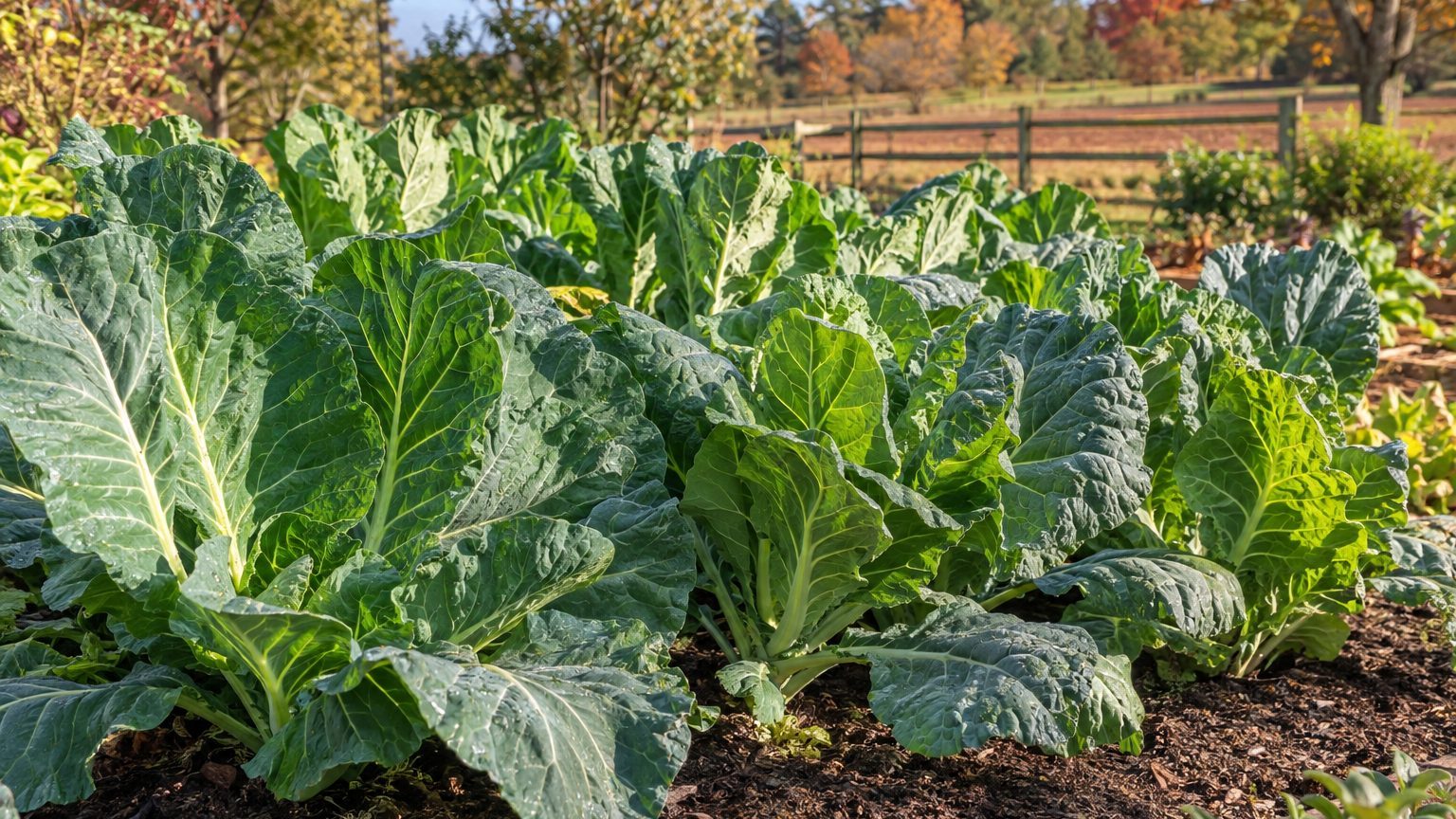

In Alberta, the safest bet is fast-maturing, compact varieties of collards and other cooking greens, not the slow, full-season types that Southern gardeners favor. The province’s short, unpredictable frost-free window rewards greens that size up quickly and tolerate a cool snap, and punishes anything bred for a long, mild season.
The short answer for Alberta
Start with the calendar, because it does most of the deciding here. The average last spring frost at the Calgary reference station falls on May 21, and the average first fall frost arrives September 16. Subtract one from the other and you get a frost-free window of about 118 days, and that’s before accounting for the fact that these are averages, not guarantees, so real years swing both earlier and later on each end.
That window is short enough to rule out the giant, slow-to-head collard types that Southern growers rely on, the ones bred to hold in the field for 70 to 90 days before they’re worth cutting. In Alberta, that kind of timeline leaves almost no margin if the spring turns cold or the fall turns early, which happens more often than the averages suggest. The types worth planting are the fast, compact ones bred to produce usable leaf in 50 to 60 days, plus quicker cooking greens like mustard and turnip greens that can be ready for cutting in 35 to 45 days.
The hardiness context backs this up. The Calgary reference station sits at Canadian zone 4a, and the coldest month here averages a daily minimum of -13.2 °C (8.2 °F). That’s a winter reading, not a growing-season one, but it tells you this is a climate built around a compressed, intense summer rather than a long shoulder season. Growers here get one real shot at a crop, so the safest strategy is succession planting of quick greens rather than betting the season on one slow-maturing collard variety.
For collards specifically, that means choosing loose-leaf or baby-leaf harvest styles over waiting for a full mature head, and treating any variety labeled “long season” or “heirloom giant” as a greenhouse or short-row experiment rather than the main planting. Mustard, turnip greens, and kale round out the mix well because they mature faster and tolerate the cool edges of the season better than collards do on their own.
What will not work here

The clearest failure mode in Alberta is planting a collard variety that needs more days than the season reliably offers. A variety that needs 80 days from transplant to full head is gambling against both ends of the calendar at once: a late spring frost eats into the front of the window, and an early fall frost catches the crop before it’s finished. With only 118 days on average between frosts, and that figure itself being a midpoint rather than a floor, there’s no cushion left for a slow variety once either end runs short.
Relying on direct seeding at the average last frost date is another mistake specific to this data. Because May 21 is a mean date from a thirty-year record, frost falls after that date in roughly half of all years. A gardener who direct-sows collard seed outdoors right on May 21 is planting into ground that still has a real chance of a hard frost in the following two or three weeks, especially away from the Calgary station itself. The safer play is starting transplants indoors and moving them out once the soil has clearly warmed, rather than trusting the calendar date alone.
Overwintering plans that assume a milder zone
Some collard growers in warmer regions leave a fall planting in the ground through winter and cut from it again in spring. That approach does not transfer to a coldest-month minimum of -13.2 °C. Collards and related greens are frost-tolerant, even sweetened by a light touch of cold, but they are not built to survive a Calgary-zone winter unprotected. Treating a fall planting as a true overwintering crop here, rather than a last harvest before hard freeze, sets up a loss almost every year.
Tight spacing borrowed from milder, more humid growing guides is worth a second look too. Alberta’s climate runs dry rather than humid, so the usual warning about crowding greens into damp air and inviting fungal disease matters less here than in the Southeast. The bigger risk in this climate is a canopy that’s too sparse to shade its own roots during the hottest, driest stretch of a short summer, which can push cool-season greens like mustard into early bolting.
What changes across Alberta
Alberta is not one climate, and this page cannot pretend otherwise. The 4a hardiness figure used above comes from a single reference station, and Canada’s zone system is built from seven climate variables, not one, so it doesn’t shift smoothly the way a simple frost-date map might suggest. A garden a few hundred meters higher in elevation, or well north of the Calgary corridor, can sit in a noticeably colder zone even within the same province, and the reverse is true in some sheltered river valleys further south.
Because of that spread, there is no single frost-free window that applies to all of Alberta, only the one recorded at this particular station. Northern districts and higher-elevation gardens should expect both a later average last frost in spring and an earlier average first frost in fall than the dates used here, which shortens the already tight 118-day figure even further. A garden closer to the foothills or the northern boreal edge is working with less room than this page assumes, not more.
The practical shift for a reader in a colder pocket of the province is to lean harder into the fastest-maturing greens on the list, treat transplants as the default rather than direct seeding, and add row cover as routine insurance rather than backup. A reader in a milder, lower pocket of the province has a little more flexibility to try a mid-season collard variety alongside the quick greens, but should still confirm that assumption locally before committing a full bed to it.
This page cannot tell an individual reader which zone their own yard falls into. The Canadian hardiness zone map, run by Natural Resources Canada, is built for exactly that lookup, down to the municipality, and it’s the only reliable way to replace this station’s number with one that actually matches a specific yard.
Where to check this for your own county
This page speaks for the province as a whole, using one reference station’s data, and that’s a real limitation worth saying out loud. A county-level or municipal recommendation will always beat a provincial one, because it accounts for local elevation, local frost pockets, and whatever varieties have actually been trialled by growers nearby.
Alberta’s provincial agriculture service is the right next stop, at alberta.ca/agriculture-and-irrigation. Once there, the goal is to find two specific things rather than browse generally: a local or regional planting calendar that reflects frost dates closer to home than the Calgary airport station, and any notes on collard or greens varieties that extension staff or master gardener programs have actually trialled in that county or municipal district.
It’s also worth checking whether the county or municipal district runs its own agricultural service board or fieldman’s office, since many rural municipalities in Alberta maintain local contacts who track conditions than a provincial page can. Calling that local office before committing seed money to a full row of collards is a small step that often catches a mismatch this page has no way to see, whether that’s a shorter local frost window, a wetter or drier microclimate, or a variety that has quietly failed for three seasons running in that specific soil.
Treat the provincial site as the starting reference, not the final word. It sets the broad expectations this article has walked through; the county or municipal contact fills in the details that actually decide whether a given collard variety heads up in a particular backyard.
Checking this against your own garden
Every date on this page is an average pulled from one weather station over a thirty-year record, and a reader’s own soil and seedlings will always outrank it. Three things are worth watching directly, none of which need any equipment beyond a hand and a bit of attention.
First, soil feel rather than the calendar. Push a finger a couple of inches into the bed before direct-sowing anything; if it still feels cold and slightly numb rather than merely cool, germination will be slow and uneven no matter what the date says. Waiting until the soil feels workable and mild is a better signal than trusting May 21 outright.
Second, timing on first true leaves. Collard and mustard seedlings typically push their first true leaves within 7 to 10 days of germination in reasonably warm soil; a longer wait suggests the local microclimate is running cooler than the provincial average, which is useful information for planning the next succession.
Third, watch for early bolting, especially in mustard and turnip greens. A flower stalk shooting up well before the leaves have filled out is the plant reacting to heat or long daylight stress, and it’s a sign that particular bed runs hotter or drier than expected for this climate, which should push future plantings toward more shade or an earlier harvest window.