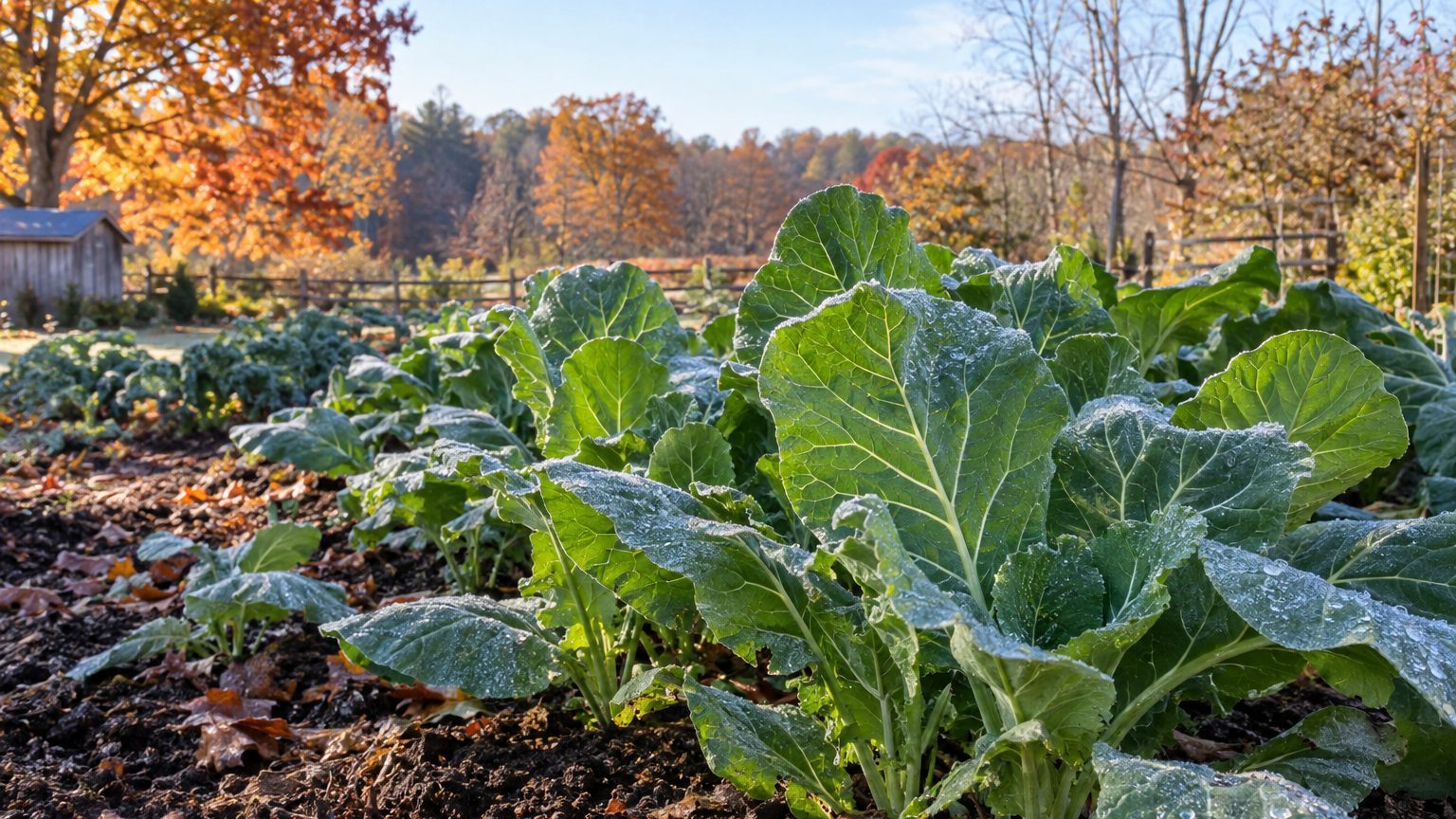

Most Alberta gardeners can sow collards outdoors starting in mid-to-late May, right around the province’s average last spring frost, and again in July for a fall crop timed to ripen before the first hard freeze. But “average” is doing a lot of work in that sentence, and the two frost dates that anchor this calendar are means, not promises.
The short answer for Alberta
Environment and Climate Change Canada’s 1981-2010 normals for the Calgary Int’l A station put the average last spring frost at May 21 and the average first fall frost at September 16. Those two dates bracket a frost-free season of roughly 118 days, which is the working budget for anything you plant outdoors in an unprotected bed.
For collards specifically, that budget supports two sowing windows. The spring window opens around the mean last-frost date and runs through early June, giving young plants a head start before summer heat sets in. The fall window opens in mid-July, aiming to have plants sized up before the mean first-frost date arrives in mid-September, since a light frost actually sweetens collard leaves rather than ruining them.
Here is the catch nobody puts on a seed packet: a mean frost date is the midpoint of a distribution, not a safe line you cross once and forget. In roughly half of all years on record, the last spring frost at this station falls after May 21, sometimes by a week or two. Treat the date as the center of a window, not the edge of one, and hold off planting anything tender until the local forecast backs it up.
Starting seed indoors sidesteps some of that risk. Collards germinate reliably at room temperature, and seedlings started inside four to six weeks before the mean last-frost date can go into the ground as sturdy transplants right around May 21, rather than as fragile sprouts still finding their first true leaves. That shift alone buys several weeks against a late cold snap, which matters more in Alberta than in almost any US state this site covers.
What will not work here

A 118-day frost-free window sounds generous until you remember it is a mean, and that collards planted at the edges of that window are gambling against real Alberta weather. Slow-maturing collard types bred for long, mild seasons in the American Southeast are the first casualty here: a variety that wants a full season plus buffer to reach full size simply runs out of daylight and warmth before the mean first frost, let alone before an early one.
Winter survival is the other trap. The coldest month in this record averages a daily minimum of -13.2°C (8.2°F), and that is an average low, not the coldest night on record. Collards are among the hardier greens, tolerant of light frost and even a modest freeze, but nothing about this figure supports leaving unprotected plants in open ground through an Alberta winter and expecting a spring harvest. Growers further south in the US, where this site’s coldest-month averages stay well above freezing, can sometimes overwinter collards in place. That option does not transfer here without row cover, cold frames, or a heavy mulch layer, and even then it is a gamble rather than a routine.
Watering habits imported from a hotter, drier climate fail differently. Collards planted for the July fall-crop window are germinating and establishing roots during the warmest, driest stretch of the Alberta summer, and a once-a-week watering schedule that works in a humid coastal state leaves this soil bone-dry within days. The fix is not more water per session but shorter, more frequent watering while seedlings are shallow-rooted, tapering off once plants are established. Get the fall sowing date right and skip the watering adjustment, and you can still lose the crop to a dry spell before it ever reaches the first-frost finish line.
What changes across Alberta
Every figure above comes from one weather station, Calgary Int’l A, and Natural Resources Canada’s plant hardiness map lists that reference city at zone 4a under the Canadian system. That number is not a stand-in for the whole province. Alberta stretches from Chinook-warmed foothills in the south to boreal forest near the Northwest Territories border, and a single zone rating for one city cannot describe that range.
The Canadian hardiness system itself is built from seven climate variables, not the single winter-minimum figure the USDA system uses, and Natural Resources Canada is explicit that the two scales do not convert cleanly. A Canadian zone 4a rating overlaps nine different USDA zones elsewhere on the map, anywhere from 3a to 7a, so resist the urge to look up an American variety’s USDA hardiness rating and assume it lines up with what “4a” means here.
Practically, that means a gardener in the far north or at higher elevation in the foothills is very likely working with a shorter frost-free season than the Calgary-based dates in this article suggest, while someone in a sheltered Chinook-belt valley may see spring arrive earlier than May 21 in most years. Neither reader should treat this page’s dates as their own without adjustment. The only reliable way to know which end of that spread you are on is to look up your own location on Natural Resources Canada’s interactive Plant Hardiness Site, rather than assuming the province-wide average applies to your specific yard.
Where to check this for your own county
This page describes Alberta at the provincial level, built from one reference weather station. That is useful for planning purposes, but it is not the same as a recommendation tuned to your specific municipality’s soil, elevation, and microclimate. For that, the right stop is Alberta’s Ministry of Agriculture and Irrigation, at alberta.ca/agriculture-and-irrigation.
Once there, look specifically for two things. First, any regional or district-level planting calendar that breaks the province down further than a single frost-date pair, since local agricultural offices often track frost risk at a finer grain than the national climate normals used here. Second, look for variety trial results or extension bulletins naming collard and leafy green cultivars that have actually performed well in Alberta’s shorter, cooler growing season, rather than relying on seed catalog descriptions written for milder climates.
A county or district-level recommendation will always beat a provincial average, for the simple reason that it accounts for local frost pockets, soil type, and elevation that a single Calgary weather station cannot capture. This article is the provincial-level answer, useful for a first pass at timing, but not the final word for a specific yard forty miles north of the reference station or a few hundred feet higher in elevation.
Checking this against your own garden
Every date on this page is a regional average, and your own soil and plants will tell you more than any calendar. Three signs are worth watching before you trust the calculation over the calendar.
Soil warmth by feel is the first check. Collard seed germinates poorly in cold, wet ground, so if a handful of soil at planting depth still feels cold and heavy in late May, the mean last-frost date has arrived on the calendar but not yet in the ground, and waiting a few more days costs nothing.
The appearance of the first true leaves, the second set to emerge after the rounded seed leaves, tells you whether a spring sowing is on pace for the July succession planting or running behind. A crop still on seed leaves in early July is unlikely to size up before the mean first frost in mid-September.
Finally, watch how quickly any weeds or volunteer greens are growing nearby. Vigorous weed growth is a reliable, no-equipment signal that soil temperature and day length have crossed the threshold where direct-seeded collards will germinate reliably, often a more honest indicator for your specific yard than a provincial average pulled from one airport weather station.
If you follow the almanac, here is when to plant collard greens by the moon. It is a tradition, not a proven method.