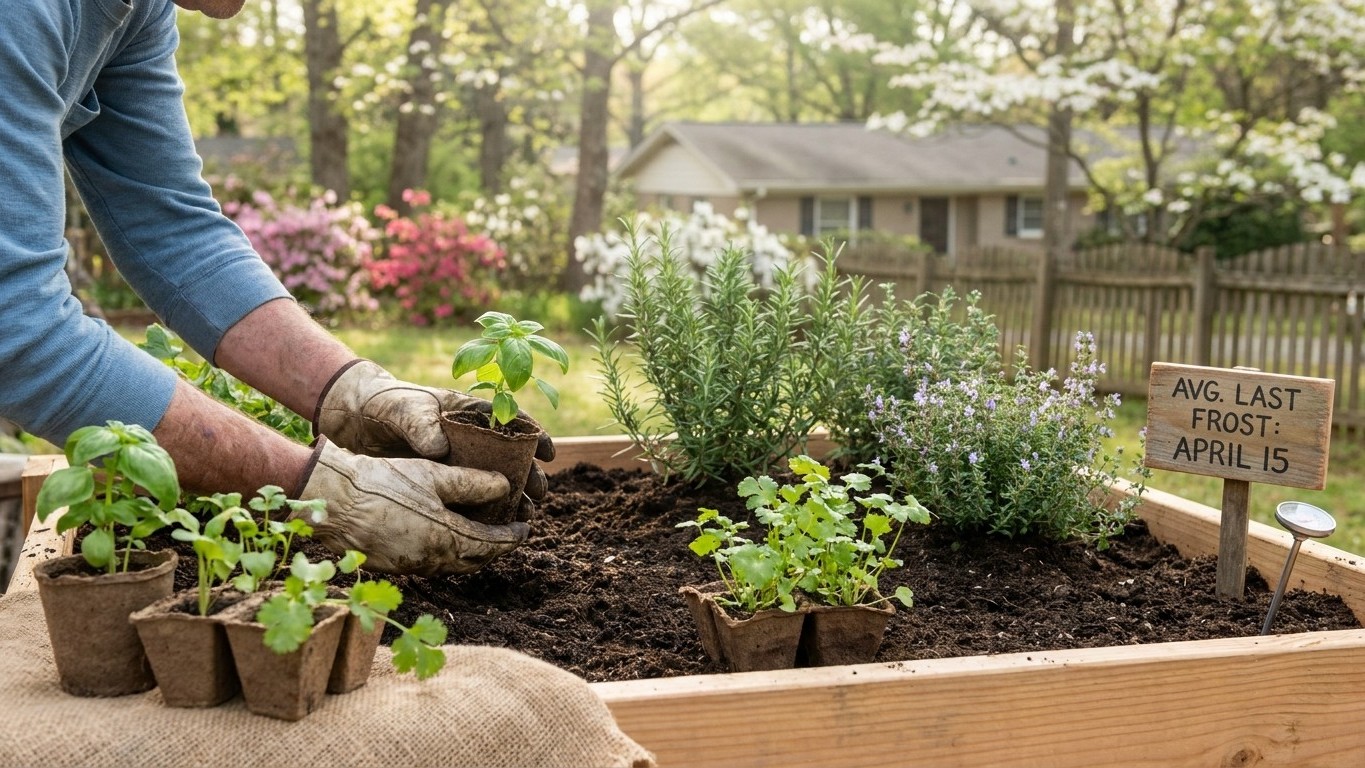

Alberta’s average last spring frost lands May 21 and the average first fall frost falls September 16, according to Environment and Climate Change Canada. That gives a frost-free window of roughly four months, on average, to move tender herbs outdoors and bring the season to a close. But “average” is doing a lot of work in that sentence, and what it actually means changes how you should read every frost date.
The short answer for Alberta
Hardy herbs, meaning chives, parsley, oregano, and mint, can go into the ground two to three weeks before that May 21 mean frost date because they tolerate a light freeze without dying back. Tender herbs, basil and cilantro chief among them, need to wait until after May 21, and even then you’re taking a calculated risk rather than a sure thing.
Here’s why: May 21 is a mean date pulled from the Calgary Int’l A station’s 1981-2010 climate normals, not a guarantee. A mean frost date splits the record roughly down the middle. In about half of the years on record, frost showed up after May 21, sometimes by a week or two. Treat it as the center of a window, not a safe line you can plant right up against.
The same logic runs in reverse come fall. September 16 is the average date of the first fall frost, which means tender herbs have about as much chance of getting nipped before that date as after it. If you’re still harvesting basil in mid-September, keep a frost cloth within reach rather than trusting the calendar to hold.
Winter hardiness for perennial herbs left in the ground is a separate question, and it comes down to the coldest month’s average daily minimum, which sits at 8.2 degrees Fahrenheit for the Calgary reference station. That’s cold enough to kill most Mediterranean herbs outright if they’re left unprotected.
| Herb type | Examples | Suggested outdoor timing |
|---|---|---|
| Hardy | chives, parsley, oregano, mint | 2-3 weeks before May 21 average |
| Tender | basil, cilantro, dill | After May 21 average, once soil has warmed |
| Woody perennial | rosemary, sage, thyme | Grow as an annual, or dig up and overwinter indoors before Sept 16 average |
What will not work here
Rosemary started from seed is the classic mistake. Rosemary seed can take two to three weeks just to germinate, and the plant needs months of warm growth after that before it’s usable in the kitchen. With a frost-free window that runs, on average, from May 21 to September 16, that’s under four months to work with, and a slow starter like rosemary from seed simply runs out of runway before the cold returns.
Leaving rosemary, or any tender Mediterranean perennial, in the ground over winter is the second failure point, and it’s a bigger one. The coldest month here averages a daily minimum of 8.2°F. Most rosemary varieties start suffering damage well above that, and outright dying at or below it. A Canadian hardiness rating attached to a nearby city doesn’t change that math for a plant that isn’t built for it. If you want rosemary or sage as a multi-year plant rather than a seasonal one, the pot comes indoors before the cold sets in, full stop.
Planting tender herbs directly in the garden right on May 21 because “that’s the frost date” is the third trap. Since that date is a 50/50 average rather than a safe cutoff, seedlings set out exactly on schedule get caught by late frost in roughly half of all years. Basil in particular sulks and yellows even from a near-miss frost, well before it actually dies, which sets the whole season back.
Finally, a succession-sowing schedule copied from a milder growing region falls apart here. If you’re used to three or four staggered sowings of cilantro or dill through a six-month season, Alberta’s shorter window compresses that math. A last sowing needs enough time to reach a harvestable size before the September 16 average frost, which, worked backward, often leaves room for only two rounds rather than four.
What changes across Alberta
Every figure above comes from one station, Calgary Int’l A, and Alberta is not one climate. The province’s Canadian hardiness zone rating (a seven-variable system, distinct from the single-variable USDA scale used elsewhere on this site) sits at 4a for that reference location. Natural Resources Canada is explicit that a single Canadian zone number, 4a included, can overlap nine different USDA zones depending on where you are, which tells you how much variation gets folded into that one label.
Alberta stretches from dry southern prairie through the foothills and up into boreal forest in the north, and elevation adds another layer on top of latitude. A garden at altitude in the foothills, or one well north of Calgary, is very likely working with a later last frost and an earlier first fall frost than the dates given here, which shortens the usable season further. A garden in a sheltered river valley or a warmer southern pocket may see the opposite.
None of this means you should guess your own zone from a provincial average. Natural Resources Canada’s Plant Hardiness Site maps zone data down to the municipality, and that’s the tool built for the job, not a single reference station’s numbers repeated across a province several times the size of most U.S. states. If you garden north of Calgary or up in elevation, plan to shift both the spring and fall ends of this window later and earlier respectively; if you’re south and sheltered, you likely have a bit more room than the numbers above suggest, but confirm it rather than assume it.
Where to check this for your own county
The provincial picture is built from one reference station’s climate normals. That’s a starting point, not a local forecast. Alberta’s own agriculture ministry, Alberta.ca’s Agriculture and Irrigation service, is the place built to narrow that down.
Two things are worth hunting for once you’re there. First, any regional or county-level planting calendar, since Alberta’s agriculture service works with growers across wildly different sub-climates and often has guidance broken out by region rather than one blanket date for the whole province. Second, look for herb and vegetable varieties that have actually been trialled in your part of Alberta. A variety bred for a longer, milder season elsewhere may technically survive here but underperform badly, while a variety selected for a short-season prairie climate can outproduce it by weeks.
A county or regional recommendation will always beat a provincial one, for the simple reason that it’s built from more localized data rather than a single Calgary weather station standing in for a province the size of France and Germany combined.
If you follow the almanac, here is when to plant herbs by the moon. It is a tradition, not a proven method.
Checking this against your own garden
Every date above is a regional average pulled from decades of weather records, and your own backyard will always tell you more than a station number can. Three signals are worth tracking, none of them requiring anything you don’t already have on hand.
Soil warmth by feel is the first. Push your hand a few inches into the bed in spring. If the soil still feels cold and damp rather than merely cool, tender herb seedlings will sit and sulk even if the calendar says the frost risk has passed. Warmth you can feel through your fingers is a better cue for basil and cilantro than any single date.
The first true leaves on anything you’ve already direct-sown are the second signal. Seed leaves (the first, rounder pair) don’t tell you much, but the next set, the ones that actually look like the herb, mean the plant has moved past its most fragile stage and is drawing real energy from the soil around it, which is a decent sign your local conditions have caught up to the season.
Spring regrowth on any hardy perennial herb already in the ground, chives or established oregano especially, is the third. When you see new green shoots pushing up on their own, without any help from you, that plant is responding to soil and air conditions in your specific yard, not to a mean date calculated from an airport weather station miles away. That’s about as reliable a local signal as a home gardener gets.