
Alberta herb gardeners work with a short, cool growing window bounded by frost dates in mid-May and mid-September, and a winter cold enough to put most woody perennial herbs into containers rather than the ground. The short answer: yes, herbs grow well here, but timing and permanence look different than in warmer provinces.
When the soil is warm enough in Alberta

The date most gardeners want is the last spring frost, and for Calgary that figure sits at May 21 on average, according to Environment and Climate Change Canada’s Canadian Climate Normals for 1981-2010, recorded at the Calgary Int’l A station. That word “average” carries weight here: it’s a mean date, not a safe date. In roughly half of all years, frost arrives later than May 21. Treat it as the midpoint of a range, not a green light.
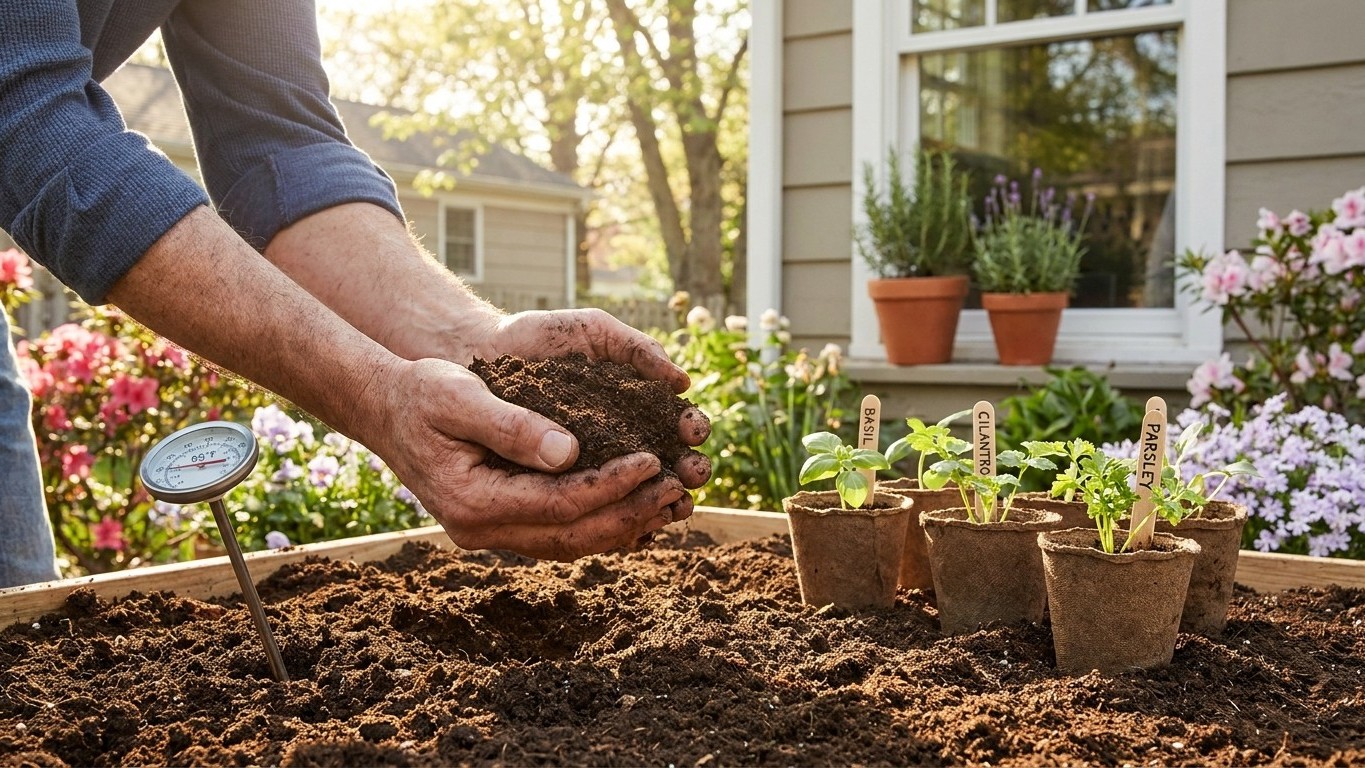
Frost itself is only a stand-in for the real question, which is soil temperature. Herbs don’t care what the air did last night; they care whether the root zone has warmed enough to support growth. Soil lags behind air temperature by days, sometimes weeks, especially in a spring with lingering snowmelt. So the practical rule is to let the frost date pass, then wait further before trusting the ground with tender seedlings.
Alberta is also not one climate. The Calgary Int’l A station describes conditions around that city; districts to the north, or at higher elevation, typically lag weeks behind it. A gardener outside Edmonton or in the foothills should treat the May 21 figure as a starting point for research, not a transferable fact.
Cold-hardy types versus tender types
Some herb types tolerate a light frost and can go into the ground before the average date passes; others are killed outright by a single cold night and need the soil fully warmed. Rather than name specific varieties, it helps to think in categories: hardy perennial herbs suited to cool soil, and tender annual herbs that want both warm air and warm soil before they’re transplanted outdoors. Several herbs carry a long-standing medicinal reputation in folk use; this page doesn’t evaluate any of those claims and sticks strictly to culinary and garden growing conditions.
How long the season lasts here
With a last spring frost averaging May 21 and a first fall frost averaging September 16 at the Calgary Int’l A station, the frost-free window runs to roughly 118 days. That’s the number that actually shapes what’s realistic to grow, more than any single frost date on its own.
A season around four months is workable for most culinary herbs, but it’s tight enough that it changes garden strategy in a specific way. In Territories with a longer frost-free window, gardeners often get two full sowings of a fast annual herb: one early, one mid-summer to replace it. In Alberta, that second sowing is a much narrower bet. A herb that needs six to eight weeks from seed to usable size still has room for a second round if started right after the first is established, but anything slower risks running into the September frost before it matures.
That’s exactly the calculation covered in this site’s succession sowing guide, which walks through how to time a second or third planting against a known frost-free window rather than guessing.
The short season also changes the transplanting question. Where the window is long, gardeners can afford to direct-seed slow herbs and simply accept a later harvest. In Alberta, starting seed indoors and transplanting out established seedlings buys back weeks that the calendar doesn’t otherwise offer. That makes checking root health before transplant more than a nicety, since a herb transplanted with damaged or pot-bound roots loses time it can’t make up before frost returns in September.
Heat and water in Alberta

This site tracks summer heat-day counts and rainfall totals for many territories, but neither of those numbers is what decides the shape of an Alberta herb bed. The number that actually matters here is winter cold, and Alberta’s verified figures on that front are specific and worth sitting with.
Calgary sits in Canadian hardiness zone 4a, based on Natural Resources Canada’s Plant Hardiness Site using 1991-2020 normals. That’s the Canadian system, built from seven climate variables, and it does not convert directly to the USDA zones used elsewhere on this site. NRCan is explicit that Canadian zone 4a overlaps nine different USDA zones, anywhere from 3a to 7a, so treat this number as its own scale, not a stand-in for a USDA rating.
The more telling figure is the coldest month’s mean daily minimum: 8.2°F, per ECCC’s Canadian Climate Normals for 1981-2010. That’s not a record low and not a monthly average temperature; it’s the typical overnight low across the coldest month of the year. A mean minimum that low is what decides which herbs can live outdoors year-round in Alberta and which ones need to come inside, or be treated as annuals grown fresh each spring.
What that means for the garden
A cold winter like this reorganizes the whole herb bed around one question: does this plant survive outdoors, or does it need a pot? Many culinary herbs sold as perennials at nurseries carry hardiness ratings suited to milder winters than Alberta’s, which means they either die back outdoors here or need to be lifted and moved indoors before the cold sets in. On the growing-season side, a short, cool summer brings its own separate risk: slower ripening and higher odds of foliar mildew on herbs that prefer heat and quick airflow, simply because the season doesn’t offer either in abundance.
Which herbs suit Alberta
The short season points toward earlier-maturing annual types rather than slow growers that need a long stretch of warmth to bulk up. A herb that reaches usable size quickly from seed fits the roughly 118-day window with margin to spare; one that needs most of a summer to mature is working against the calendar from day one.
The cool, short summer also raises the priority on disease resistance and airflow. Herbs planted too densely, or grown without attention to drainage, are more prone to mildew in a climate that doesn’t dry out quickly between rains. Spacing plants for airflow and choosing a well-drained spot matters more here than it would in a hotter, drier province.
Winter cold is the deciding factor for anything grown as a perennial. Hardy perennial herb types bred for cold soil have a real chance of surviving an Alberta winter outdoors, provided the planting site and mulch are right. Woody, warmth-loving perennial herb types are far safer treated as container plants, brought indoors or into an unheated but frost-free space before the first fall frost.
What this page won’t do is name a specific variety. Naming a cultivar without local trial data behind it is a guess dressed up as advice, and Alberta’s zone 4a rating alone covers a nine-zone range of USDA conditions, which shows just how much local variation this single label hides. The varieties actually trialled for Alberta’s soils and seasons are published by Alberta’s provincial agriculture and irrigation service, and that recommendation carries weight this page simply can’t match.