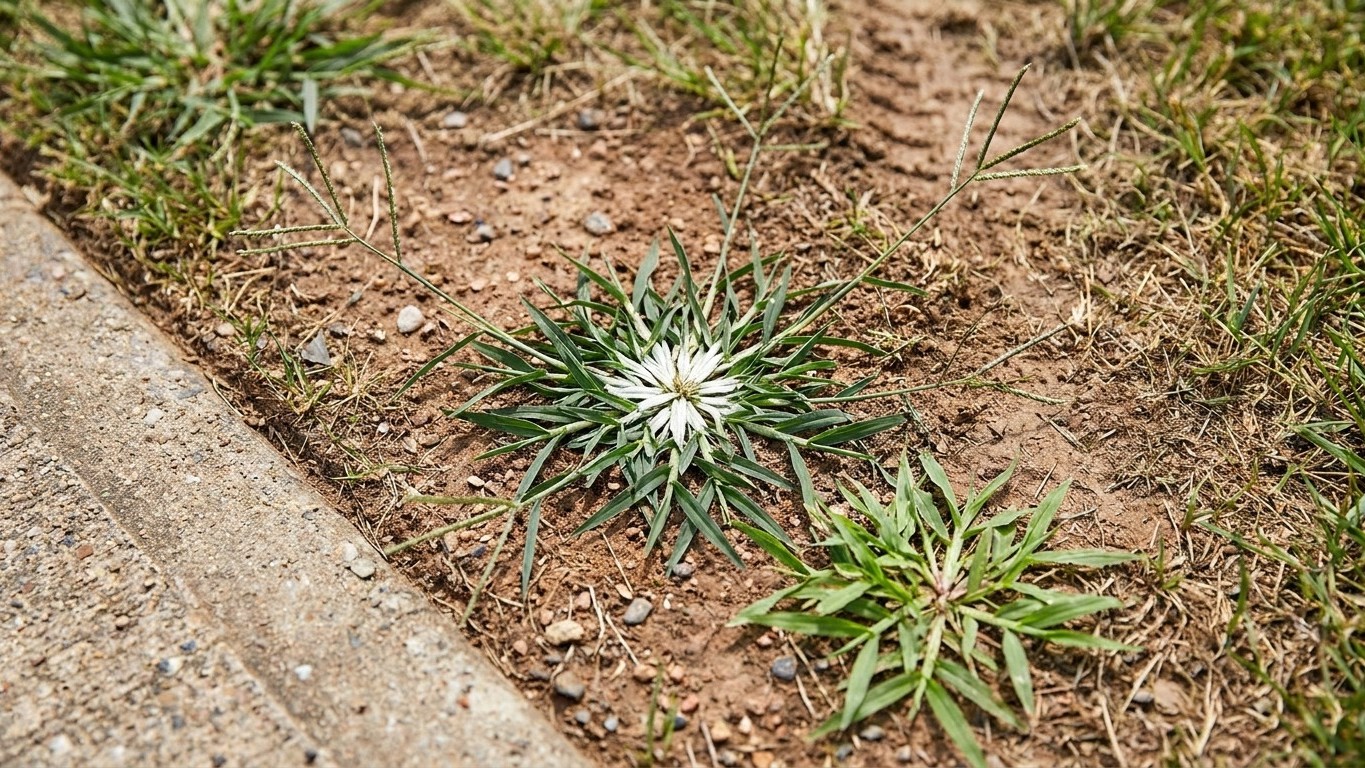

Overseed Alberta lawns in later summer, not fall. Work backward from the average first frost, September 16 at the Calgary Int’l A station, and count 45 days of growing weather before it. That points to a sowing window running from mid-July into early August for most of the province’s settled corridor, earlier if you garden north of Edmonton or at elevation. Miss it and germinating seed enters winter without enough root to survive.
The overseeding window in Alberta
The math behind that window looks tidy until you read the fine print on the frost date itself. September 16 is a mean, pulled from the 1981-2010 Canadian Climate Normals at one station, Calgary Int’l A. A mean is not a guarantee. In one year out of two, frost at that station actually lands later than September 16. In the other half, it arrives on or before it. Treat the date as the midpoint of a range, never as a fixed deadline you can sow right up against.
Why the calendar math cuts it close
Cool-season turf needs roughly 45 days of active growing weather to move from bare seed to a stand that can hold through winter. Count 45 days back from September 16 and you land on August 2. That’s the last date the math forgives, assuming frost behaves exactly like the average. Sow later and you’re betting on a warm autumn that the normals don’t promise. Sow by mid-July instead, and a seedling that germinates in ten days to two weeks still has a full month of growth in hand before the average frost, plus whatever extra weeks a mild fall hands you.
One frost date does not cover the province
Alberta stretches from the Montana border to the boreal forest, and no single station speaks for all of it. The Calgary figure describes the southern foothills corridor reasonably well. Push north toward Edmonton, the Peace River country, or Fort McMurray, and frost typically settles in weeks earlier, which shifts the whole sowing window back by a comparable stretch. Gain elevation near the mountains and the same shift happens for a different reason: cold air pools in valleys and on benches regardless of latitude. If you garden outside the Calgary area, treat August 2 as a southern-Alberta reference point and move your own last-sowing date earlier rather than later.
The soil temperature that actually decides it
Calendar dates are a planning tool. Soil temperature is what actually triggers germination, and for the cool-season species grown across Alberta, that band sits at 50 to 65°F, measured two inches down. Air can feel warm on a September afternoon while the soil underneath is still cold from an overnight low, so relying on how the day feels will mislead you more often than it helps.
Measuring it right
A simple soil thermometer pushed two inches into the lawn, read mid-morning before the sun has heated the surface, gives a workable number. Check it over a few consecutive days rather than once. Soil that reads 50 to 65°F on a Tuesday and drops back to 45°F by Friday because of a cold front hasn’t stabilized yet, and seed sown into that swing germinates unevenly at best.
Why warm-season grass never works here
Alberta sits in what turf extension literature classes as a cool zone, and that label rules out warm-season species entirely, not just as a preference. Warm-season grasses need soil well above the 50 to 65°F band to germinate and they go dormant, then die outright, at the first hard freeze. Every grass suited to this territory, Fine Fescues, Kentucky Bluegrass, Perennial Ryegrass, Rough Bluegrass, and Tall Fescue, is a cool-season species built to germinate in that lower temperature band and to tolerate the cold that follows. That’s the whole list worth planting here; nothing warm-season belongs in an Alberta overseeding job.
How much seed, and what it costs to guess
Seeding rates for these five grasses are fixed by the species, not by local soil or weather, and they’re published for new lawns. Overseeding an existing lawn uses half those figures, because the seed is filling gaps in a stand that’s already partly established.
The rates, halved for overseeding
| Grass | New lawn rate (per 1,000 sq ft) | Overseeding rate (per 1,000 sq ft) |
|---|---|---|
| Tall Fescue | 6 to 8 lb | 3 to 4 lb |
| Fine Fescues | 4 to 5 lb | 2 to 2.5 lb |
| Kentucky Bluegrass | 1.5 to 2 lb | 0.75 to 1 lb |
| Perennial Ryegrass | 6 to 8 lb | 3 to 4 lb |
| Rough Bluegrass | 1.5 to 2 lb | 0.75 to 1 lb |
Guessing high on these numbers doesn’t buy insurance, it buys competition. Seedlings crowded into the same square foot fight each other for light and water, and the stand thins out on its own within a season regardless of how thick it looked at first mow. Guessing low wastes the narrow window Alberta’s frost timeline already leaves you, since a thin overseed job in early August won’t fill in before growth shuts down for winter. Weigh the seed for the actual square footage of the area you’re patching, not the whole yard, and split it into two passes crossing at right angles for even coverage.
The three weeks after you sow
Seed down is the easy part. What happens over the following three weeks decides whether it survives to spring, and Alberta’s tight window makes those weeks less forgiving than in a longer growing region.
Watering and mowing in the first three weeks
Keep the top half-inch of soil consistently damp with light, frequent watering, several short sessions a day rather than one long soak, until germination shows. Once seedlings are up, ease back to fewer, deeper waterings that push roots downward instead of keeping them shallow. Hold off mowing until the new grass reaches about three inches, and set the mower high for that first cut. Cutting too early stresses seedlings that haven’t rooted enough to recover.
What frost risk means for care choices
Because you’re sowing against a mean frost date rather than a settled one, skip any heavy nitrogen application in this window. A flush of soft, fast top growth right before a cold snap is more vulnerable than steady, moderate growth. A light phosphorus-leaning starter feed at seeding time supports root development, which matters more than leaf growth when the clock is running against a frost date that could land two weeks early or two weeks late depending on the year.
Common questions
Can I overseed in spring instead of late summer?
Spring seeding competes with weed germination and the established grass’s own spring growth surge, both of which crowd out new seedlings more aggressively than the quieter late-summer window does.
What if I miss the early-August cutoff?
Seed sown too close to frost may germinate but won’t build enough root before winter, and it typically dies over the cold months rather than surviving to fill in next spring.
Does a mild fall change any of this?
It can extend your margin, but the normals don’t promise a mild fall, and sowing as if one is coming is a bet, not a plan.
Where can I check current provincial growing conditions?
Alberta’s agriculture department publishes seasonal guidance at alberta.ca/agriculture-and-irrigation, useful for conditions specific to your growing season beyond the averages cited here.