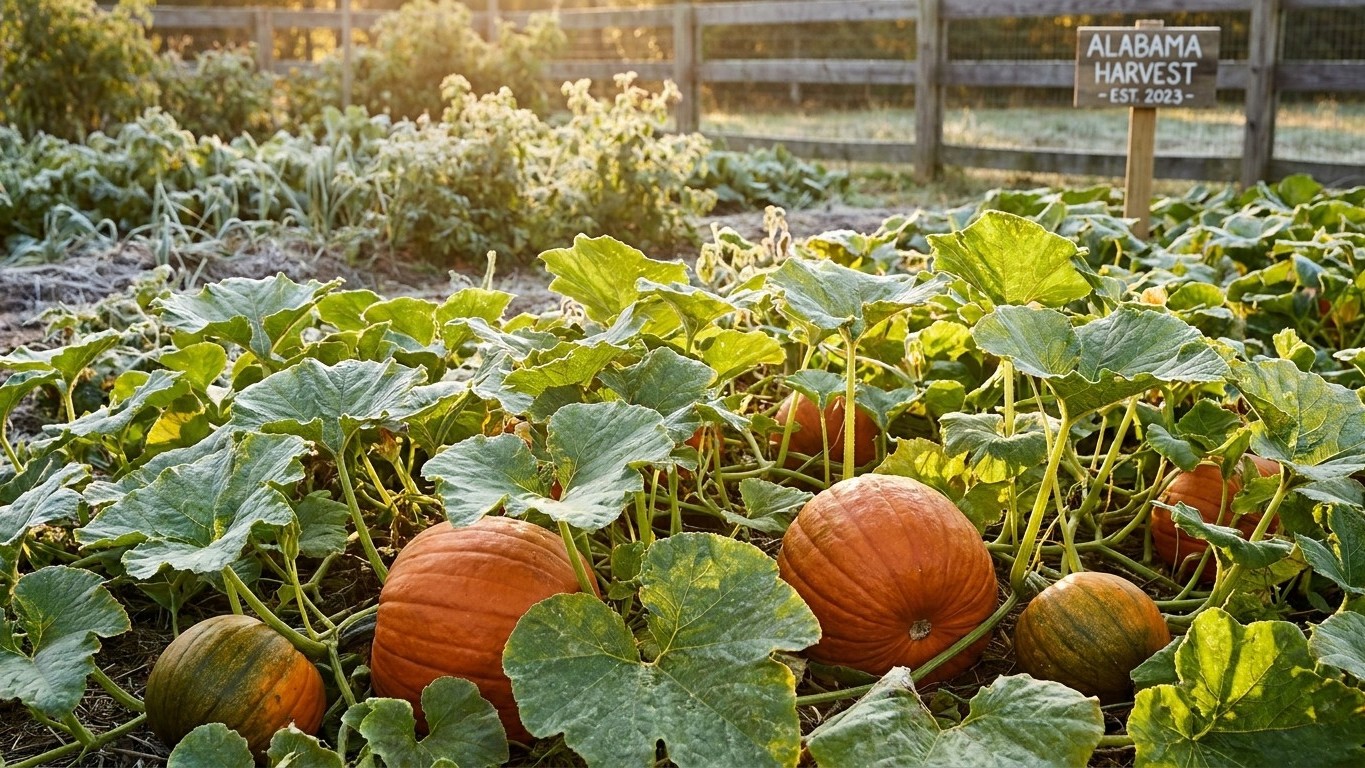

Most pumpkin vines in Alberta only make it to a ripe, orange finish if flowering wraps up by late July. The province’s growing season is short for a crop that needs 45 to 55 days between the first open flower and a fully colored, hard-skinned fruit, and a slow spring pushes that flowering date later than the season can absorb. Whether a patch makes it before frost depends less on the day seed went into the ground than on the day the first bloom actually opened.
The short answer
Start with the frost. Environment and Climate Change Canada’s 1981-2010 climate normals put Calgary’s average first fall frost at September 16, drawn from the Calgary International Airport station. That word “average” matters: it’s a mean date, not a safety line. In one year out of two, the actual first frost lands later than September 16, and in the other half it lands earlier. Treat September 16 as the midpoint of a window that shifts year to year, not a date to circle on the calendar and trust.
Utah State University Extension’s guidance on pumpkin timing supplies the other half of the equation: pumpkins need 45 to 55 days from flowering, not from the day the seed went into the ground, to reach full color and a hardened rind. Counting back from September 16, a flower needs to open by roughly August 2 if the fruit only needs the shorter 45-day run, or by around July 23 if it needs the full 55 days. That puts the flowering deadline somewhere in the last ten days of July to the first few days of August for most of the province.
Miss that window and the arithmetic turns against the fruit. A flower opening in mid-August is asking for another 45 to 55 warm, sunny days in a place where the average frost arrives roughly a month later, and where a cool, wet September isn’t unusual. The fruit may still swell in size, but color and rind hardness lag behind size, and an early cold snap can catch it green.
None of this changes because a gardener starts seeds indoors or under cover. What changes the outcome is the date the first female flower opens and sets fruit, since that’s the clock Utah State’s 45-to-55-day figure actually measures. Sowing date, soil temperature, and transplant timing only matter because they decide how early that flower can open.
Calgary’s numbers are also just one station’s record for one corner of a large province. Northern districts, the Peace region, and higher foothill towns typically see frost arrive ahead of Calgary’s date, sometimes by a couple of weeks, while some lower-elevation southern pockets can run a little later. Gardeners outside the Calgary area should treat September 16 as a rough reference point rather than a local forecast, and lean toward the earlier end of the flowering window rather than the later one.
When to sow here
Sowing pumpkins in Alberta isn’t as simple as counting forward from the last frost. Two different clocks run at once, air temperature and soil temperature, and pumpkin seed only cares about the second one.
- Mark the last spring frost. Calgary’s average last spring frost falls May 21, again a mean figure from Environment and Climate Change Canada’s 1981-2010 normals, and again a date that lands earlier in roughly half of all years and later in the other half. It marks the earliest point air temperatures are likely safe, nothing more.
- Wait for the soil to catch up. Utah State University Extension calls for 65°F soil before sowing pumpkin seed, and soil doesn’t warm at the same pace as air. Bare ground in late May is routinely still cool a few inches down even once overnight air frost has stopped, so the 65°F mark tends to arrive well after May 21, not on it.
- Test before trusting the calendar. A soil thermometer pushed a few inches into the bed, checked in the morning before the sun heats the surface, is the only reliable way to know the ground has actually reached 65°F rather than guessing from a date on the wall.
- Use row covers to close the gap. Floating row covers trap solar heat and can buy roughly two weeks on the sowing date, warming the soil underneath faster than open ground and giving seed a head start without exposing it to a stray late frost.
- Run the arithmetic forward from that sowing date. Count the weeks to the first female flower, then add the 45 to 55 days from that flower to ripeness. If the total lands past the flowering deadline worked out above, roughly the last ten days of July to the first days of August, the season is too tight for that sowing date and needs to move earlier, move under cover, or move indoors as transplants.
What goes wrong here
- A flower opens too late to color. Any female flower opening after the first few days of August is racing a clock it likely won’t win, since the fruit still needs 45 to 55 days to reach full color and a hard rind before the average September 16 frost. The fix is upstream: sow earlier under row covers, or start transplants indoors, rather than hoping a late-set fruit finishes outdoors on borrowed time.
- An early frost catches a fruit still ripening. Because September 16 is only a mean, plenty of years bring frost earlier, sometimes weeks earlier, catching fruit that was on track under an average timeline. Harvest with the stem attached as soon as frost threatens, even if the rind hasn’t fully hardened, and finish curing indoors somewhere it won’t freeze, which is the only storage condition Utah State University Extension actually specifies.
- The vine collapses before the skin toughens. Frost, disease, or plain exhaustion can kill the foliage while the fruit underneath is still soft-skinned. A pumpkin cut from a dead vine before its rind hardens won’t store well and won’t finish coloring on the counter the way a vine-ripened fruit does, so protecting the vine on cold nights with row covers matters as much as protecting the fruit itself.
- Pest pressure shortens an already short season. Squash bugs and cucumber beetles can weaken vines mid-season, and a stressed plant sets flowers later and fills out fruit slower, squeezing an Alberta timeline that had no slack to begin with. Managing them early keeps the vine’s own clock from adding days it doesn’t have to spare; see this site’s pages on squash bugs and cucumber beetles for identification and control.
Common questions
Can I still get ripe pumpkins if my flowers opened in mid-August?
It’s a long shot rather than a lost cause. Since September 16 is a mean frost date, roughly half of all years push frost later than that, sometimes by weeks, so a mid-August flower can occasionally still finish. But that’s betting on a milder-than-average fall rather than working within a normal one, and a gardener counting on it should have a backup plan, whether that’s row covers over the fruit or accepting an unripe, green pumpkin for decoration rather than eating.
What’s the real difference between the last frost date and the day soil is warm enough to sow?
The last frost date, May 21 on average here, describes air temperature at a specific hour overnight. The 65°F soil threshold Utah State University Extension calls for describes ground temperature several inches down, which warms on its own slower schedule. Air can be safely above freezing for weeks while soil is still too cold for pumpkin seed, which is exactly why row covers, which warm soil directly, can buy meaningful time that waiting on the calendar alone can’t.
Which pumpkin varieties do Alberta gardeners often choose for a short season?
Names that come up repeatedly in short-season gardens include Sugar Pie, Baby Pam, Wee-B-Little, Jack Be Little, New England Pie, Racer, Spirit, Autumn Gold, and Small Sugar. No days-to-maturity, size, or color figures are published here for any of them, so treat the names as a starting point for further research rather than a guarantee tied to Alberta’s frost dates.
How should pumpkins be stored after harvest?
Utah State University Extension’s published guidance stops at storing pumpkins “where they will not freeze.” No specific temperature, humidity level, or keeping time is given in that source, so the practical rule for Alberta growers is simply frost-free storage, not a particular number on a thermometer.