
Pumpkins in Alberta go into the ground once the soil holds steady at 65°F, usually a few weeks after the average May 21 last frost. But that sowing date isn’t the number that decides success or failure. The real deadline is when the first flower opens, because that moment starts a 45-to-55-day clock racing against Calgary’s average September 16 first fall frost.
The short answer
Start with the end of the season, because that’s where the math actually begins. Environment and Climate Change Canada’s 1981-2010 normals put the average first fall frost at Calgary Int’l A on September 16. That’s a mean, not a promise: in one year out of two, frost arrives later than that date, and in the other half, it shows up sooner. Treat September 16 as the midpoint of a window, not a line you can plant right up against.
Utah State University Extension’s guidance on pumpkin timing is specific about one thing: pumpkins need 45 to 55 days after flowering to reach maturity. Not from seeding. Not from transplanting. From the day the flower opens. Count backward from September 16 and the arithmetic writes itself. Fifty-five days back lands on July 23. Forty-five days back lands on August 2. That gives a flowering window of roughly July 23 to August 2 as the latest point a bloom can open and still finish as a colored, hardened pumpkin before frost.
Miss that window and the fruit is still green, still soft-skinned, still weeks from ripe when the cold arrives. That’s the entire problem this page exists to solve: working backward from a frost date that itself moves around by weeks, using a maturity window that only starts counting once flowers appear.
Because the frost date is an average and not a guaranteed cutoff, the safest approach is to treat the late end of that flowering window, August 2, as already cutting it close. Alberta gardeners who wait for flowers in early August are betting on a later-than-average frost. Some years that bet pays off. Some years it doesn’t. Aiming for flowers by mid-July, rather than late July or early August, builds in the cushion that a single mean date can’t give you.
None of this accounts for elevation or local microclimate. The September 16 figure comes from one station, Calgary Int’l A. Higher ground, northern districts, and low-lying frost pockets across the province routinely see their first frost earlier than that station does. A province isn’t one climate, and this window should be read as a starting point, not a fixed rule for every yard.
When to sow here
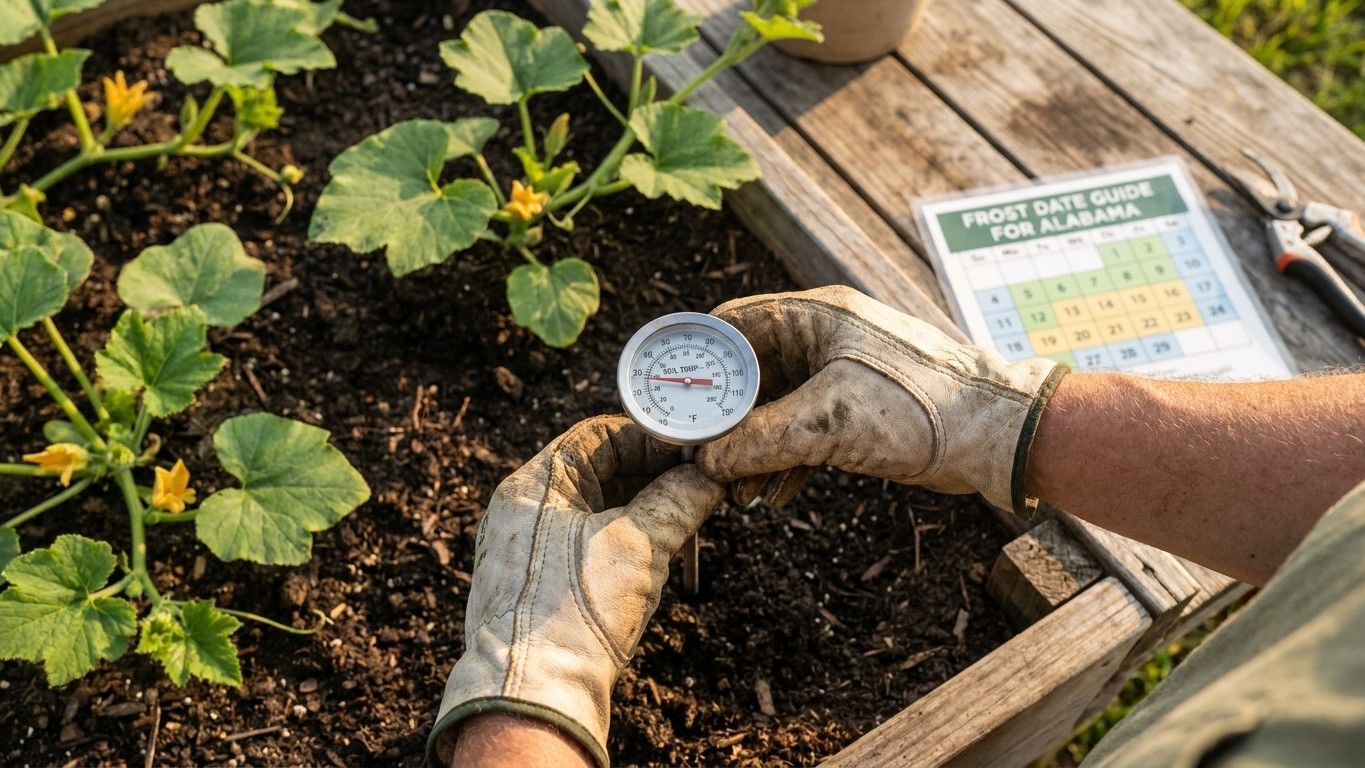
- Check the soil, not the calendar. Pumpkin seed wants soil holding at 65°F, measured a few inches down, not the air temperature and not the frost date. Seed sown into cold soil sits and rots more often than it sprouts.
- Understand the gap between frost and soil warmth. The average last spring frost at Calgary Int’l A lands on May 21. Soil doesn’t hit 65°F on that same day. Ground takes weeks to catch up to air temperature, since soil warms far more slowly than the air above it. Treat May 21 as the earliest marker on the calendar, not the sowing date itself.
- Use row covers to close some of that gap. Clear or floating row covers, or plastic mulch laid over the bed ahead of sowing, trap solar heat in the soil and can bring that 65°F threshold forward by about two weeks compared with bare, uncovered ground.
- Pull the covers once seedlings are up and soil is consistently warm. Covers that helped germination can trap too much heat and stress young plants once real summer warmth arrives.
- Work backward from the flowering deadline. Every week gained on soil warming through covers is a week of cushion against the July 23 to August 2 flowering window. A garden that reaches 65°F soil in late May, thanks to covers, gives vines far more runway to flower on time than one that waits for bare soil to warm on its own in mid-June.
What goes wrong here
- A late flower that never colours. Vines that don’t bloom until mid-August are already past the point where 45 to 55 days fits before an average frost. The fruit sizes up but stays green and hard-skinned. Remedy: push soil warming earlier with row covers so flowering happens by mid-July rather than late July, and accept that any bloom after the first week of August is a gamble against the calendar.
- A fruit caught by frost before it finishes ripening. Because September 16 is only an average, some years bring a killing frost well before that date. A pumpkin that set fruit inside the window can still be caught mid-ripening. Remedy: watch the forecast in late August and early September, and cover vines with blankets or tarps on any night frost threatens, buying a few extra days of ripening time.
- A vine that dies back before the skin hardens. Foliage lost to disease or an early cold snap leaves fruit exposed with a soft rind, which invites rot in storage even if the pumpkin looks orange. Remedy: harvest with the stem attached as soon as the rind resists a fingernail, and move fruit somewhere it will not freeze rather than leaving it on a dying vine hoping the skin will still toughen.
- Pest pressure that stalls the vine mid-season. Vines weakened by squash bugs or cucumber beetles flower late or stop flowering altogether, which pushes the whole clock past the safe window. Alberta gardeners dealing with either pest should check this site’s dedicated pages on squash bugs and cucumber beetles for identification and control specific to those insects.
Common questions
Is September 16 a safe date to count on for frost?
No. It’s the average first fall frost recorded at Calgary Int’l A over the 1981-2010 normals period. In half the years on record, frost arrived after that date; in the other half, it arrived before. Use it as the middle of a range, not a fixed deadline, and give yourself extra cushion rather than planning right up against it.
Can I sow later if I use row covers all season?
Row covers help most at the start, warming soil enough to sow up to about two weeks earlier than bare ground would allow. They don’t extend the flowering deadline itself. The 45-to-55-day clock still starts the day a flower opens, so covers are best used to get flowering done earlier, not to justify sowing later.
What if my pumpkin flowers open in early August?
Fifty-five days from August 2 lands right around the average frost date itself, with no cushion for a year when frost comes early. Fruit from flowers that late is at real risk of being caught green. Watching the forecast closely and being ready to cover vines on cold nights becomes essential at that point.
Do certain pumpkin varieties suit Alberta’s short season better?
Smaller, quicker-finishing types are commonly grown in short-season regions, including Sugar Pie, Baby Boo, Jack Be Little, Wee-B-Little, Small Sugar, Casper, Cinderella, Connecticut Field, and Jack O’Lantern. No verified maturity-day figures for these specific varieties are published on this page, so treat variety choice as a separate decision from the sowing and flowering timing laid out here.