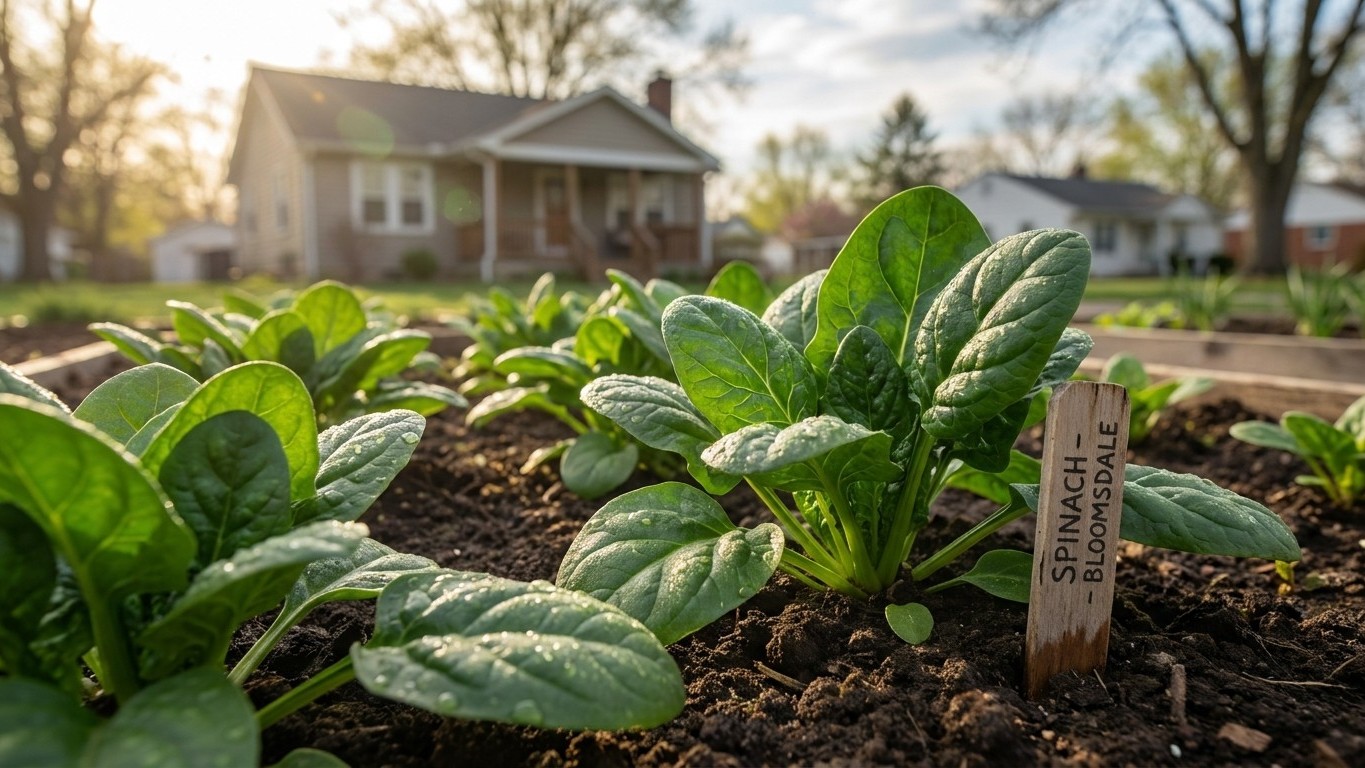

In Calgary, spinach typically starts bolting from mid-June onward, once the daylight stretches past the point where the plant switches from making leaves to making seed. That switch has almost nothing to do with how hot the summer gets and almost everything to do with the calendar. Alberta gardeners work with two short windows instead of one long season: an early spring crop, then a second sowing timed to beat the September frost—see When to Sow Autumn Spinach in Alberta for how to time that second window.
The short answer
Calgary sees 16 hours and 20 minutes of daylight on the longest day of the year. That number matters more than any thermometer reading you’ll take this summer, because spinach flowers in response to long days as well as warmth. A cool July in southern Alberta does not push the bolting date back. The plant is reading the length of the day, and once it crosses its threshold, it starts running to seed whether the afternoon feels like 65 F or 80 F.
That’s the part worth sitting with, because it flips the usual gardening instinct. Most vegetable problems in Alberta trace back to a short, cool growing season and not enough heat. Spinach is the opposite case. The daylight here climbs fast through May and June, and by the time the solstice arrives, the day length has already been long enough for weeks to flip most spinach plants into flowering mode. A grower who keeps the plants shaded, mulched and watered through a mild June will still watch them bolt, because none of that changes what the daylight is doing.
Heat is not irrelevant here, but it’s a secondary factor rather than the trigger. Calgary averages 0.0 days a year at 90 F or hotter, which tells you plainly that extreme heat almost never happens on this ground. Spinach grows best where temperatures stay under 75 F, and that ceiling is also roughly where the leaves start turning bitter. In a region with essentially no 90-degree days, spinach rarely fails because of scorching afternoons. It fails because the days got long before the plant finished growing.
So the honest way to frame it: day length is the dominant limit on when Alberta spinach bolts, and heat is a secondary quality issue that shows up on the occasional warm stretch rather than a defining feature of the climate here. Anyone growing spinach in this province is racing daylight, not racing degrees. That reframes the whole planting strategy around the calendar instead of the weather forecast, and it’s worth digging deeper into Will Spinach Bolt Early in Alberta? to understand exactly how that timing plays out.
How long the spring window really is
Working out the spring window means starting from the last frost and working forward, then checking that date against how fast the daylight is climbing.
- Start with the frost date. Environment and Climate Change Canada’s 1981-2010 normals put the average last spring frost at Calgary Int’l A around May 21. That’s a mean, not a guarantee, so in roughly half of all years the real last frost lands later than that date.
- Sow two to three weeks earlier. Spinach seed goes in the ground before the frost risk clears, typically two to three weeks ahead of the last frost date. Against a May 21 mean, that puts sowing somewhere around the last days of April into the first week of May, with the understanding that a late frost year could push this back further.
- Track the daylight from there. By early June, Calgary’s day length is already well past 15 hours and climbing toward the June solstice peak of 16 hours 20 minutes. That climb is steady and fast, and it doesn’t pause for a cool spring.
- Watch the 75 F ceiling as a secondary check. Since Calgary logs essentially no 90 F days in an average year, the spring stretch rarely gets hot enough to force bolting on heat alone. The daylight gets there first.
- Add it up. From a late April or early May sowing to a mid-June bolt point, Alberta’s usable spring spinach window runs somewhere around six to seven weeks. That’s the whole crop, from seed to the point where the plants start sending up flower stalks.
The autumn crop, and when the soil lets you sow
A second sowing in mid-to-late summer works around the same daylight problem from the other direction. As days shorten again after the solstice, the flowering trigger eases off, but two separate obstacles now bracket the window: soil that’s still too warm for the seed, and a frost that arrives before the leaves are ready.
Soil too warm to germinate
Spinach seed germinates poorly once soil temperatures climb above 80 F, according to Utah State University Extension. In a lot of the country, that’s the tighter constraint on a fall crop, because gardeners have to wait out a stretch of baked, overheated soil before sowing again. Alberta’s climate works differently here. With an average of 0.0 days a year reaching 90 F, the province rarely builds up the kind of sustained heat that pushes garden soil past 80 F for long. That doesn’t remove the obstacle entirely, since a sunny bed in full exposure during late July can still run hot at the surface, but it’s a smaller hurdle here than in warmer regions, and it eases quickly once the sun angle drops in August.
The frost that ends the season
The average first fall frost at Calgary Int’l A lands around September 16, again drawn from the 1981-2010 climate normals. Treat that the same way as the spring date: it’s a midpoint, and in roughly half of all years the frost arrives later. Utah State University Extension gives no fixed maturity figure for spinach, only a planting rule of thumb: sow 50 to 75 days before the date you want to harvest. Counting back from a September 16 target puts the fall sowing window between roughly July 3 and July 28. Sow in that stretch, and there’s a realistic shot at harvesting before the average frost date arrives, with the usual caution that any given year could run earlier or later than the mean.
Four varieties come up often in spinach growing guides: Bloomsdale, Melody, Teton and Olympia. Utah State University Extension names them without publishing days-to-maturity or performance data for any one, so there’s no verified figure here to compare between them for Alberta’s specific window.
Checking this against your own county
Calgary’s numbers are a useful anchor, but Alberta stretches from the dry southern prairie to cooler northern districts and higher-elevation foothill areas, and none of those match Calgary’s frost dates or day length exactly. A garden in the Peace Country region will see a later spring frost and an earlier fall frost than Calgary does, which tightens both ends of the spinach window described here.
The most reliable way to adjust these dates for your own ground is to check with Alberta Agriculture and Irrigation, the provincial department that tracks local growing conditions and frost patterns across Alberta’s regions. Local frost records and soil data will tell you whether your spring window opens earlier or later than the Calgary-based dates used above, and whether your fall sowing target needs to shift by a week or two in either direction.
Common questions
Does shade or extra water delay spinach bolting in Alberta?
Neither changes the day length the plant is responding to. Shade and water can slow bitterness and stress from the occasional warm afternoon, but they don’t stop the flowering trigger tied to long summer days.
Is Alberta’s short spring season actually a disadvantage for spinach?
Not really. Because spinach bolts on day length rather than accumulated heat, a longer, hotter spring wouldn’t extend the harvest anyway. The plant is going to bolt around the same point in the daylight calendar regardless of how warm or cool the weeks leading up to it have been.
Can spinach be sown again right after the spring crop bolts?
Sowing into the longest days of the year (mid-June through July) runs straight into the same long-day trigger that ended the spring crop, so a resow at that point tends to bolt quickly too. The better second sowing comes later, timed to the fall frost window described above.
Does the 1981-2010 frost data match current conditions closely enough to plan around?
It’s the most recent official climate normal published for the Calgary Int’l A station, and it remains the standard reference point, but treat both the May 21 and September 16 dates as long-run averages rather than fixed calendar markers for any single year.