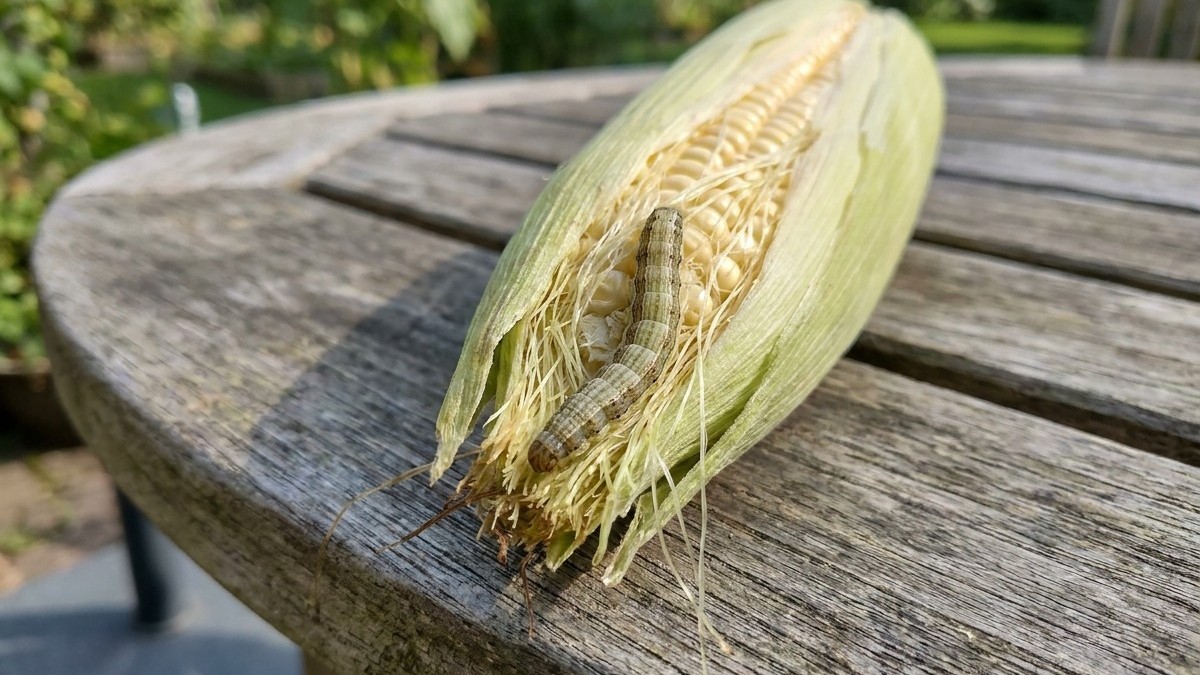

Grasshoppers, brown marmorated stink bugs, and thrips are the insects documented for this region that can actually feed on corn, and each one shows up on a different part of the plant. The trick isn’t spotting damage, it’s matching the damage to the right insect, and to the right week in a growing season that runs roughly from late May to mid-September here.
Which pests attack corn in Alberta

Montana State University Extension, Urban IPM documents five insects for this territory: Brown marmorated stink bug, Grasshoppers, Miller moths, Social wasps, and Thrips. That’s the full list for this region, and it’s a short one, which is worth saying plainly rather than padding it with insects that show up on other sites but aren’t documented here.
Not all five belong on a corn page, though. Miller moths are adult army cutworm moths that feed on nectar, not foliage or kernels — they’re a seasonal nuisance around porch lights and window screens, but the moths themselves don’t chew on corn. Social wasps are predators and scavengers that hunt other insects and raid sugary food; they don’t feed on standing corn plants either, so seeing wasps around a corn patch usually means they’re after something else nearby, not the crop itself.
That leaves three that genuinely matter to a corn grower. Grasshoppers chew leaf tissue and, in high numbers, can strip young plants or scar developing ears. Brown marmorated stink bugs pierce husks and feed directly on kernels, leaving shriveled or discolored spots where they’ve fed. Thrips scrape at leaf surfaces and inside the whorl, leaving a fine silvery or bronzed stippling on young growth, and they tend to build up fastest during hot, dry stretches.
None of the three is described by the extension service as a routine, guaranteed problem for corn here. They’re documented as present in the region, which is different from being documented as common on this particular crop. A gardener who never sees any of them in a given season isn’t missing something, they’re just not unusual. The value of the list is knowing what to check for if damage does show up, rather than assuming every mark on a leaf came from a bug at all.
When each one shows up, and what it does first
The frost-free window here runs from an average last spring frost of May 21 to an average first fall frost of September 16 — a mean date, not a guarantee, since frost falls later than that in roughly half of all years. Corn planted at the start of that window won’t show insect activity right away; the first weeks are about soil warming, not pests.
Thrips tend to be the earliest sign of trouble, showing up on young leaves not long after seedlings emerge. What you’d notice first isn’t a bug, it’s the leaf itself: a silvery or bronzed sheen along the surface, sometimes concentrated near the base where new growth is folded tight. Thrips activity tends to pick up during the hottest, driest stretches of summer, which at this station means the handful of days that reach into the low 30s Celsius rather than a steady heat wave, this location averages just 1.37 days a year above 32 °C, and about 5.1 days above 30 °C, so thrips pressure here is more about short dry spells than prolonged heat.
Grasshoppers build gradually rather than arriving all at once. Numbers are usually low early in the season and climb through the warmer weeks, so the first sign is often ragged, notched edges on lower leaves rather than a sudden infestation. In a dry year, that chewing can move up the plant fast enough to reach young ears by late summer.
Brown marmorated stink bugs are the latest arrivals of the three, and the first evidence of them usually isn’t the insect but the ear. Feeding punctures on developing kernels show up as sunken or discolored spots under the husk, often not visible until the husk is pulled back. Because this insect targets the ear directly, it tends to matter most in the second half of the season, closer to when silks have dried and kernels are filling, which for sweet corn typically falls somewhere in the 60 to 90 days from planting that Utah State University Extension gives as the standard maturity window.
Telling the damage apart from everything else
Insect feeding gets blamed for a lot of corn trouble that has nothing to do with insects. Before treating anything, it helps to rule out the more common causes first, since a misdiagnosis wastes the short season this region has to work with.
| Symptom | Possible cause | What distinguishes it |
|---|---|---|
| Ragged, notched leaf edges | Grasshopper feeding vs. wind or hail scarring | Grasshopper damage is irregular and concentrated where insects were seen resting; hail and wind damage tends to be uniform across a whole row, matching the direction of the storm. |
| Silvery or bronzed patches on young leaves | Thrips vs. nutrient deficiency | Thrips damage sits along the leaf surface in a stippled pattern; a deficiency (often nitrogen or magnesium) shows as yellowing that follows the leaf veins rather than scattered speckling. |
| Discolored or sunken spots on kernels under the husk | Stink bug feeding vs. poor pollination | Stink bug damage is localized to individual kernels with a visible puncture mark; poor pollination leaves whole sections of the cob with missing kernels in a pattern, no puncture involved. |
| Wilting or stunted whole plants | Drought stress or root damage vs. insect feeding | Insects rarely cause whole-plant wilting on their own; check soil moisture and the base of the stalk for mechanical or rodent damage first. |
None of this replaces a direct look. A local extension office can identify what’s actually on a plant far more reliably than matching symptoms from a list, and that’s especially true here, where the documented pest list for the territory is short enough that something outside it is entirely possible.
What actually works here, and what is a waste of time
On a growing season bounded by a mean frost window of about four months, timing does more work than any treatment applied later. Planting once soil has warmed past 60 F, rather than rushing seed into cold ground right after the average frost date, gives corn a stronger start against thrips, since vigorous young plants tolerate feeding far better than stressed ones. Soil hitting 60 F comes well after the last frost, not on the same day, so checking soil temperature directly matters more than watching the calendar.
Physical barriers placed early, like row covers over young seedlings, keep grasshoppers and thrips off plants during the vulnerable first weeks and can simply be removed once plants are established enough to tolerate light feeding. That timing detail matters more than any product choice, because a barrier put on after damage has already started does nothing for what’s already happened.
For stink bugs feeding on ears late in the season, monitoring husks as silks dry down is more useful than any preventive spray, since the damage window is narrow and tied to kernel development rather than the whole season. Checking a handful of ears across the patch, rather than assuming uniform pressure, catches the problem before harvest.
What tends to waste time is treating for insects that aren’t the actual cause, especially since deficiency symptoms and stink bug or thrips damage look similar to an untrained eye. Product decisions, including what’s legally available to use in a home garden here, aren’t something this page prescribes; a provincial or extension pest specialist knows what’s currently registered and appropriate far better than a generic list ever could.
Where to check this for your own county
Montana State University Extension, Urban IPM documents the pest list this page relies on, and it covers a region, not a specific yard. Pest pressure inside that region varies a great deal from one property to the next, depending on nearby vegetation, moisture, and what was planted the year before, so a documented species doesn’t mean it’s present everywhere.
The most useful next step is contacting a local extension or agricultural office directly, since they track what’s actually showing up in gardens nearby this season, not just what’s been documented as possible across the broader territory. Bring a sample or a clear photo if something’s damaging a corn patch, since visual identification from a description alone is unreliable even for experienced growers.
Given how short the frost-free window is here, getting an identification early enough to act still within the growing season matters more than getting a perfect answer weeks later. A quick call, rather than waiting to see if damage spreads, is the more useful habit to build.
Common questions
Do grasshoppers actually damage mature corn, or just seedlings?
Both. Young plants are more vulnerable to being stripped entirely, but grasshoppers will also feed on leaves and ear tips later in the season, especially when populations build up during dry stretches.
Are miller moths worth worrying about in a corn patch?
Not for feeding damage. Miller moths are nectar-feeding adults and don’t chew on corn plants; their larval stage (cutworms) can damage seedlings, but that’s a separate life stage and a separate concern from the moths themselves.
Why do social wasps show up around corn if they don’t eat it?
They’re usually hunting other insects or drawn to sugary plant exudate, not the corn itself. Their presence isn’t a sign of crop damage on its own.
Is 60 F soil the same as the last frost date?
No. Soil temperature climbs well after the air has cleared frost risk, so waiting for 60 F soil, rather than planting right at the average frost date, is the more reliable rule for corn.