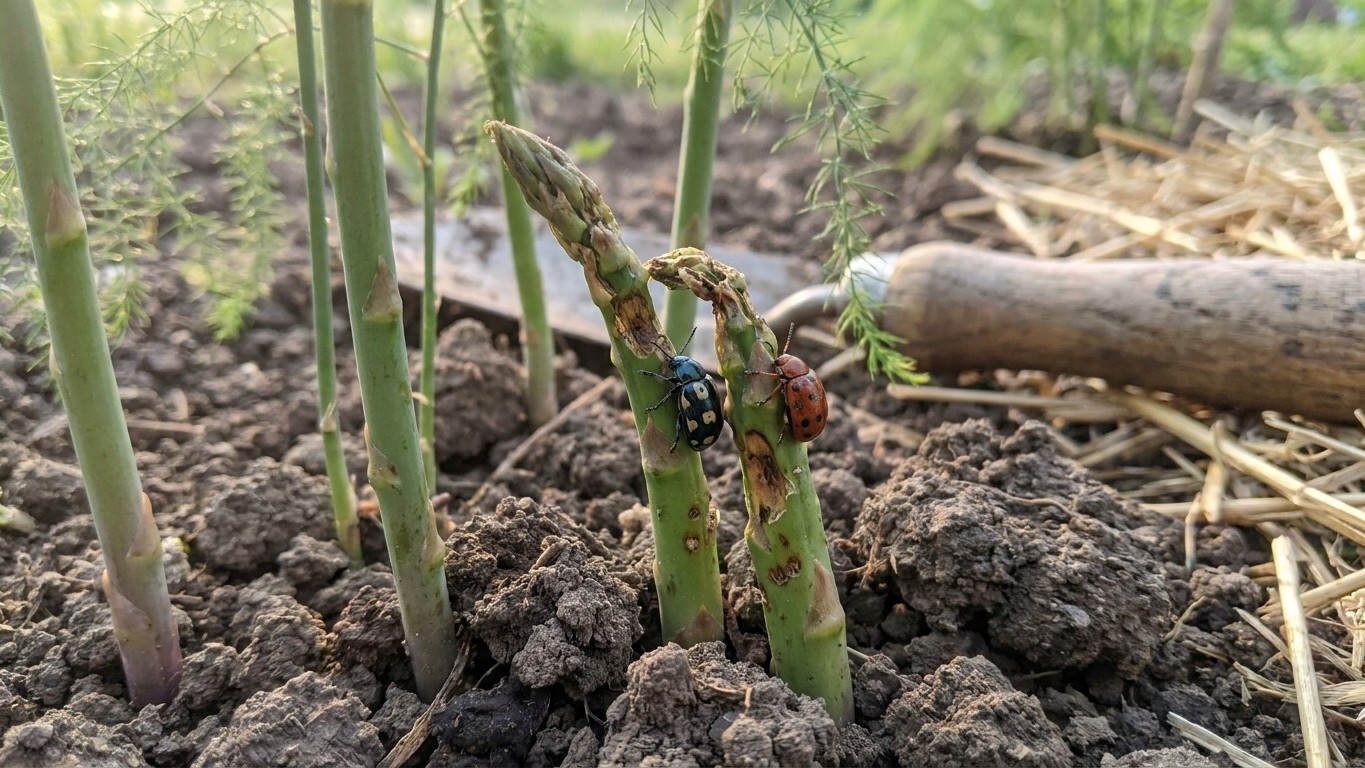

The University of Arizona Cooperative Extension documents ten garden pests statewide, but only seven of them have any business on an asparagus fern. The other three chew tomatoes, squash, or ripening fruit instead. Knowing which is which matters more here than in most states, because an asparagus bed in Arizona’s low desert stands in the same spot for 10 to 15 years once it starts bearing.
Which pests attack asparagus in Arizona

The University of Arizona Cooperative Extension lists ten pests for home gardens across the state: Aphids, Beet leafhopper (vector of curly top virus), False chinch bug (Nysius raphanus), Grasshoppers, Green fruit beetle (Cotinis mutabilis), Spider mites, Squash bug (Anasa tristis), Thrips, Tomato hornworm (Manduca quinquemaculata), and Whiteflies. That’s the full documented list for this territory. It isn’t padded here, and it shouldn’t be padded anywhere else either.
Three of those ten don’t belong on an asparagus page. The squash bug feeds on cucurbits, squash, pumpkin, melon, and has no reason to touch a fern-like asparagus stalk. The tomato hornworm is built for solanaceous plants, tomato, pepper, eggplant, and asparagus isn’t in that family. The green fruit beetle (Cotinis mutabilis) goes after soft, ripening, sugary fruit; asparagus never produces anything that fits that description. Naming these on an asparagus page would be the kind of mismatch that makes a reader stop trusting the rest of the list.
The seven that actually show up
What’s left is Aphids, Beet leafhopper, False chinch bug, Grasshoppers, Spider mites, Thrips, and Whiteflies. None of these are asparagus specialists. They’re general feeders that land on whatever green tissue is available, and an asparagus fern qualifies once it leafs out. Because the bed occupies the same ground for 10 to 15 years of production, it becomes standing habitat rather than a crop that rotates pests out each season the way an annual vegetable bed does. That’s a different kind of exposure than a tomato or squash planting gets, and it’s worth watching for precisely because the fern is always there.
The beet leafhopper deserves a second look because of what it carries rather than what it eats. It’s the documented vector of curly top virus, a disease that spreads across many garden crops in the low desert. A leafhopper feeding on an asparagus fern is a minor nuisance on its own; the virus it might be carrying is the actual concern, and that’s a call for the local extension office, not a home diagnosis.
When each one shows up, and what it does first
Arizona’s low desert doesn’t run on a frost calendar the way most vegetable-growing states do. In most years there’s no freeze at all, and even the rare cold snap only shows up between late December and mid January. That means pest activity on an asparagus bed isn’t bounded by a last-frost date the way it would be elsewhere. It’s bounded by fern growth, which starts once crowns planted in 8-inch furrows in early spring push up new spears.
Aphids and whiteflies are usually the first to appear, clustering on tender new fern growth within the first few weeks after it emerges. They’re soft-bodied and slow-moving, and a close look at the underside of young fronds is enough to spot them before numbers build. Spider mites follow once the weather turns hot and dry, and they build fastest during stretches with almost no rain to knock them back. June is the driest month of the growing season, averaging just 0.02 inches of rain, which is exactly the kind of stretch that lets spider mite populations climb unchecked on stressed fern growth.
Thrips show up around the same dry window, leaving a silvery or bronzed streaking on fronds rather than obvious holes. Grasshoppers tend to arrive later, once fern growth is fuller and more attractive, and their damage looks like ragged notches taken out of the edges of fronds and stems. False chinch bugs are different again: they build up in weedy, drying ground nearby and then move onto garden plants, including asparagus, in large numbers all at once when that weedy vegetation dies down. Beet leafhoppers can be present through most of the warm season, and the first sign is rarely the insect itself but the yellowing and crinkling of curly top virus on the plants they’ve visited.
Telling the damage apart from everything else
An asparagus fern that looks off isn’t automatically a pest problem. Arizona’s dominant surface soil, the Casa Grande series, runs alkaline at a surface pH around 8.5 and carries salts typical of an Aridisol, conditions that can mimic insect damage all on their own. Yellowing, stunted growth, or scorched frond tips can come from soil chemistry just as easily as from an aphid colony.
A quick way to sort it out
| What you see | Possible cause | What tells them apart |
|---|---|---|
| Fine yellow stippling, webbing | Spider mites | Check undersides with a hand lens during hot, dry weeks |
| Silvery or bronzed streaks | Thrips | Streaking follows leaf veins, not random patches |
| Overall yellowing, crinkled growth | Curly top virus (beet leafhopper) | Symptoms spread plant to plant, not just where watering is uneven |
| Scorched tips, slow growth | Salty, alkaline soil or drought stress | A soil test rules chemistry in or out; even watering rules drought out |
| Ragged notches on fronds | Grasshoppers | Look for chewing at leaf margins, and the insects themselves nearby |
Mechanical damage, a bent fern, a broken spear from wind or a stray foot, looks nothing like any of the above once you know to check for a single clean break instead of scattered feeding marks across many plants. The distinguishing move is always the same: check more than one plant before assuming it’s a pest. Soil problems and water stress tend to show up evenly across a bed; insect feeding is usually patchier, worse on some plants than others. Beyond that, this is where a local diagnosis matters more than a description on a page, because soil salinity, watering habits, and pest pressure all vary from one yard to the next even within the same county.
What actually works here, and what is a waste of time
Timing beats almost everything else on a short desert growing season. Since asparagus crowns go into 8-inch furrows in early spring and the furrow is backfilled gradually, about two inches every other month across the year, the plant is at its most vulnerable to aphids and whiteflies right as that new fern growth appears. A physical barrier, like fine mesh row cover, placed over young plantings before that growth flush works far better than trying to catch an established infestation later.
Keeping weedy ground near the bed knocked down through the driest stretches reduces the buildup of false chinch bugs before they move onto garden plants in numbers. A strong jet of water on the undersides of fronds knocks back aphids and spider mites without needing anything else, and it’s worth repeating every few days during the driest weeks rather than once and forgetting it. Because June brings only about 0.02 inches of rain, a plant that’s already drought-stressed is far more attractive to spider mites, so steady watering does double duty as pest prevention.
What doesn’t work is guessing at a spray without an identification first. Products and timings that are labeled for one pest often do nothing for another, and applying something without knowing what’s actually feeding wastes both time and money. This site doesn’t recommend specific products or active ingredients; only the University of Arizona Cooperative Extension can say what’s currently labeled for use in the state, and that’s the call to make before buying anything.
Where to check this for your own county
Everything above comes from statewide pest documentation kept by the University of Arizona Cooperative Extension. A statewide list is a starting point, not a forecast for any single garden. False chinch bug pressure near a weedy field is different from a walled backyard a few miles away, and beet leafhopper activity shifts with what’s growing nearby that year.
The next useful step is a call or visit to the University of Arizona Cooperative Extension office in your own county, where staff track what’s actually showing up locally, not just what’s documented for the state as a whole. Bring a clear description of the damage, or a sample if you can collect one safely, rather than a guess at the insect’s name. That’s also the right place to ask about anything beyond identification, since local staff know current recommendations for the specific pest in question.
The same caution applies to soil. The Casa Grande series represents the state on paper, but a builder-scraped lot, a river-bottom yard, or ground that’s been amended for years can behave nothing like it. A soil test through the local extension office settles the pH and salinity questions that a symptom on a fern can’t answer by itself.
Common questions
Does the asparagus beetle show up in Arizona gardens?
It isn’t among the pests the University of Arizona Cooperative Extension documents for this state, so it isn’t covered here. Check with your county extension office if you suspect it.
Can curly top virus kill an established asparagus bed?
The facts available here don’t cover disease outcomes for asparagus specifically. Report suspected curly top symptoms to your local extension office rather than assuming the outcome.
Why do pests seem active almost year-round in the low desert?
Because a freeze is rare in most years, there’s no long cold stretch to shut pest activity down the way there is in colder states. Growth and pest pressure both track the fern’s own cycle instead of a frost calendar.
Is the driest month, June, also the worst month for pests?
It’s the month spider mites tend to build fastest, since there’s almost no rain to knock populations back. Other pests, like grasshoppers and false chinch bugs, tend to peak at different points in the fern’s growth rather than tracking rainfall directly.