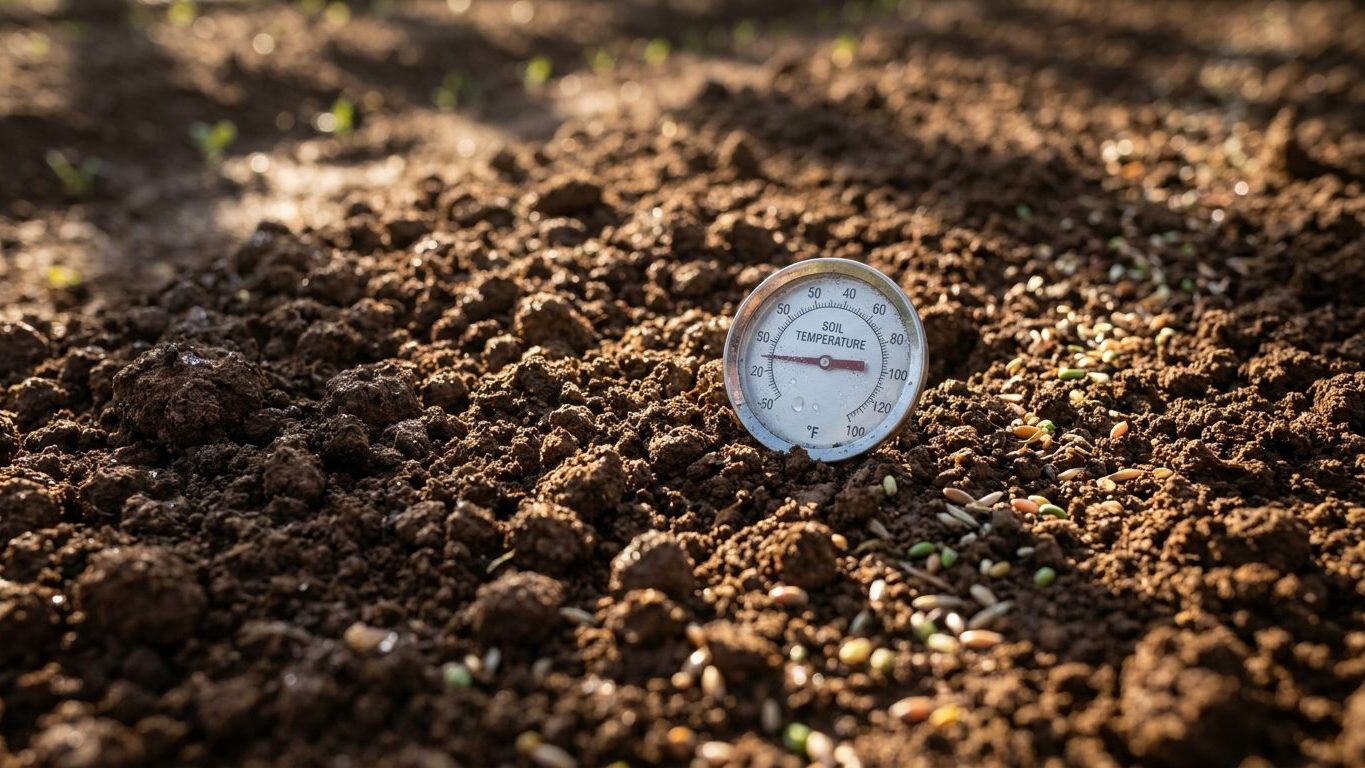

In most of Arizona, cover crops don’t wait for a killing frost, because there often isn’t one. The low desert around Phoenix averages a 365-day frost-free season, so the real trigger runs backward from what gardeners expect elsewhere: it’s the first stretch of cool weather after summer heat finally breaks, usually in the fall, that opens the door for legumes and cereal grains to germinate and grow through a mild winter before next season’s heat shuts things down again.
When the soil is warm enough in Arizona
Ask when to plant a cover crop almost anywhere else in the country, and the answer starts with a frost date. Ask it in the low desert around Phoenix, and the question barely applies. NOAA’s 1991-2020 Climate Normals, drawn from station USW00023183, list the frost-free season here at 365 days. Over three decades, that station dipped to 32°F in only 6 of 30 springs, and when it did, the cold snap landed anywhere from late December to mid-January, not in the tidy spring window gardeners in other territories rely on.
That single fact flips the usual planting logic. Elsewhere, a frost date works as a proxy: soil warms up a few weeks after the risk of freezing clears, and that’s when seeds go in. In the low desert, there’s rarely a freeze to clear, so soil temperature isn’t really the limiter on the cold side either. What actually decides when you can plant a cover crop here is heat retreating in the fall, not frost releasing its grip in spring.
That distinction changes the whole calendar. Cool-season legumes like vetch or field peas, and cereal grains like oats, barley, or wheat, need weeks of moderate temperatures to germinate evenly and establish roots before summer heat returns. In most of the country, that window opens in spring. In Phoenix and the surrounding low desert, it opens in the fall, once the worst of the triple-digit heat has passed, and it stays open through a winter mild enough that occasional cold snaps rarely do more than nip the tips of tender growth.
Flagstaff and the high country are a different story entirely. Arizona’s hardiness zones span 4b to 10b under the USDA’s 2023 Plant Hardiness Zone Map, a range built on average annual extreme minimum temperatures, and that spread alone tells you the state isn’t one climate but several stacked on top of each other by elevation. In 4b territory, real winter freezes happen, cover crops follow something closer to the traditional frost-to-frost calendar, and spring sowing after the last hard freeze makes sense the way it does in much colder states.
For the low desert majority of the state’s gardeners, the practical answer is this: don’t wait for a frost date that mostly won’t come. Watch for when daytime highs stop climbing into the triple digits, get seed of a cool-season legume or grain into the ground, and expect it to grow through winter rather than around one. Local extension agents track exactly when that heat break tends to land in a given county, and since seeding rates depend on species, seed size, and drilling method, that’s also the right place to get an actual number instead of guessing at one here.
How long the season lasts here
In territories with a real frost-to-frost interval, season length is simple subtraction: last spring frost, first fall frost, count the days between. Arizona’s low desert breaks that math before it starts. The records for station USW00023183 don’t give two dates to subtract, they give one number instead: a 365-day frost-free season, with an occasional exception between late December and mid-January that shows up in barely a fifth of years. There’s no reliable fall frost date either, for the same reason the spring one is unreliable, so the usual subtraction simply doesn’t apply here.
That absence isn’t a gap in the data, it’s the actual climate. Instead of a season bounded by cold on both ends, the low desert has a season bounded by heat on both ends, spring heat building back up in one direction and summer heat only fully breaking in the other. Because that window runs through an entire mild winter rather than around one, it tends to stretch longer than the frost-bound season in most cover-crop territories, long enough that a single planting often isn’t the only option.
That length is what makes a second sowing worth considering. A fast legume or a quick cereal grain planted right after summer heat breaks can be grown, cut down, and followed by a second crop, either another cover crop chasing the rest of the mild season or a vegetable transplant taking advantage of soil that legume has already been improving. Whether that second planting makes sense depends on how much of the mild window is left and how deep the first crop’s roots went, which is exactly the kind of decision covered in this site’s guide to succession sowing.
The calculation looks different up in the high country. Zone 4b conditions near Flagstaff bring a real frost-bound season, shorter and firmly bracketed, where the first sowing is usually the only sowing, and the choice between direct seeding and transplanting carries more weight because there’s less room to recover from a false start. A gardener working two properties, one in the valley and one in the mountains, is effectively managing two different growing calendars under one state line.
Heat and water in Arizona
For most crops, summer is the season that matters. For cover crops in the low desert, summer is mostly the season to avoid. The heat that defines Arizona’s reputation, long stretches with daytime highs well above 90°F, is exactly what makes the cool months the only real growing window here. There’s no meaningful summer sowing to plan around, because nothing planted then survives long enough to do its job.
Winter is where the real decisions happen instead, and the number that matters most is the coldest month’s mean minimum. At the Phoenix reference station, that figure sits at 45.3°F, the average low during the coldest stretch of the year, not a record low and not a monthly average high. That’s mild. Mild enough that a lot of cool-season cover crops don’t die back the way they would somewhere colder, and that changes what termination actually means here.
Why a mild winter creates work, not less of it
In a territory with a hard winter freeze, oats are about the easiest cover crop there is: they grow all fall, then a hard freeze kills them outright, leaving a dead mulch on the surface by spring with no extra effort required. In Arizona’s low desert, that same freeze mostly doesn’t show up. A 45.3°F average minimum won’t reliably kill oats or many other cool-season grasses, so instead of dying back on their own, they keep growing, flower, and can turn into a weed problem in whatever gets planted next if nobody steps in. That’s exactly why this site treats mowing, crimping, and cutting as the real termination tools for gardeners here, not frost and not any chemical shortcut. A crop needs to be cut down at the right growth stage, generally around flowering for a legume aiming to hold onto its nitrogen, rather than left to finish on its own schedule.
Rainfall follows a similarly split pattern across the state. The low desert’s summer moisture arrives as brief, scattered storms rather than steady rain, and that pattern does little to change the cover-crop calendar, since heat rules out summer planting regardless of how much rain falls in a given month. Higher, cooler parts of Arizona see a different balance of moisture across the year, one more reason the state doesn’t reduce to a single climate story, and one more reason the hardiness zone range of 4b to 10b is worth citing by reference city rather than treated as one number.
Which cover crops suit Arizona
None of this points toward a single best cover crop for Arizona, because Arizona isn’t a single climate to plant for. It points toward a way of choosing by type, based on what the ground actually does here rather than what works two states over.
In the low desert, the absence of a reliable killing frost is the deciding fact. Species that depend on winter cold to terminate themselves, cereal grains especially, need to be treated as crops that require active management rather than crops that finish on their own. That favors types suited to mechanical termination, ones that hold their structure well enough to be mowed, crimped, or cut at the right growth stage without simply regrowing from the base. Legumes chosen for their nitrogen contribution matter here too, though how much nitrogen becomes available depends on the species, how much biomass it built, and when it gets cut down, not on a number that can be quoted in advance.
Heat shapes the other half of the decision. Because nothing survives Arizona’s low-desert summer, the practical question isn’t which cover crop tolerates heat, it’s which cover crop can complete its job entirely inside the mild season between one summer and the next. That argues for species and planting timing chosen to finish, flower, and get terminated before the heat rebuilds, rather than ones that need a long, slow finish.
Up in the high country, where zone 4b conditions bring a real frost-bound season, the reasoning flips closer to what gardeners in colder states already know: a short window favors the earliest-maturing types, and a genuine winter freeze can still be counted on to do some of the termination work.
What this page won’t do is name a specific variety, and that’s a deliberate choice, not an oversight. A grass or legume that performs well in trial plots near Yuma may behave completely differently at elevation near Flagstaff, and the only trials that mean anything for a specific address are the ones run in that specific county. The University of Arizona Cooperative Extension tracks exactly that kind of local variety data, along with seeding rates suited to specific species and drilling methods, which makes it the right source for a number this page can’t responsibly guess at.