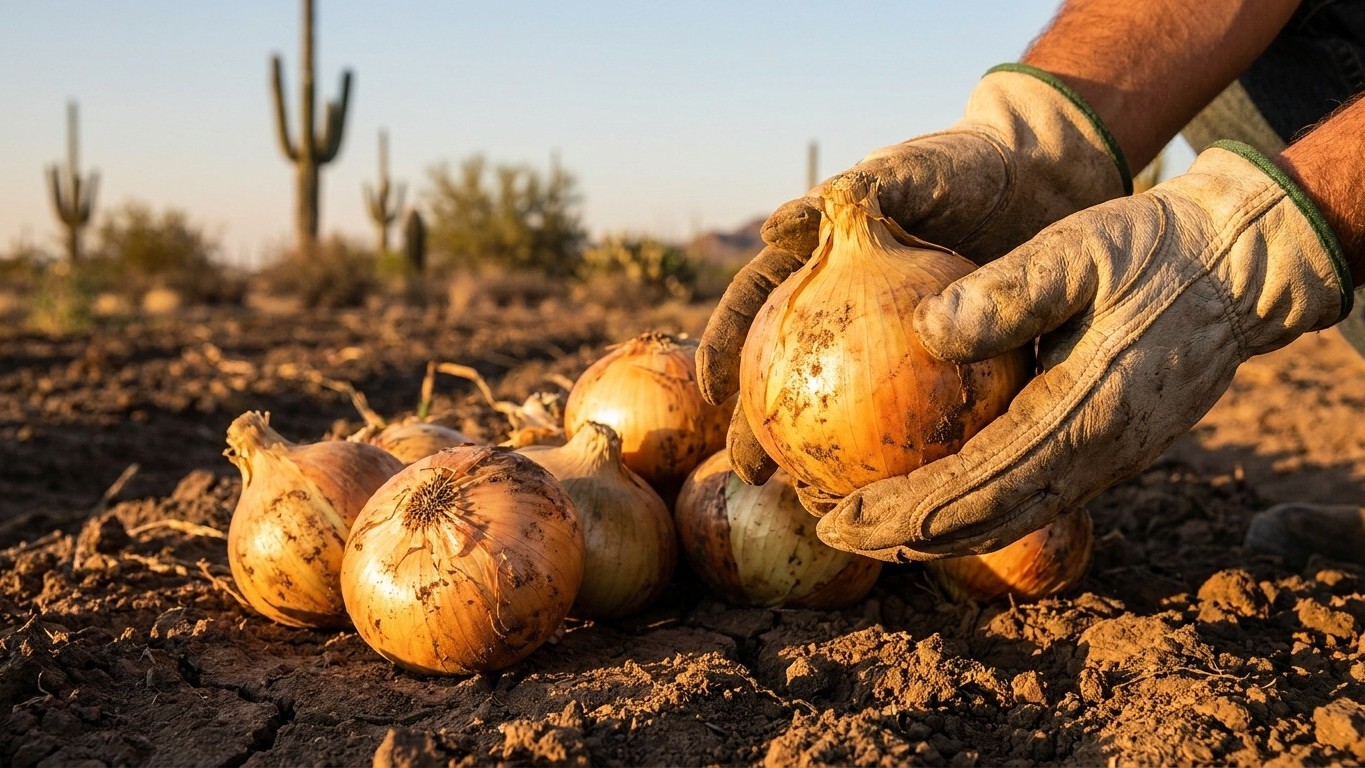

Arizona’s low desert calls for fall planting, not spring. At 33.43 degrees north, Phoenix gets 14 hours and 13 minutes of daylight on the summer solstice, which is exactly why the timing here runs backward from what a Northeastern gardener expects. Get the season wrong and you won’t just harvest later. You’ll harvest a smaller onion, or none at all.
The short answer for Arizona

Onions bulb because of day length, not warmth. That single fact drives everything about growing them in Arizona, and it’s why the calendar here looks nothing like the one printed on a seed rack designed for Ohio or Minnesota. At 33.43 degrees north latitude, the reference point for this territory, the longest day of the year delivers 14 hours and 13 minutes of daylight. That number sits well below what long-day onions need to trigger bulbing, and comfortably within range for short-day and intermediate-day types. So the variety question and the timing question are really the same question, answered by the same number.
In the low desert around Phoenix and Tucson, where winters stay mild and frost is a rare, brief visitor, onions go in the ground in fall, typically October through November. The plants spend the cool season building leaves and root mass, then respond to the lengthening days of late winter and early spring by starting to bulb. By the time the fierce Arizona summer arrives, the crop is already curing.
Move to higher elevation, colder pockets of the state, and that fall window becomes riskier. Harder frosts and shorter growing seasons before winter push the safer planting time to late winter or very early spring instead, using transplants or sets rather than direct-seeding in autumn. The soil there simply isn’t warm enough, or safe enough from hard freezes, to support fall-planted onion starts through the winter months.
The variety choice follows the same logic as the timing. Because 14 hours and 13 minutes falls into short-day and intermediate-day territory, the onions best suited to Arizona’s reference latitude include short-day types such as Texas Grano 1015Y, Vidora, and Red Sensation, alongside intermediate-day types like Candy, Elsye, and Scout. These are bred to start bulbing when day length reaches roughly 12 hours (short-day) or 12 to 14 hours (intermediate-day), which lines up with what the desert sky actually provides.
What will not work here
Planting a long-day onion in Arizona doesn’t produce a smaller bulb. It produces no bulb at all. Long-day varieties are bred to wait for 14 to 16 hours of daylight before they’ll switch from leaf production to bulb formation, and at 33.43 degrees north, the sky never delivers that much light, not even on the solstice. The plant keeps making leaves all season long, using up its energy on top growth that never converts into a storage bulb. Then, as the desert heat climbs, the plant weakens and rots in the ground. That’s not an underperforming harvest. That’s a wasted growing season.
This is also the trap hiding in “plant it a little late and see what happens.” Delaying an onion planting doesn’t push the harvest date back the way it might with tomatoes or peppers. Bulbing still starts the moment day length hits the variety’s threshold, regardless of how big or small the plant happens to be at that moment. A short-day onion set in the ground late has less time to build leaves before the trigger hits, so it bulbs early relative to its growth, and the bulb that forms is whatever size the plant managed to reach. Late planting doesn’t shift the calendar. It shrinks the onion.
The following varieties are published for latitudes above Arizona’s reference point and will not bulb reliably in this territory:
- Ailsa Craig (long-day, 38-60N), the day never gets long enough here to trigger bulbing.
- Walla Walla Sweet (long-day, 35-55N), bred for latitudes well north of Phoenix’s daylight ceiling.
- Redwing (long-day, 43-65N), needs far more summer daylight than the desert sky provides.
- Bridger (long-day, 35-50N), its bulbing threshold sits above Arizona’s longest-day maximum.
- Red Long of Tropea (intermediate-day, 35-48N), its lower range still starts north of 33.43N.
- Cabernet (intermediate-day, 35-45N), will only make leaves, then rot as the season closes.
Several others share this fate, including Barolo, Blush, Frontier, Monastrell, New York Early, Patterson, Powell, Red Carpet, Red Long of Florence, Rossa di Milano, Safrane, Talon, and Calibra. All are catalogued for latitudes higher than Arizona’s reference point, and every one of them will leaf out and never bulb here.
What changes across Arizona
Arizona isn’t a single point on the map. The state stretches from around 31.3 degrees north at the Mexican border near Nogales up to roughly 37 degrees north along the Utah line, a span of nearly six degrees of latitude. That’s enough distance to shift a garden from comfortably short-day territory into the lower edge of intermediate-day range, and it changes more than just the sun angle.
All the figures in this article are tied to Phoenix, at 33.43 degrees north, the reference city for the coordinates and daylight calculation used here. A gardener in Nogales, close to the southern border, sits at a slightly lower latitude and stays firmly inside short-day country. A gardener near Flagstaff or the Utah border sits several degrees higher, meaning the longest day there delivers noticeably more daylight than Phoenix’s 14 hours and 13 minutes, pushing that garden closer to intermediate-day, and even edging toward long-day, territory.
| Location | Approximate latitude | What changes |
|---|---|---|
| Phoenix (reference city) | 33.43N | 14h13 on the solstice; short-day and intermediate-day onions bulb reliably; fall planting works. |
| Southern border area (Nogales) | ~31.3N | Slightly less daylight than Phoenix; solidly short-day territory; fall planting window may open a little earlier. |
| Northern Arizona (Flagstaff area and beyond) | ~35N to 37N | More summer daylight than Phoenix; intermediate-day varieties become the safer bet; higher elevation also brings harder frosts, which favors late-winter planting over fall. |
Elevation compounds the latitude effect here in a way that’s easy to overlook. Northern Arizona isn’t just farther north, it’s also thousands of feet higher, which brings frost risk that has nothing to do with day length. A gardener near the Mogollon Rim or the high plateau country needs to weight frost dates as heavily as latitude when picking a planting date.
Sweet now, or onions that last
Every onion grower in Arizona eventually runs into this trade-off, whether they realize it or not: the varieties that taste mild and sweet fresh out of the ground are the same ones that turn soft and sprout in storage within a few weeks. According to University of Missouri Extension, “as a rule, ‘sweet’ onions do not store as well as the more pungent types,” and the reason isn’t bad luck or poor curing technique. It’s chemistry. The volatile sulfur compounds responsible for an onion’s sharp bite are the same compounds that protect the bulb’s cell structure during storage. Breed the sulfur content down for a milder flavor, and you also breed out the natural preservative.
This lines up neatly with the day-length math already at work in Arizona. Short-day varieties, the ones suited to the state’s reference latitude, tend to run sweeter and lower in those protective sulfur compounds. That’s part of why Texas Grano 1015Y and similar short-day types are prized for fresh eating and salads, but not for a root cellar. Intermediate-day varieties like Candy or Scout sit a step further toward the pungent, longer-keeping end, though still nowhere near the storage life of a true long-day onion grown further north.
What that means for an Arizona pantry is straightforward. A crop planted from short-day sets will taste excellent through late spring and early summer, sliced raw on a sandwich or grilled whole, but by March of the following year, most of it is gone or going soft. Gardeners who want onions to last deep into winter have to lean toward the intermediate-day end of what will actually bulb here, and even then, expect a shorter storage window than a grower in Idaho or Washington state gets from a long-day crop bred specifically for the root cellar.
Checking this against your own garden
The 33.43-degree figure belongs to Phoenix, and it’s a reference point, not a guarantee for every yard in the state. A garden sitting near the state’s northern or southern edge is dealing with a meaningfully different daylight number, and possibly a different frost calendar altogether. Before committing to a planting date or a variety, run through a short set of checks specific to your own location:
- Look up your city or county’s latitude, especially if you’re near Nogales in the south or the high country near Flagstaff and the Utah border in the north.
- Confirm your average first and last frost dates for the season, since elevation in Arizona can shift these by weeks even at similar latitudes.
- Contact your local University of Arizona Cooperative Extension office, which tracks soil temperature and regional planting windows specific to your county.
- Check whether your chosen variety’s published day-length range actually includes your latitude, rather than assuming the state-wide advice applies exactly where you garden.
- Ask your extension office about local onion trial results if you’re near the edge of short-day and intermediate-day territory, since real-world performance sometimes shifts slightly from catalogue ranges.