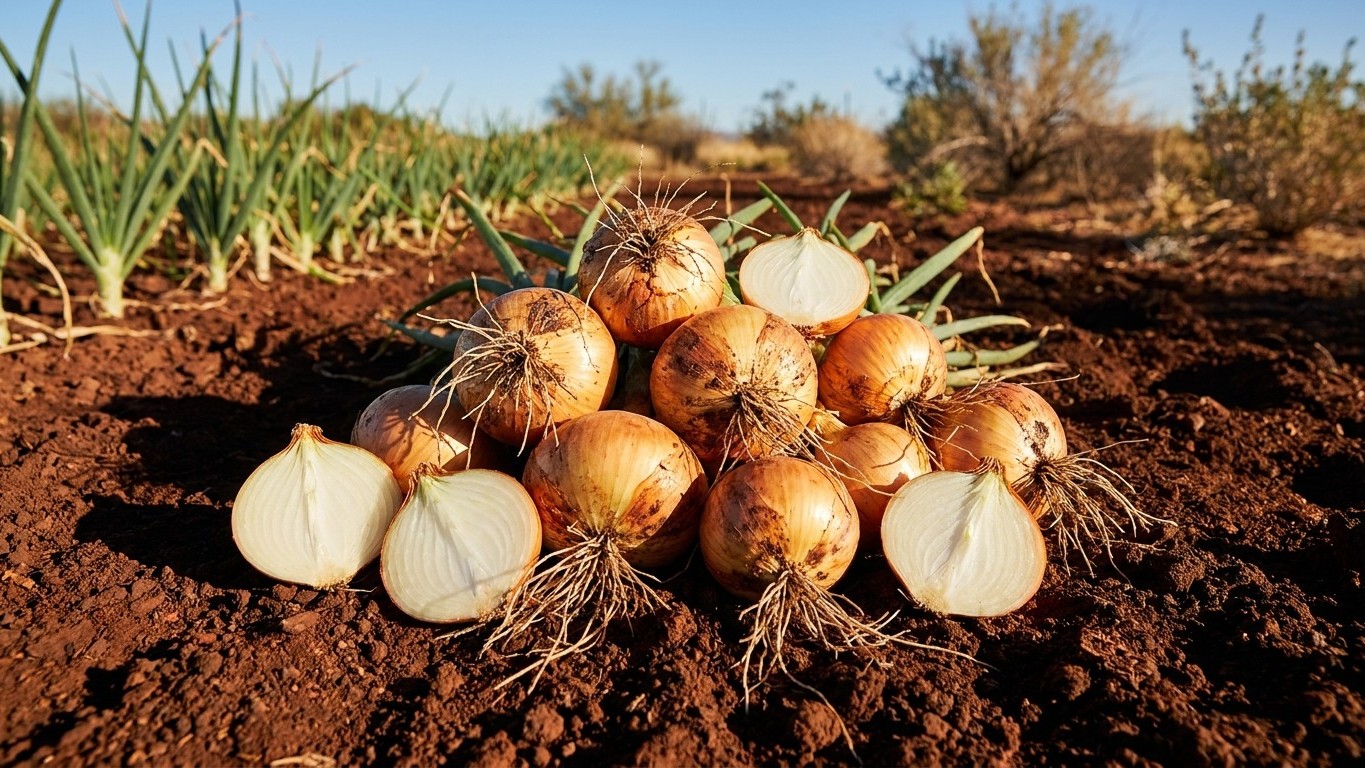

If you garden in Phoenix or anywhere near the Arizona low desert, the day length on your longest day sits at 14 hours and 13 minutes. That number rules out most of what you’ll find in a seed catalog and points you toward a short list of varieties that actually form a bulb here. Everything below explains why, and which onions belong on your shopping list this fall.
How long your longest day is

Phoenix sits at 33.43 degrees north latitude, and on the summer solstice the sun is up for 14 hours and 13 minutes there. That single figure decides more about your onion harvest than soil, water, or fertilizer ever will. Onions don’t bulb because the weather warms up. They bulb because the length of daylight crosses a threshold that tells the plant to stop building leaves and start packing sugars into a bulb. Clemson Cooperative Extension puts that trigger at roughly 12 hours of daylight for short-day types, and Arizona’s low desert clears that bar early in the season, then keeps climbing toward 14 hours and change by June.
That puts the reference city squarely in short-day and intermediate-day territory. Varieties bred to need 14 to 16 hours of daylight, the long-day types you’ll see in plenty of national seed racks, simply never get what they need here. The day tops out around 14:13 and stops climbing well short of what those plants require. Knowing this daylight ceiling is also the key to timing your planting correctly; see When to Plant Onions in Arizona for a full schedule.
Arizona stretches from the low desert around Phoenix and Yuma, sitting near 32 to 33 degrees north, up through the Mogollon Rim country to Flagstaff, which sits closer to 35 degrees north and behaves like an entirely different climate. A few degrees of latitude shifts both the daylight curve and the growing season significantly. If you garden in the high country, check your own latitude before you buy seed, because the varieties that thrive in Phoenix backyards may still fall short of what a gardener at 35 degrees north needs, and the reverse is also true: something suited to the high country will bulb too early and too small down in the valley.
Which varieties bulb in Arizona
Twelve documented varieties have a published latitude range that covers 33.43 degrees north, which means their breeding matches the daylight this territory actually delivers. Some are short-day types built for exactly this kind of desert daylight curve, and a few are intermediate-day varieties whose range stretches wide enough to still work here. For a closer look at each of these options, see The Best Onion Varieties for Arizona.
- Candy (intermediate-day, 33-40N)
- Elsye (intermediate-day, 32-45N)
- Expression (intermediate-day, 32-45N)
- Gabriella (short-day, 20-35N)
- Madalyn (short-day, 20-35N)
- Red Rock (short-day, 30-36N)
- Red Sensation (short-day, 25-35N)
- Scout (intermediate-day, 32-46N)
- Sierra Blanca (intermediate-day, 32-45N)
- Texas Grano 1015Y (short-day, 25-35N)
- Vidora (short-day, 25-35N)
- White Castle (short-day, 30-38N)
That’s the list worth acting on. But the more useful list, if you’ve ever bought a bag of onion sets from a big-box garden center and ended up with a patch of tall green tops and nothing underneath, is the one below. These 19 varieties are published for latitudes above 33.43 degrees north, meaning they need more daylight hours than the Arizona low desert ever provides.
- Ailsa Craig (long-day, 38-60N)
- Barolo (long-day, 38-55N)
- Blush (long-day, 38-55N)
- Bridger (long-day, 35-50N)
- Cabernet (intermediate-day, 35-45N)
- Calibra (intermediate-day, 35-45N)
- Frontier (long-day, 40-50N)
- Monastrell (intermediate-day, 35-46N)
- New York Early (long-day, 38-50N)
- Patterson (long-day, 38-55N)
- Powell (long-day, 43-47N)
- Red Carpet (long-day, 40-45N)
- Red Long of Florence (intermediate-day, 38-50N)
- Red Long of Tropea (intermediate-day, 35-48N)
- Redwing (long-day, 43-65N)
- Rossa di Milano (long-day, 38-50N)
- Safrane (long-day, 42-50N)
- Talon (long-day, 42-50N)
- Walla Walla Sweet (long-day, 35-55N)
Plant any of these in the Arizona low desert and here’s what actually happens: the plant grows a healthy-looking rosette of leaves all winter and spring, because leaf growth doesn’t need long days. Then summer arrives, the day length here maxes out at 14:13, and the plant never receives the 15 or 16 hours of daylight its genetics are waiting for. It doesn’t bulb small. It doesn’t bulb late. It just keeps pushing leaves until the heat shuts it down, and the base often rots in the ground instead of forming anything you’d call an onion. If that description matches a bed you planted last year with a generic “onion sets, mixed” bag, that’s almost certainly what happened.
When to plant onions in Arizona
Planting season for onions is set by day length, not by frost, and that’s exactly why the low desert calendar looks nothing like a calendar written for Ohio or Minnesota. NOAA’s 1991-2020 climate normals for the Phoenix station show that a hard freeze is genuinely rare here. A 32-degree reading has only shown up in 6 of the last 30 springs, and it falls in a narrow window from late December to mid-January when it happens at all. NOAA’s own frost-free season figure for this station is listed at 365 days.
That doesn’t mean plant whenever you feel like it. It means the frost dates that anchor a planting calendar almost everywhere else in the country simply don’t apply in the low desert. The factor that actually limits your window is summer heat, which shuts down normal growth and fruit set for months at a time. Onions, though, are the rare crop that benefits from this backwards climate. Because short-day and intermediate-day varieties need to build a strong root system and leaf canopy before the days lengthen enough to trigger bulbing, low desert gardeners plant in fall, typically October through November, letting the onions grow through the mild winter and into the lengthening days of late winter and early spring, well ahead of the punishing heat that arrives by May or June.
Treat any frost date you see quoted for this region as an average across three decades, not a guarantee for this particular winter. A rare cold snap can still dip to 32 degrees in a bad year, and young onion transplants can take a light frost without much trouble, but the bigger risk in Arizona is planting too late and running the bulbing window straight into triple-digit heat before the onions have sized up.
Sweet onions or onions that keep
What you’ll pull out of the ground here leans sweet, and it leans short-keeping, and neither of those is an accident of variety selection. It’s chemistry. University of Missouri Extension notes that sweet onions do not store as well as more pungent types, and the reason traces back to volatile sulfur compounds, the same compounds responsible for the sharp bite and the tears at the cutting board. A bulb with fewer of those compounds tastes milder and sweeter fresh, but it also lacks the natural preservative effect those compounds provide once the onion is in storage.
Day length and sulfur content travel together. Short-day varieties, the ones that actually bulb in the Arizona low desert, tend to run lower in those pungent compounds than the long-day types grown in northern states, where the growing season is longer and cooler and the bulbs build up more sulfur reserves over time. That’s not a flaw in desert-grown onions. It’s a direct consequence of the same daylight math that determines whether they bulb at all.
Set expectations for your pantry accordingly. Onions harvested from a low desert spring planting are best treated as a spring and early-summer crop to eat, cook, and share, not a stockpile. By March, if you’ve held onto some from a fall-planted, spring-harvested crop, expect softening and sprouting well before then unless storage conditions are unusually good, cool, dry, and dark. Gardeners in northern states growing long-day varieties are the ones who open a mesh bag in March and still find firm, sharp onions worth cooking with. In Arizona, plan to eat what you grow, and don’t count on this year’s harvest lasting through next winter.