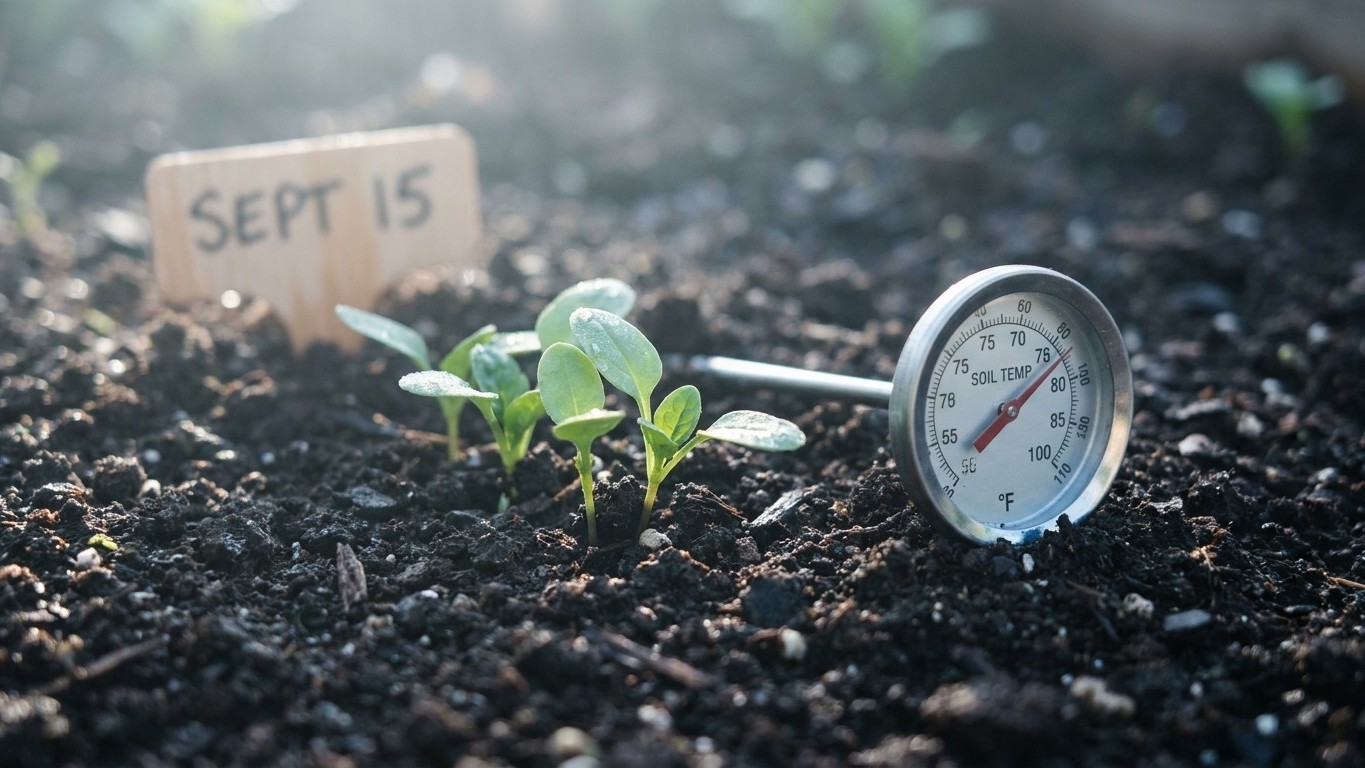

In Arizona’s low desert, count on sowing autumn spinach from mid-October through November, once soil temperatures finally drop below 80°F after the long summer heat. There’s no reliable fall frost here to force an end date, since NOAA’s climate normals put the frost-free season around Phoenix at close to 365 days in a typical year. Flagstaff and Arizona’s high country run on a completely different, frost-bound calendar. For the low desert, the limiting factor isn’t cold. It’s getting the ground cool enough for seed to germinate in the first place.
The short answer
On the longest day of the year, Phoenix sees 14 hours and 13 minutes of daylight. That’s a long day by any measure, and for spinach, long days are trouble, not opportunity. Flowering, what gardeners call bolting, is triggered by day length as much as by heat. A cool summer wouldn’t buy extra weeks even if Arizona had one, because the day itself is the switch that tells the plant to stop making leaves and start pushing up a seed stalk.
Arizona doesn’t get a cool summer, though, and that’s the second half of the problem. Phoenix averages 168.9 days a year at 90°F or hotter, a heat load few other US gardens ever face. Spinach grows best where temperatures stay under 75°F, and that same 75°F mark is also where the leaves start turning bitter. Once the mercury clears that ceiling, and in the low desert it clears it early and stays there for months, spinach isn’t just slow. It’s actively working against itself, pushed toward bolting by the long day and toward bitterness by the heat, at the same time.
So the honest answer to whether the limit here is day length or heat is both, arriving together rather than one after the other. In much of the country, gardeners can sometimes dodge one problem if the other is mild, a cool but long-day summer up north, say, or a short-day but hot stretch further south. Arizona’s low desert doesn’t get that trade-off. The days are long and the heat is extreme, stacked on top of each other for roughly half the year.
That’s why spinach in Arizona is strictly a two-window crop, one bracket in late winter into spring, another in fall into winter, with the entire summer written off. It’s also why the frost-based planting language used across most of the country doesn’t map cleanly onto the low desert. Phoenix’s frost-free season runs close to 365 days most years, so there’s rarely a frost date to count backward or forward from at all. The calendar here gets written by soil and air temperature, not by frost risk.
Higher elevations change this picture substantially. Flagstaff and the surrounding high country sit in a genuinely different climate, with hard freezes and a much shorter frost-free season, closer to what gardeners in northern states already deal with. A single answer for “Arizona” really has to split in two: the long, mild, frost-scarce low desert, and the short, cold-bound high country. What follows focuses on the low desert pattern, since that’s where the day-length and heat mechanics above actually apply.
How long the spring window really is
The standard rule of thumb for spinach, wherever it’s grown, is to sow it two to three weeks ahead of the last expected frost, then expect good growth only as long as temperatures stay under that 75°F ceiling. Applying that rule to the low desert takes some translation, because the “last frost” half of the equation barely exists here.
- Start with the rule as written: sow spinach two to three weeks ahead of the last expected frost, once soil is workable and cool.
- Check what “last frost” actually means locally. Around Phoenix, a 32°F freeze shows up in only about 6 of the last 30 years, and NOAA’s climate normals list the frost-free season at close to 365 days. Often there simply isn’t a last frost to count backward from.
- Replace the frost trigger with the heat ceiling instead. Without a frost date to anchor the calendar, the real signal for ending the spring planting window is temperature climbing past 75°F, the point where spinach growth slows and flavor turns bitter.
- Recognize how fast that ceiling arrives. In the low desert, daytime highs push past 75°F well before the calendar says spring is over almost anywhere else spinach is commonly grown, closing the window early.
- Add the day-length pressure stacking on top. As that window closes, days are also lengthening toward the 14-hour-13-minute peak, so even the tail end of the spring crop fights bolting pressure from two directions at once.
- Total the result. What’s left is a short, early window. Planting can start in winter itself since there’s no frost forcing a later start date, but it closes quickly once heat and day length both tip past the plant’s tolerance, leaving spring spinach in Arizona a matter of weeks rather than months.
The autumn crop, and when the soil lets you sow
Fall works in the reverse order from spring. Instead of racing a rising heat ceiling, the fall crop waits for a falling one, and the two obstacles gardeners plan around here are close to mirror images of the spring problem.
Soil still too warm to germinate
Spinach seed struggles once soil temperature climbs above 80°F, according to Utah State University Extension, with germination dropping off from there. Phoenix’s summer heat load, 168.9 days a year at 90°F or hotter at the reference station, means the ground holds onto that heat long after the calendar turns toward autumn on paper. Sowing too early, while soil is still sitting in the 80s, wastes seed on poor germination for little gain. The practical move is checking soil temperature directly rather than going by a date, since ground temperature lags well behind cooling air by weeks.
The frost that (almost) never arrives
On the back end, most gardens elsewhere have to race a killing frost to get a fall spinach crop harvested in time. Low-desert Arizona mostly skips that problem. In most years there’s no freeze at all here; the rare exception is a cold snap that can bring a 32°F reading sometime between late December and mid-January. That means the fall sowing window isn’t bounded by cold the way the spring window is bounded by heat. It’s bounded almost entirely by how soon the soil drops below that 80°F mark.
Utah State University Extension’s fall guidance calls for sowing 50 to 75 days before the date you want to harvest. Applied here, a gardener aiming to harvest through the mild stretch of the year, sometime in December or into January before that rare frost risk shows up, would count back 50 to 75 days and land on a sowing window running from mid-October into November, right as soil finally cools out of the 80s after summer. That timing also keeps the crop clear of the long, bolt-triggering days of summer, since day length is falling rather than rising through this stretch of the calendar.
The source used here doesn’t publish days-to-maturity figures for spinach, and no specific number should be assumed or borrowed from another crop. It does name four varieties commonly grown for the fall crop: Bloomsdale, Melody, Teton, and Olympia. No performance data for any of them is published in that source, so variety choice has to be treated as a separate decision from timing, not something the 50-to-75-day window can adjust for on its own.
Common questions
Can spinach survive an Arizona summer if it’s kept shaded and watered?
Not reliably. Bolting in spinach is triggered by day length as well as heat, so shade and irrigation only address one half of the problem. Even in filtered light, the long summer days around the solstice, over 14 hours in Phoenix, push the plant toward flowering regardless of how well temperature is controlled.
Why doesn’t Arizona have a frost-based spinach calendar like other states?
Because there’s rarely a frost to build one around. NOAA’s climate normals for the Phoenix-area station list a frost-free season close to 365 days, with a 32°F freeze showing up in only about 6 of the last 30 years. The planting calendar here follows soil and air temperature instead of frost risk.
Is Flagstaff on the same fall spinach schedule as Phoenix?
No. Flagstaff and Arizona’s high country sit in a distinctly different climate, with real, recurring freezes and a much shorter frost-free season than the low desert. A fall calendar built around Phoenix’s warm-soil, frost-scarce pattern doesn’t transfer up there; the high country needs its own frost-based timing entirely.
Which spinach varieties should I plant for the fall crop?
Utah State University Extension names four commonly grown varieties for fall sowing, Bloomsdale, Melody, Teton, and Olympia, without publishing performance data for any of them in the source used here. Variety selection is a separate decision from timing and isn’t something the 50-to-75-day sowing window can substitute for on its own.