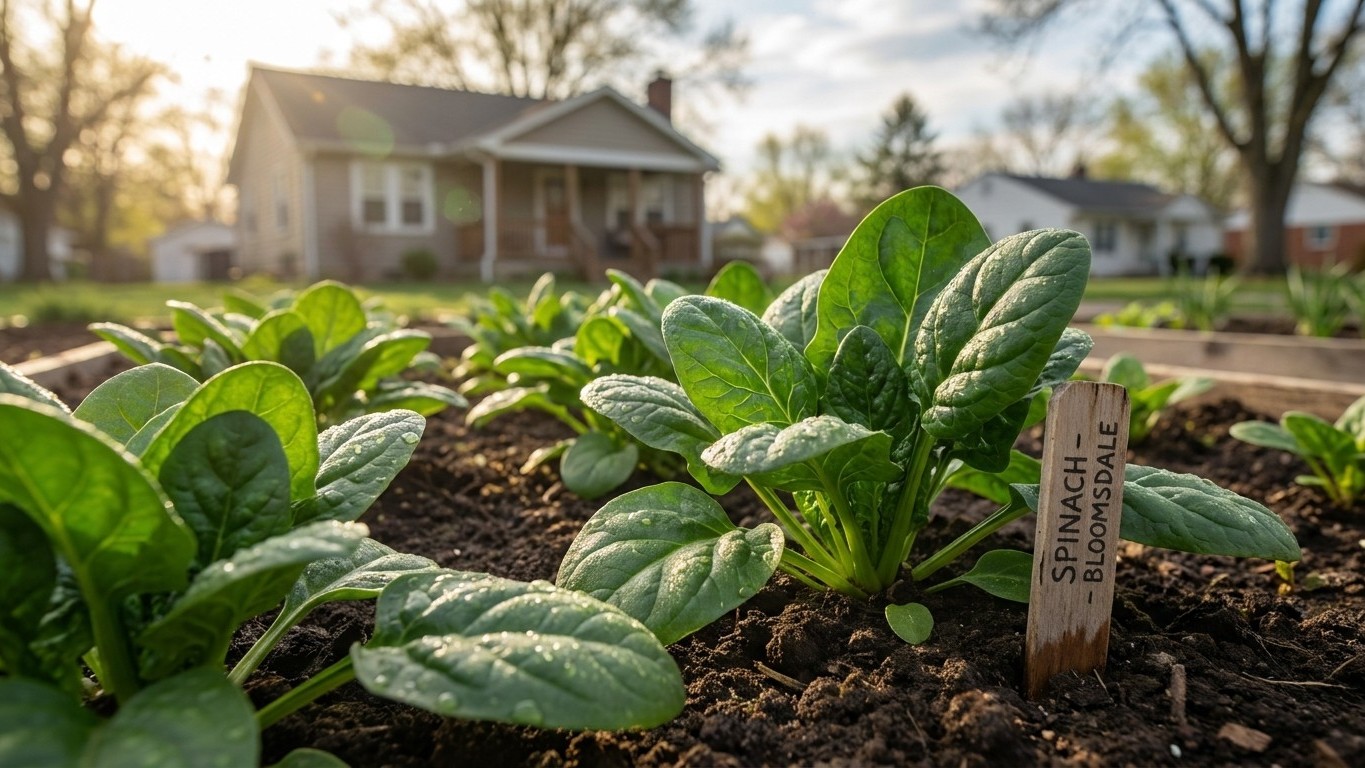

In the low desert around Phoenix, spinach doesn’t get much of a window at all. The plant bolts once heat and long days stack up together, and here the heat arrives first, almost every year, weeks before the calendar clock of daylight even becomes relevant. That means the real spring crop runs through winter, and When to Sow Autumn Spinach in Arizona depends on soil cooling down, not on frost showing up.
The short answer
On the longest day of the year, Phoenix gets 14 hours and 13 minutes of daylight. That’s a lot of light hitting a plant that flowers in response to long days combined with warmth. Spinach doesn’t need long days to thrive, quite the opposite: long days are one of the two triggers that push it into bolting, the other being heat above 75 F. So a gardener hoping that a “mild” stretch of long summer days will somehow stretch the harvest is working against the plant’s biology, not with it.
Except Phoenix summers aren’t mild in any sense that matters here. The station data show an average of 168.9 days a year reaching 90 F or higher. That’s nearly half the calendar spent well above the temperature spinach tolerates for good growth, let alone the 75 F ceiling where quality and flavor start to slide. By the time daylight is climbing toward its June peak, soil and air temperatures in the valley have usually blown past 75 F for weeks already. The heat gets there first.
That timing matters for how you think about the crop. In a place like the upper Midwest or the Pacific Northwest, long days near the solstice are often the first thing to push spinach into bolt, because temperatures there can still sit comfortably under 75 F even in June. In the low desert, the order reverses. Heat closes the door before day length even becomes the deciding factor. So the honest answer to “what makes Arizona spinach bolt” is: both mechanisms are in play, but heat is functionally the limiting one, because it arrives earlier in the season and holds on longer.
Practically, this means the plant only behaves well during the part of the year when both numbers stay low, short days and temperatures under 75 F at the same time. In the Phoenix area, that combination exists for a real but narrow stretch centered on the coldest months, not in spring or early summer the way garden calendars written for other regions suggest. Anyone transplanting a Midwest or Northeast planting schedule onto a Phoenix yard is going to watch the crop bolt on schedule, just a very different schedule than they expected, which raises the question Will Spinach Bolt Early in Arizona?
How long the spring window really is
- Start with the frost rule as written. The standard guidance is to sow spinach 2 to 3 weeks before the last spring frost. In most of the country, that anchors a calendar date. In the Phoenix area, it doesn’t, because a killing freeze doesn’t show up in most years at all. NOAA’s station data for the reference station show 32 F occurring in only 6 of 30 recorded springs, and NOAA lists the frost-free season here at 365 days.
- Replace the frost anchor with the heat ceiling instead. Since frost isn’t the constraint, the “2 to 3 weeks before” rule stops being useful on its own. What actually bookends the spring window is the 75 F growth ceiling. Spinach can be sown as soon as soil is workable in the coldest part of the year, and it keeps growing well only until temperatures push past that ceiling.
- Recognize how fast that ceiling arrives. With an average of 168.9 days a year at 90 F or above, the valley’s warm-up is quick and early compared to most of the country. That compresses the usable spring stretch into essentially the depth of winter, not a springtime planting season in the way gardeners elsewhere picture it.
- Watch for bitterness, not just wilting. The 75 F mark isn’t only a growth ceiling, it’s also the point where leaves start turning bitter. So even a spinach plant that survives past that temperature without visibly bolting is already past its best eating quality.
- Treat the window as short and front-loaded. Given how early the heat load builds in this climate, the usable spring stretch for spinach in the low desert should be treated as a compressed cool-season opportunity, not a multi-month spring crop the way it functions in cooler states.
The autumn crop, and when the soil lets you sow
The fall crop faces a completely different obstacle than the spring one. Instead of racing daylight and heat forward, you’re waiting for the ground itself to cool down enough to let seed germinate at all.
Soil still too warm
Spinach seed germination drops off once soil temperature climbs above 80 F, according to Utah State University Extension. In a region where air temperatures sit at or above 90 F on nearly 169 days a year, soil holds that heat well into what other states would already call autumn. Sowing too early into warm ground simply means poor, patchy germination, not a faster start. The practical move is to wait until soil has actually cooled below that 80 F mark before putting seed in the ground, rather than sowing by a fixed date on a calendar built for a cooler climate.
The frost that ends the season
In most parts of the country, the fall spinach crop is timed backward from the first fall frost, counting 50 to 75 days from sowing to a realistic harvest date, per Utah State University Extension’s planting guidance. That backward count still applies here, but the endpoint looks different. NOAA’s climate data for the reference station show no reliable fall freeze in this area at all, the same 365-day frost-free season that shows up in the spring data. So the fall harvest window isn’t closed by cold. It’s closed later, by the return of longer, warming days as winter ends and the bolting triggers come back into play. That’s a very different shape of season than gardeners in Flagstaff or the high country deal with, where hard freezes are a normal and expected part of the year.
Four varieties commonly discussed for garden planting are Bloomsdale, Melody, Teton, and Olympia. Utah State University Extension’s guidance doesn’t publish days-to-maturity figures or performance data for any of them specifically, so no comparison between them can be made here without inventing numbers that don’t exist in the source.
Checking this against your own county
Phoenix and the surrounding low desert are one climate. Flagstaff and the high country of northern Arizona are a completely different one, with real winter freezes that change every part of this calculation. Rural counties, higher elevations, and areas farther from the valley floor will all see different soil warm-up timing and different heat-day counts than the numbers used here.
Before locking in a sowing date, run the same logic past your local office of the University of Arizona Cooperative Extension. County agents there track soil temperature and local frost patterns specific to your elevation and can tell you when soil has actually dropped below that 80 F germination threshold in your area, rather than relying on valley-wide averages.
Common questions
Can spinach grow through the Phoenix winter?
Yes, and for the low desert, winter is effectively the main growing season for spinach, since it’s the only stretch that reliably keeps both daylight and temperature low enough to avoid triggering bolting.
Does frost end the fall spinach crop in Phoenix?
No. NOAA’s climate normals for the reference station show no reliable fall freeze, with 32 F occurring in only 6 of 30 recorded years. The season ends when warming days return in late winter, not from a killing frost.
Why does spinach bolt even if the weather feels cool?
Because bolting is triggered by long daylight hours as well as by heat. Even on a day that doesn’t feel hot, daylight stretching past a certain length can be enough to push the plant toward flowering.
Is 75 F really that important a number?
It does double duty. Utah State University Extension identifies it as both the temperature above which growth quality declines and the point where leaves tend to turn bitter, so it functions as a ceiling for both yield and flavor at once.