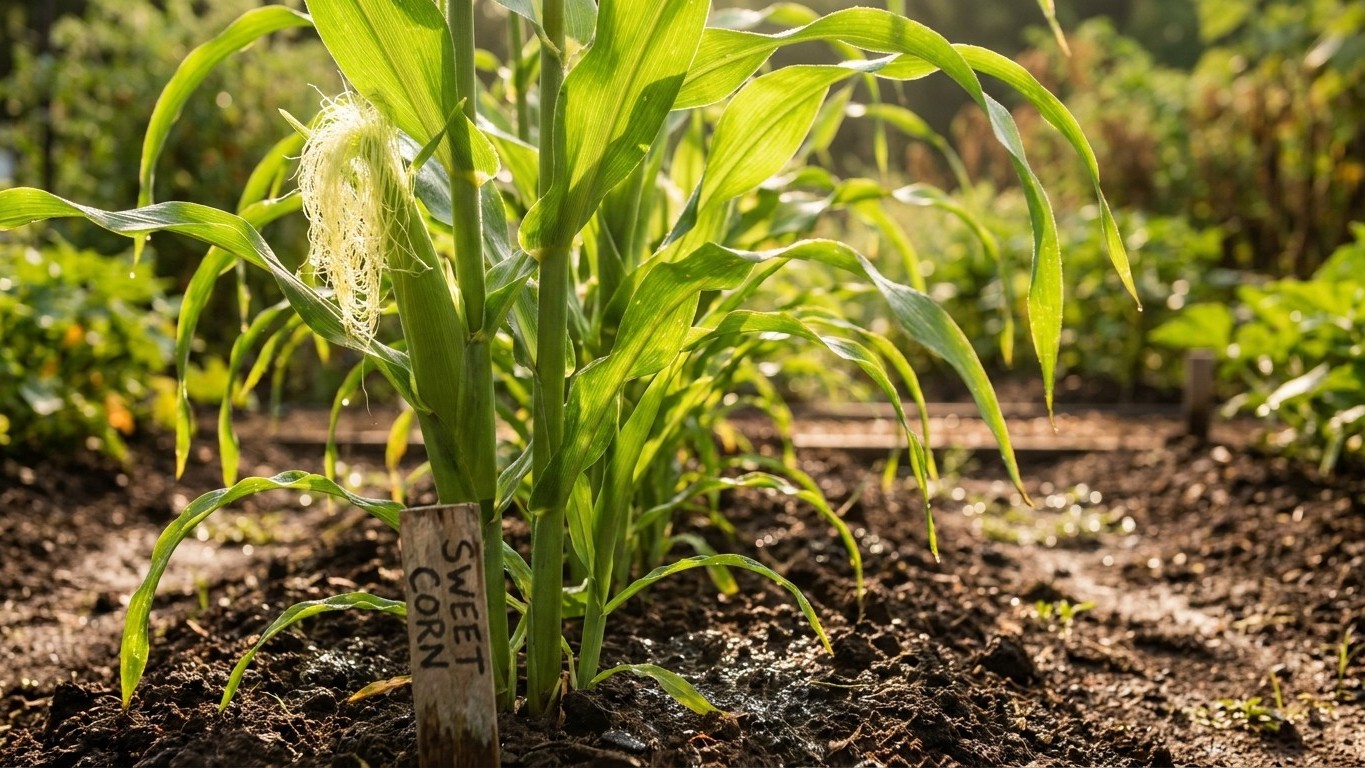

Yes, sweet corn ripens across Arizona’s low desert, but the calendar that works almost everywhere else doesn’t apply here. Frost isn’t the boundary that shapes planting; summer heat is. Soil has to reach 60°F before seed goes in the ground, and the 60 to 90 days a crop needs to mature has to land before that heat locks in, not after some frost date most seasons never actually see.
The short answer
Soil temperature is the number that matters first, and in the low desert it climbs to 60°F well before frost risk has any relevance, because frost risk here is already close to nothing. NOAA’s 1991-2020 Climate Normals list the low desert reference station’s frost-free season at 365 days, and the daily records behind that normal show freezing temperatures reaching the ground in only 6 of 30 tracked springs, arriving anywhere from late December to mid-January in the years it happened at all. That’s the reverse of the pattern most gardeners plan around, where soil warms after frost clears. Here, the rare cold snap sits in the dead of winter, and soil temperature runs on its own schedule tied to day length and sun angle, not to whatever freeze did or didn’t show up in January.
So the planting question isn’t “when did the last frost hit.” For most low desert gardens, it simply didn’t. The real question is when the ground itself hits 60°F, and that happens as late winter turns toward spring, on a timeline separate from any cold snap that may or may not have occurred.
Once soil clears that mark, the clock most seed packets quote, 60 to 90 days from planting to harvest, starts running. Whether that stretch fits depends on what comes next, and in the low desert what comes next isn’t a fall frost. It’s summer heat. The reference station near Phoenix logs an average of 168.9 days a year at 90°F or hotter, a heat load spread across nearly half the calendar. That’s the wall a spring-planted crop has to clear before it arrives, and it’s why low desert growers often work with two separate windows instead of one long season: an early one timed to finish before the heat solidifies, and a second one timed for after the worst of it eases.
Whichever window gets used, the planting still needs a shape that lets pollination happen. Utah State University Extension’s guidance on sweet corn calls for blocks of three or more rows rather than one or two long rows, since corn relies on wind carrying pollen from tassel to silk, and a block keeps that pollen where the plants can use it. That detail has nothing to do with frost or heat. It’s about the shape of the planting, and it applies no matter which window is chosen.
Does a late variety fit here?
Maturity length decides more here than it does in places with a hard frost boundary on both ends of the season. With heat doing the limiting instead of cold, the question for any variety is whether it can finish before 90°F days pile up back to back, or whether planting has been pushed late enough into the year that the heat has already broken, so a longer season stops working against the clock.
A 60-day variety
A 60-day type planted once soil hits 60°F has a real shot at finishing before the heat load becomes constant. Two months is short enough that a spring planting can move through tasseling and fill the ears while 90°F afternoons are still occasional rather than an everyday event, since the 168.9-day annual average is spread mostly through the hottest stretch of summer rather than concentrated at its very start. That timing gives a fast variety room to clear pollination, the stage most sensitive to heat, before conditions turn against it. For the low desert’s early window, a 60-day option fits without much argument.
A 90-day one
A 90-day type asks for a month longer in the ground, and that extra month lands during the worst of the heat load if it’s planted on the same early date as a faster variety. Instead of finishing before 90°F days become routine, a slow variety would still be tasseling or filling ears well into the stretch where that threshold is crossed on most days of the week, for weeks running. No source here publishes a specific heat cutoff for pollination, so no exact temperature can be named as the failure point. What can be said plainly is that a 90-day variety planted on the low desert’s early spring date does not fit that window comfortably, because it spends far more of its cycle inside the heat load a fast variety avoids. It fits better, if it fits at all, in a planting aimed at the cooler shoulder of the year rather than the first spring push.
What goes wrong here
Most sweet corn failures in the low desert trace back to one of three causes, and only two of them are about climate.
- Soil sown too cold. Because a hard freeze skips most low desert springs entirely, some gardeners still plant on a frost-based calendar, one that barely applies here, before the soil has actually reached 60°F. Cold, damp soil below that mark slows germination or rots seed outright rather than sprouting it. The fix isn’t a different date on a calendar. It’s checking soil temperature directly with a thermometer a few inches deep and waiting for that reading, rather than trusting a frost date that rarely governs this territory.
- A variety too late for the season. A 90-day type, or any variety planted later than intended, can still be filling ears when the 168.9 annual days above 90°F start arriving back to back instead of scattered. Fruit set weakens under that kind of sustained heat load. The remedy is matching maturity length to the window in use: fast varieties for the early spring push, and anything longer held for a planting date late enough that its cycle lands after the worst of the heat rather than inside it.
- Sweetness lost to timing, not climate. Utah State University Extension is specific here: su, se and sh2 sweet corn types lose their sweetness if they tassel at the same time, because pollen from one type crossing into another changes the kernel’s sugar content. That failure has nothing to do with soil temperature or summer heat; it can happen in an otherwise perfectly timed planting. The source publishes no separation distance to plant by, so the fix isn’t measuring feet between rows. It’s timing plantings so different types don’t tassel in the same window, or growing just one type in a given season.
Common questions
Does frost ever end the sweet corn season in Arizona’s low desert?
Rarely. NOAA’s Climate Normals list a 365-day frost-free season at the low desert reference station, and the daily records behind that normal show only 6 of the last 30 tracked springs reaching 32°F, in a window running from late December to mid-January. Most seasons, frost simply isn’t part of the sweet corn calendar here.
How is ripeness judged if there’s no hard frost deadline to work toward?
By three signs checked together, not one alone: dry, brown silks; husks that are still moist and green; and milky juice from a punctured kernel. All three need to line up before the ear is called ready. That’s a separate clock from the 60 to 90 days counted from planting, which only tells a grower whether the crop fits the season, not which week to pick.
Can two sweet corn varieties be grown in the same low desert garden?
Yes, but only if their tasseling windows don’t overlap. The concern isn’t distance between plots; it’s timing. Su, se and sh2 types lose sweetness when they tassel at the same time, so staggering planting dates, or choosing a single type for a given season, avoids the problem without needing any measured separation.
Is a 60-day or 90-day variety the safer choice for a first planting?
A 60-day type is the safer fit for the low desert’s early spring window, since it can clear pollination before the heat load becomes constant. A 90-day type spends more of its cycle inside the hottest stretch of the year if planted on that same early date, and generally suits a later planting timed for after the worst heat has eased instead.