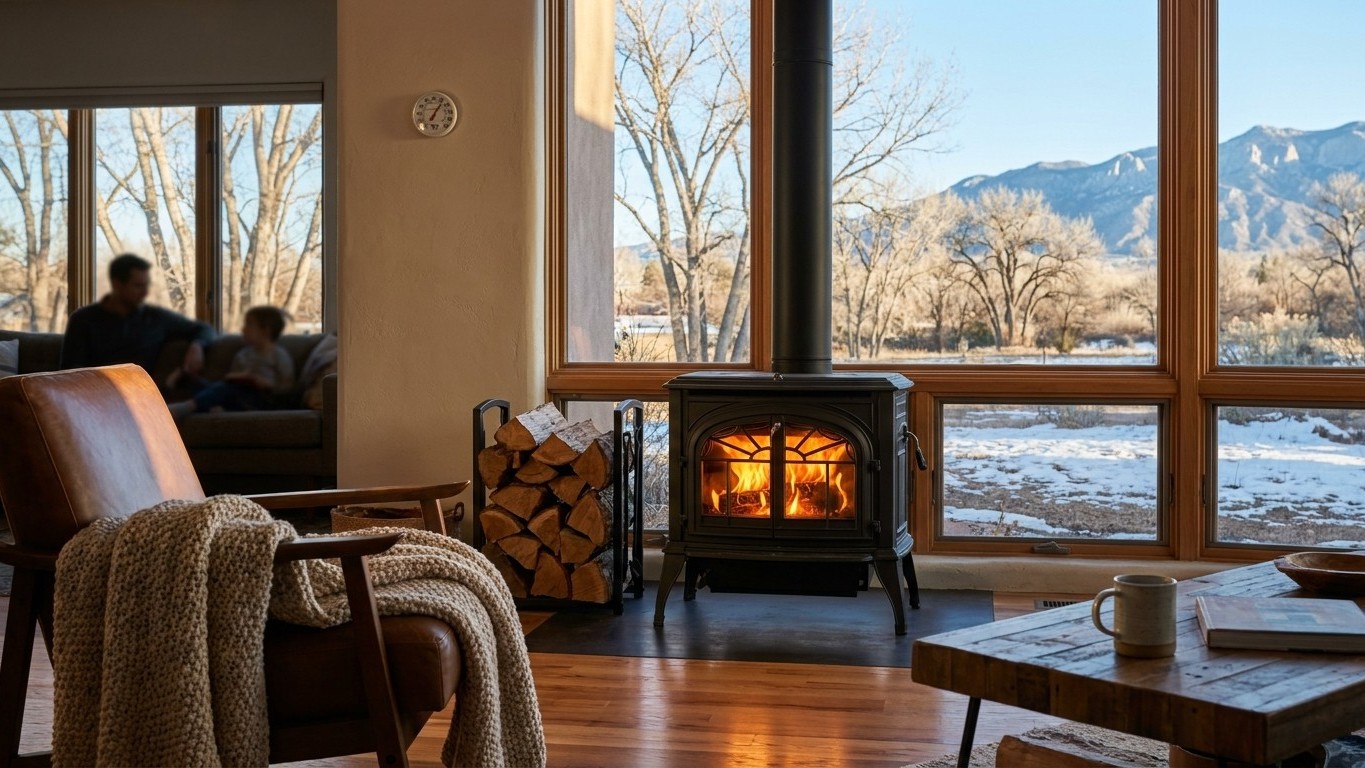

New Mexico’s winter bill depends less on the state’s reputation for sunshine and more on elevation: Albuquerque’s coldest month averages a nightly low of 26.4°F, which is a moderate, four-month heating season rather than a brutal one. For households burning wood as a primary or backup heat source, that translates into specific, measurable numbers on how much wood you need and how long it takes to dry.
How cold it gets, and for how long

The reference figure for this territory, from NOAA’s 1991-2020 Climate Normals at the Albuquerque station, is a coldest-month average minimum of 26.4°F. That’s the mean nightly low in January, not the record cold snap and not a daytime average. It sits a few degrees below freezing, which puts New Mexico in a middle band of winter severity compared with the rest of the country.
What that number means in practice is a heating season that runs roughly from late October through March, with the coldest stretch concentrated in December and January. A house here doesn’t need a furnace built for weeks of sub-zero punishment. It needs one that can hold steady through months of near-freezing nights, night after night, without a break.
Why the shape of the cold matters more than the depth
A winter that hovers just below freezing for four months puts different demands on a heating system than a winter that plunges far colder for six or eight weeks. The New Mexico pattern favors steady, moderate output over raw capacity. Wood stoves sized for constant, lower-intensity burns tend to perform well here, and a chimney gets more total hours of use across the season even if it’s rarely working at its hardest.
That steady-but-long pattern is also why seasoning and fuel quality carry outsized weight in a place like this. A stove running for four months on wood that’s even a little too wet compounds the problem every single night, rather than just during a short cold snap. The math on wood quality below applies with more force here than it would in a shorter, harsher winter.
Elevation shifts this picture fast. Albuquerque sits around 5,300 feet, but plenty of New Mexico communities sit thousands of feet higher, in the mountains around Taos, Ruidoso, or the Sangre de Cristo foothills, where nights run noticeably colder than the state reference figure suggests. The 26.4°F figure is a starting point, not a promise for every zip code.
What a cord of wood is worth here
A cord is a volume, not a weight, and that distinction is where a lot of firewood buyers get taken advantage of. A full cord measures 4 feet by 4 feet by 8 feet, a stack that works out to 128 cubic feet. What varies enormously inside that fixed box is density: a cord of a heavy hardwood packs in far more burnable mass than the same-size stack of a soft, light species, even though both are technically “a cord.”
| Measurement | Value |
|---|---|
| Standard cord dimensions | 4 ft x 4 ft x 8 ft |
| Total volume | 128 cubic feet |
| Heat energy, well-seasoned hardwood | about 20 million BTU per cord |
That 20 million BTU figure, from Michigan State University Extension, is an average for hardwood that’s properly dried, and it moves a lot depending on species and moisture. MSU’s own comparison is the one that makes it concrete for a homeowner: a cord of well-seasoned hardwood carries roughly the heat of 145 gallons of #2 fuel oil, or 215 gallons of LP gas. Given New Mexico’s roughly four-month heating season built around nightly lows near 26.4°F, a household burning wood as a primary heat source in a moderately sized home typically works through several cords across the winter, with the exact count driven by how tight the house is, how large it is, and how much the stove runs on the coldest nights.
None of that arithmetic matters if the wood is wet. Green wood can carry over 60 percent moisture, and every bit of that water has to boil off before the wood releases usable heat. That’s energy the stove burns just to dry the fuel, energy that never reaches the room. Buying by the cord without asking about moisture content is buying a number that looks solid on paper and burns cold in the stove.
How long wood takes to dry in New Mexico
Firewood needs to reach roughly 20 percent moisture or less before it burns efficiently, according to Michigan State University Extension, down from the 60-plus percent it can carry when freshly cut. Getting there generally takes one full summer of seasoning, provided the wood is split and stacked so air moves freely through the pile. Wood left in whole rounds, or stacked tight against a wall with no airflow, won’t hit that mark on the same schedule, no matter how many months pass.
New Mexico’s dry air and long, hot summers work in a wood-burner’s favor here. Low humidity pulls moisture out of split wood faster than it would in a muggier climate, which is part of why the region’s dry conditions are often cited as good news for seasoning. But dry air doesn’t rescue wood that’s stacked wrong. Split, stacked with gaps for airflow, and covered on top while left open on the sides is still the baseline that gets a pile to 20 percent moisture on schedule.
Red oak is the one MSU flags by name as slower than the rest, because its cell structure resists drying even under good conditions. A homeowner counting on a single summer to season red oak may find it’s not there yet by the time the first cold nights arrive, and that’s a case where checking with a moisture meter beats guessing by the calendar.
The cost of skipping this step shows up in two places. First is heat: wood that’s still holding water burns cooler and less efficiently, since energy that should be warming the room is instead boiling off moisture inside the log. Second is the chimney. Burning unseasoned wood produces more creosote, the flammable residue that builds up in the flue and is the leading cause of chimney fires. A stove running on green wood through New Mexico’s four-month season needs the flue swept more often than one burning properly dried fuel.
Where to check before you buy
The figures above describe Albuquerque, the NOAA reference station for this territory, but New Mexico stretches from low desert basins to mountain towns above 8,000 feet, and conditions shift fast across that range. A cold-minimum figure and a seasoning timeline that hold true in the Rio Grande valley won’t necessarily match what a household at higher elevation or in a different microclimate experiences.
For local guidance on which wood species are actually available in your part of the state, and for current seasonal burn restrictions, the New Mexico State University Cooperative Extension Service is the resource built for exactly this. Burn rules in particular are set at the local and county level, tied to air quality and fire conditions, and they change from year to year rather than staying fixed. Checking before stocking up, not after, saves a wasted trip and a stove that sits unused on a red-flag day.