
In Little Rock and across most of Arkansas, heating demand starts in October, when the average monthly temperature first drops below the 65°F mark used to calculate heating need. The season runs roughly seven months, with January as the coldest stretch on average, before temperatures climb back above that threshold in May.
When the heating season starts in Arkansas

October is the month to watch, according to National Weather Service data collected at Little Rock’s Adams Field station. That’s when the 30-year average temperature (62.6°F) first falls below the 65°F baseline meteorologists use to calculate heating degree days, the standard measure of how much a building needs heat on a given day. From there, demand builds through the fall, peaks in January at 754 degree days, and tapers off as spring arrives, with the average climbing back above 65°F by May.
That gives Arkansas a heating season of about seven months, longer than many people assume for a state known for its mild image. But a monthly normal is a 30-year average, not a forecast for any particular week. The first real cold snap of a given year often lands well before October ends, sometimes weeks ahead of when the calendar average says it should.
The table below breaks down heating degree days by month, based on the same 1991-2020 climate normals from the Little Rock station. Reading it top to bottom shows the actual shape of the season, not just how long it lasts.
| Month | Heating Degree Days |
|---|---|
| January | 754 |
| February | 569 |
| March | 391 |
| April | 154 |
| May | 30 |
| September | 11 |
| October | 145 |
| November | 425 |
| December | 684 |
Notice the table skips June, July, and August entirely. Those three months don’t register a single heating degree day at this station, meaning a furnace or heat pump has nothing to do during the heart of the Arkansas summer.
How hard the winter works here
Little Rock’s climate normal adds up to about 3,165 heating degree days a year, alongside roughly 1,989 cooling degree days. Heating degree days work like a running tally: every day the average temperature sits below 65°F adds points to the total, and a house that needs twice as many degree days in a season generally burns through roughly twice as much fuel to stay comfortable, all else being equal.
That 3,165 figure puts Arkansas in a middle position, not the brutal, short winters of the northern Plains, and not the barely-there heating needs of the Gulf Coast. The monthly table above tells the more useful story though. A state can rack up a similar annual total either through one brutal month or through several moderate ones spread across a long stretch, and those two patterns call for different habits around the house. In Arkansas’s case, the season is long relative to its intensity: seven months of some heating need, but only three of those months (November through January) do the heavy lifting.
What that means in practice is a heating system that gets used lightly but often, rather than one that gets slammed hard for a few brutal weeks and then shuts off. Equipment built for that pattern, and maintained with that pattern in mind, tends to hold up better over the years than one treated like an emergency backup.
What most homes in Arkansas actually heat with
Federal survey data shows a clear split in how Arkansas households heat their homes. The numbers below come from the Residential Energy Consumption Survey, which tracks both the equipment installed and the fuel that powers it.
| System or Fuel | Share of Homes |
|---|---|
| Furnace | 60% |
| Central heat pump | 19% |
| Steam or hot-water boiler | none reported |
| Natural gas | 43% |
| Electricity | 46% |
| Fuel oil or kerosene | none reported |
| Propane | 4% |
A furnace is the dominant setup in the state, and electricity and natural gas run close behind each other as the fuels behind those furnaces and heat pumps. Note that “none reported” for boilers and fuel oil doesn’t mean zero homes use them; it means the survey sample turned up too few respondents in Arkansas to publish a reliable figure for those categories.
None of this is a recommendation. A high share simply reflects what builders installed decades ago, based on whatever fuel was cheapest or most available at the time. A furnace works well in Arkansas’s climate because it can respond quickly to short cold spells and doesn’t need to run constantly through a mild winter. Its main weak point is the duct system that carries that heated air to each room, and skipping filter changes is the single most common way homeowners choke off airflow and shorten the equipment’s working life.
Run it once before you need it
Waiting for the first genuinely cold night to find out whether the furnace still works is a bad habit, mainly because that’s also the night every HVAC technician in the region is already booked solid. Running the system in October, before the cold arrives in earnest, means small problems get caught while there’s still time to fix them without shivering through the wait.
- Turn the thermostat up and run the system for ten to fifteen minutes, listening for grinding, rattling, or a burning smell that doesn’t fade.
- Expect a faint burnt-dust odor the first time it fires after months of sitting idle. That’s normal dust burning off the heat exchanger and should clear within a few minutes.
- Check the filter and replace it if it’s visibly gray or clogged. A dirty filter restricts airflow and forces the whole system to work harder for the same result.
- Clear furniture, curtains, and clutter away from vents, radiators, or an outdoor heat pump unit so air can move freely.
- Test the carbon monoxide alarm’s function button and replace its batteries if needed. A furnace that’s leaking combustion gases is a real risk, and a working alarm is the cheapest protection against it.
- Call a licensed technician if the burning smell doesn’t fade, if the system won’t hold a set temperature, or if the alarm test fails.
Even a furnace in perfect working order loses heat before it ever reaches a room. According to the U.S. Department of Energy, “in a typical house, about 20%-30% of the air that moves through the duct system is lost due to leaks, holes, and poorly connected ducts.” That’s not a flaw unique to older homes; it’s common enough that sealing and insulating ducts is one of the more reliable upgrades a homeowner can make, separate from whatever maintenance the furnace itself needs.
What turning it down is actually worth
The Department of Energy states plainly: “You can save as much as 10% a year on heating and cooling by simply turning your thermostat back 7-10°F for 8 hours a day from its normal setting.” That figure covers both heating and cooling combined, over a full year, tied to that specific setback and that specific stretch of hours, not a smaller tweak applied for a shorter window.
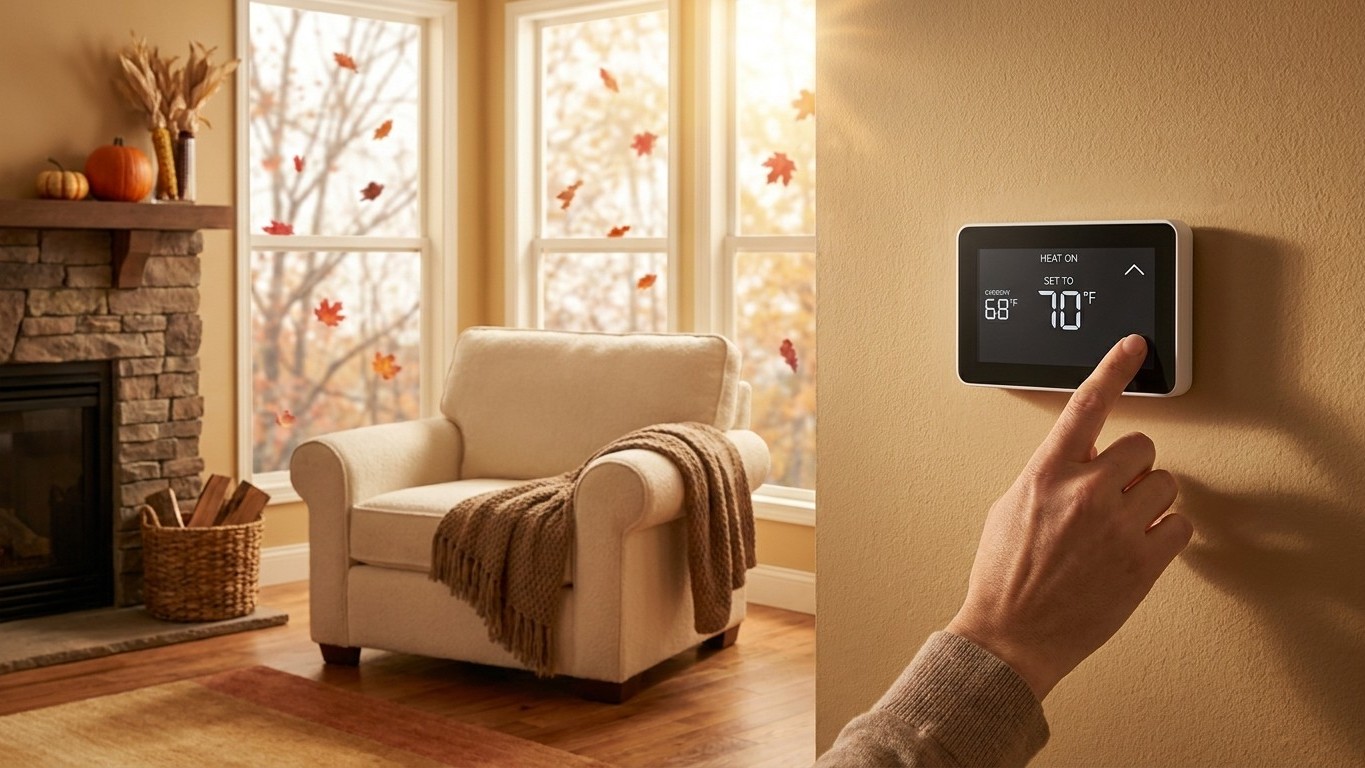
For a state with a seven-month heating season like Arkansas’s, that setback has more hours to work with than it would in a state where furnaces barely run. A programmable or smart thermostat set back overnight or during the workday, when nobody’s home to notice the difference anyway, captures those savings automatically across a season that includes several genuinely cold months, not just a handful of chilly evenings.